
Business Leaders interview: Andrew Fishwick
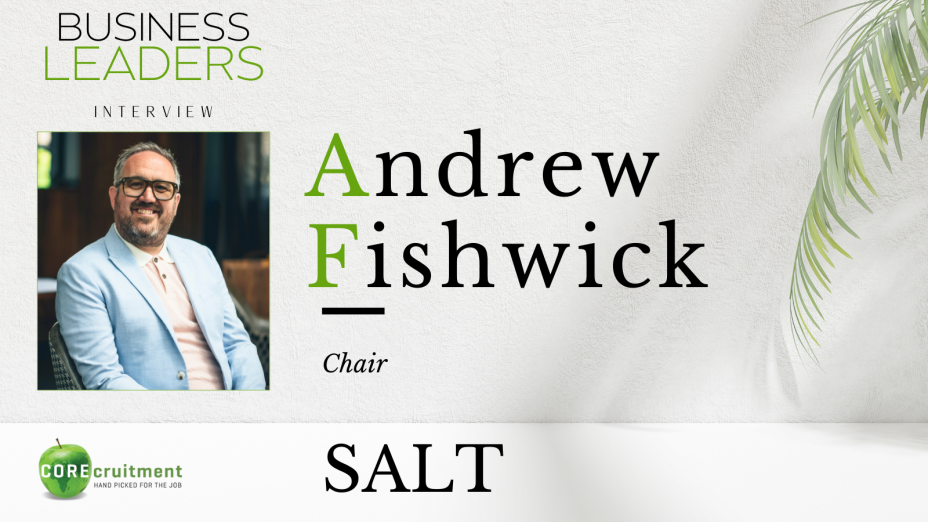
Tell us a little about yourself and your business.
I wear several hats at the moment. My day job (although it rarely is just that) is as CEO for Hestia. Hestia is an acquisitions and investment in the Hospitality sector. We have made some smaller acquisitions into our incubator fund and are working on the first few larger deals now. I still Chair SALT (the marketing agency specialising in Food and Drink) that I founded 8 years ago. It’s now run by amazing team who are far more talented than me! I always say that SALT has to be the most fun company in the world; they work with amazing luxury brands doing the coolest things in F&B anywhere in the world. If I’m lucky I sometimes get an invite….
I have also taken a new charity role as a Director of Home Kitchen. We are purpose-driven, community-interest restaurant company that aims to recruit, train and employs people who have experienced homelessness. We are opening our first site in Primrose Hill in September.
What motivates you in your work and what do you find most fulfilling about being a business leader?
These days I’m incredibly lucky in that I get to choose the projects I dedicate my time to and the people I get to work with. Building exceptional teams has always been the thing that gets me out of bed. I’ve always said that I myself have no real talent, but I am good at making actually talented people even better at what they do.
How did you develop your leadership skills and how would you define your leadership style?
I initially developed my leadership skills by leading! Simple as that. From a (probably too) young age I have led projects and businesses and learnt my craft from trying (and failing) and trying some more. However, I have completed my MBA (with Warwick Business School) and this has been a revelation. It was one of the most challenging things I have done, and it taught me so much. It taught me the things I had been doing right (and, for the first time, the academic theory behind why they were right) and the things I didn’t know you could do that way.
Innovating is crucial in our very diverse industry. How do you stay ahead of trends and incorporate them into your global strategy?
This is a perfectly worded question! Because for me every strategy must have two components; two lenses through which to evaluate any opportunity – and they are innovation and globalisation. Trends aren’t something we ever really talk about in our businesses. We’re not in this for the short-term and therefore passing fads and fashions aren’t our drivers. True innovation and hospitality will outlast any new-fangled craze.
What do you consider to be the key component(s) of effective business operational development?
Operational development is not something that can be achieved in isolation – and this is where so many businesses fall down. Operational development must be seen as a one part of strategic development of cultural development, of stakeholder management, of partnerships. Once you see the matrix, once you understand that these elements are intrinsically linked and that you must assess the whole first then the components that need fixing will become clear.
How do you approach identifying areas for improvement within a company’s operations?
You talk to people. If something in a company isn’t working, EVERYONE in that company will know it. They might not all feel it equally, but it will have an impact on everyone. Name any area (supply chain, marketing, HR, IT….) and think about how many people in the organisation that single aspect affects. The answer is usually almost everyone. Talk to the people about how the issue affects them, about their ideas about what needs to change and, as a leader, start to distil these talks into actionable objectives.
Where do you think the most promising investments should be focusing on and/or made on?
If I had a job description, it would basically be this question! Watch whatever Hestia is investing in. That’s what you should have done. Ha!
What is or are your biggest career achievement(s)?
Still being in the game feels the biggest achievement! I love seeing people I’ve worked with go on and do incredible things. That’s the legacy and that’s probably the biggest achievement.
Do you have examples where your leadership made a difference? If so, what were they?
When I’m working out of the SALT office in Shoreditch I sometimes just sit and listen in to the conversations happening in the room. It’s not just about the work they do but about how they work in collaboration. When I founded SALT, I wanted it to be different from all the other agencies out there. I wanted it to be truly holistic in its approach and inclusive in its style. Day One it was just me at SALT, by the end of year 1 there were 3 of us and now there 12 of them (with many other partners who join for certain projects). I still feel that my founding principles, intentions and ways of working are there in everyone who passes through our doors. If you can lead anything, then lead the culture. Get that right and the rest is easy… [it’s not. But it helps!]
What’s the most important leadership lesson you’ve learned?
Every time I have done something that I knew wasn’t authentic it has failed. Every time I’ve second guessed a situation or been driven the wrong motivators or worked with people, I didn’t believe in it has failed. Every time the reason for a project or indeed a single decision has been true it has been right. Easier said than done.
How important is personal development to your success, and how do you approach it?
Personal development is everything. Basically, everything I do I do because I think it will develop me as a leader or I’ll learn a new set of skills, or it will challenge me in a new way. All of these things are crucial in personal development.
How do you prioritise tasks when everything feels like a priority?
I love a list. Not following a list but the act of making a list sort of organises the thoughts and needs in its own way.
What was the hardest decision you have taken as a leader?
Letting people go is always the hardest thing. Even when you know that ultimately, they’ll be happier and more successful because of it. It’s still hard.
What does success mean for you as a business leader?
Success means freedom; freedom to do the work that excites me, freedom to work with the people who inspire me and freedom to not imitate but to innovate. If you can get to that point, then you’ve achieved success.
If you had one piece of advice for aspiring leaders – what would that be?
The team at SALT bought me a poster with a smiley face on it and the words I apparently give as advice more than any others: “don’t be a d***”.
Author
Date Published: 1st August 2024
