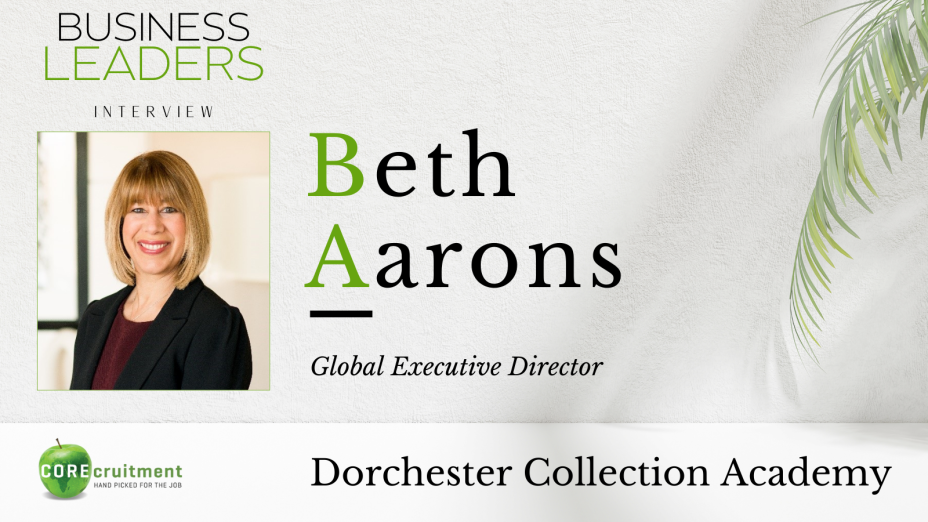
Business Leaders interview: Beth Aarons
Tell us a little about yourself and your business.
I have now worked for Dorchester Collection (DC) for almost 9 years. Prior to this I have spent the majority of my career in luxury hospitality, which is now over 30 years. Giving back to the wider community and industry is important to me and is very much supported by DC. I am a Trustee for a social care organisation, called SCiA based in Hampshire as well as sitting on the board of one of Britain’s oldest liveried companies that represents hoteliers, the Worshipful Company of Innholders. I am an HR Director by profession, with a love for learning and development. I have always been responsible for this area within businesses I have previously worked in. I was given the opportunity to set up Dorchester Collection Academy in 2018. As well as providing the learning and development for all our exceptional employees, DCA is a commercial business, delivering training in customer experience through inspirational leadership for other luxury brands. We have worked with over 40 companies as well as working with private and royal households.
What motivates you in your work and what do you find most fulfilling about being a business leader?
Being part of the businesses we work with, progressing and improving. When we’re able to help these companies find the solution that makes the difference to their individual and collective success. Seeing my own team and our wider teams develop is my biggest thrill. Our purpose within Dorchester Collection Academy is Helping People to Flourish – I live by this every day.
How did you develop your leadership skills and how would you define your leadership style?
There are so many ways, but I feel it’s important to have great role models. I’ve been fortunate to have had some wonderful ones over the years. At the same time, I have also worked with some terrible leaders. There is also much to learn from these people – never to be like them. Our own personal brand is essential to the legacy each of us leaves. I learnt that I want this to be a positive one.
Innovating is crucial in our very diverse industry. How do you stay ahead of trends and incorporate them into your global strategy?
Embracing new technologies is part of any business today. I am delighted that this year, we have introduced an LMS which is part of our strategy to reinforce the in-person learning we deliver in the classroom. However, it’s not just about technology, creating interesting activities to help participants transfer their learning from the classroom to the business environment is a key responsibility of our facilitators. We are continuous reviewing our training content and activities to ensure that they deliver what today’s businesses need.
What do you consider to be the key component(s) of effective business operational development?
Listening to your guests/the customers and the people within your business and taking on board their feedback. Being open to try new things, experiment. We believe that testing and learning is an important component.
How do you approach identifying areas for improvement within a company's operations?
We have a unique structure which allows us to analyse the data we receive from our guests’ experiences. This feeds in to our teams responsible for performance improvement. Combining these insights, gives us clarity of the learning topics we should be providing. These topics are developed into bite-sized training sessions which we call LEARN modules. These are typically 90 minutes long which works well for our operational teams, maximising attendance.
What’s the most important leadership lesson you’ve learned?
There isn’t one lesson so I’ll share a few: Decisions become more difficult the more senior you get and therefore there are times when you will make a mistake. Own up to making a mistake. Really listen to your teams and your customers. Love your numbers. Be kind to people.
How important is personal development to your success, and how do you approach it?
When I started in this profession, we were seen as the experts in everything. We also defined everyone’s career path and their learning experiences. I’m pleased to say that this approach has changed a lot over the years. Within Dorchester Collection, we discuss the aspirations of each of our employees and work with them to create a learning pathway that works for them and their progression plans.
How do you prioritise tasks when everything feels like a priority?
Everything does feel like a priority especially when you have an incredibly long To Do list. For me it’s about dates and deadlines. I like to ensure that I agree realistic dates to deliver against our clients’ expectations and this also means considering the activities of my team.
What steps do you take to measure your own performance?
We use engagement surveys twice a year to help us in our focus. This is a great measurement tool as it provides me with my priority areas to work on. Importantly, I share this with my team so that they know what I have committed to. At this moment, understanding the changing landscape of DEI is a focal point.
Author
Date Published: 6th September 2024
