
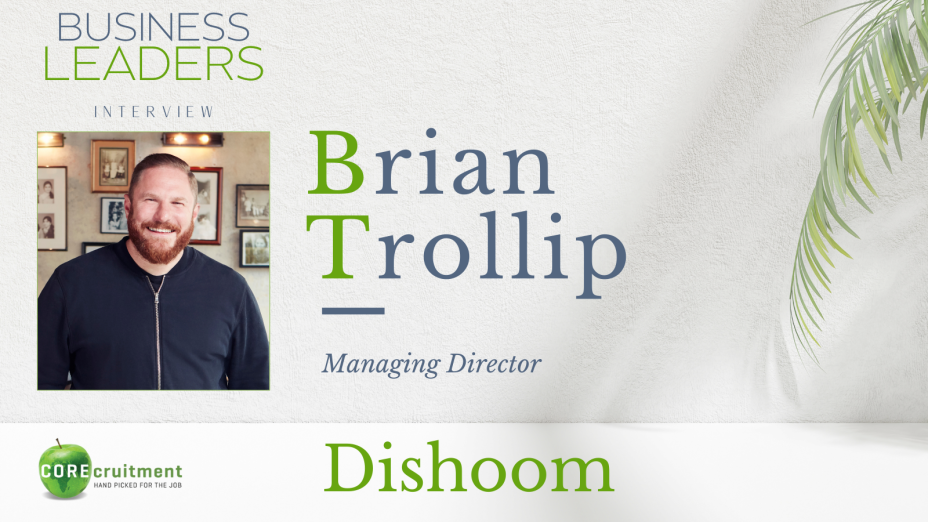
Business Leaders interview: Brian Trollip
TTell us a little about yourself and your business…
I’ve been with Dishoom for 14 years now (Wow that’s a long time… I must have been young once!) Click here if you’d like to know a little more about us.
What motivates you in your work and what do you find most fulfilling about being a business leader?
A few things really:
- I love the fact that everything we do is essentially focused around connecting with others, bringing people together, breaking down barriers and making sure that people have a bloody good time!
- I like doing great work - whatever the work is. Figuring out how to do something as well as is possible is weirdly exciting to me. I don’t care how small the task is - I get a kick out of knowing that we did something as well as we possibly could have done.
- I love working with so many people who care about doing the right thing when no-one is looking. It’s a really big deal and creates a lovely working environment
How did you develop your leadership skills and how would you define your leadership style?
They’re still very much developing. I don’t think that one ever completes leadership development. There is always something we're not seeing and alongside that, both you and the world around you are ever changing. To me, it’s essential to keep listening and learning. I’m pretty paranoid about most things I guess; I’m always trying to figure out what it is that I could be doing slightly better (sometimes significantly better). As far as defining my leadership style goes, I’m not sure that I can do that, other than to say that I think that my role is to serve and look after the whole team, all of our guests and then the business as a whole. Probably in that order so that everyone gets what they need, where possible.
Innovating is crucial in our very diverse industry. How do you stay ahead of trends and incorporate them into your global strategy?
Maybe… I think slightly differently to that really. Seeking innovation for the sake of innovation is a really odd thing to do in my view. Often innovation is brilliant but that needs to be balanced with the fact that it isn’t always brilliant and there are a lot of “Emperor’s new clothes” out there. It’s often better to slow your thinking right down and to spend the time figuring out what it is that’s going to make your team and your customers happy, which will ultimately lead to better business success. Sometimes the answer is going to be innovation and often the answer is going to be to double down on something that you know is important so that you can do it in an even better way. I’m not really one for chasing trends until, or unless, I’ve spent the time understanding them well enough to be convinced that they’re going to drive improvement.
What do you consider to be the key component(s) of effective business operational development?
Get clear about what good looks like, then work really hard to get a little better every day. You don’t need to move everything on in a hurry. If you break it all down into little pieces and concentrate on marginal gain, often you’ll get more done, more quickly in the long run.
How do you approach identifying areas for improvement within a company's operations?
I try to talk to people from every corner of the business, often, then listen really carefully. It can be really unhealthy to assume that the way you’re doing something is right and that someone is being a pain by challenging it. Be curious about every single suggestion or concern that comes your way. I feel that when we’re doing this really well, the areas to focus in on seem to fall out pretty quickly.
What is or are your biggest career achievement(s)?
My biggest achievements have all been shared achievements. I’m not sure that there’s anything I’d take personal credit for.
Do you have examples where your leadership made a difference? If so, what were they?
Only in that I’m part of a team that’s helped to build a culture which, I hope, helps to create a brilliant work environment for people. That’s not an easy question to answer about myself really.
What’s the most important leadership lesson you’ve learned?
Probably that it’s totally fine not to have all the answers all of the time and that, even when I think that I do have the answer, I should check it (ideally with the person who I think is least likely to agree with my prescribed solution).
I find it so important to be open about things that I’m finding challenging or that I don’t have an answer to so that we can figure things out together. In my experience, this gives others permission to do the same, which is very helpful too.
How did you identify and seize opportunities for advancement in your career?
I’m not sure that I ever thought that way.
For me it’s always been about volunteering to do things that I knew were going to be super challenging, before turning up earlier than everyone else and staying later than everyone else until I figured out how to get the work done as efficiently as everyone else. That and making sure that I do what I say I’m going to do.
This approach comes with some health warnings and I’m not certain that I’d prescribe it, but it’s meant that people have tended to believe that if they ever needed me to get a job done, it’d get done if it was at all within my ability. That’s led to some great opportunities over the years.
Have you achieved everything you wanted in your career so far?
I’ve loved every minute of my career, I really have.
How important is personal development to your success, and how do you approach it?
Everything, for me, starts with investing in self-development. That’s often as simple as finding out what people that I respect are reading and making sure that I’m keeping up with that. I subscribe to some good personal development newsletters. I’ll take any opportunity to focus in on a specific skill and get some exec ed done wherever practically possible; and I also see a coach once a month who holds a mirror up to me and helps me to sense check my thinking, amongst other things.
How do you prioritise tasks when everything feels like a priority?
I’m pretty disciplined on this front. When everything feels like a priority, nothing is. I start with making sure that I’m crystal clear about what it is that I want to achieve for the year/quarter/month/week/day, then I sense check all my projects and tasks against this. I put the ones that are going to move me towards my goals in the most significant way at the top and the rest below that in descending order. I work pretty hard to take any distracting work off my list too. That’s often as important as anything else.
What was the hardest decision you have taken as a leader?
That’s an impossible question to answer, I think. There have been hundreds [decisions] (at least) over the years that I could point to as being really tricky at the time. I’ve always tried to go back to basics in these situations and ask a few questions that help me to get to the right answer.
- Given the fact that I have a fairly clear set of principles and values, what’s the right thing to do from that perspective?
- What’s the real need here and can I make a decision that means that everyone wins as opposed to one person winning and one losing?
- What’s the fairest process that I can use with which to make this decision, and how can I give the most amount of transparency on the process where I’ve managed to get this right? People are generally supportive of a decision whether they agree with it or not.
I know that might sound like a bit of a cop out to the question, but that’s the only way that I can really answer it.
What steps do you take to measure your own performance?
I check in with people a lot, it’s helpful to have a fairly constant 360° going and to foster a culture where people feel like they’re helping you out by telling you when they think you’re not seeing an angle or are coming at something in the wrong way. Outside of that and business performance, if my family, my team and my guests are happy, I feel like I’m doing ok.
What does success mean for you as a business leader?
Success for me is waking up every day to do work that I believe is worthwhile and meaningful with people who I enjoy spending time with. That and carving out enough time to ensure that my relationships are healthy outside of work.
Author
Date Published: 1st August 2024
