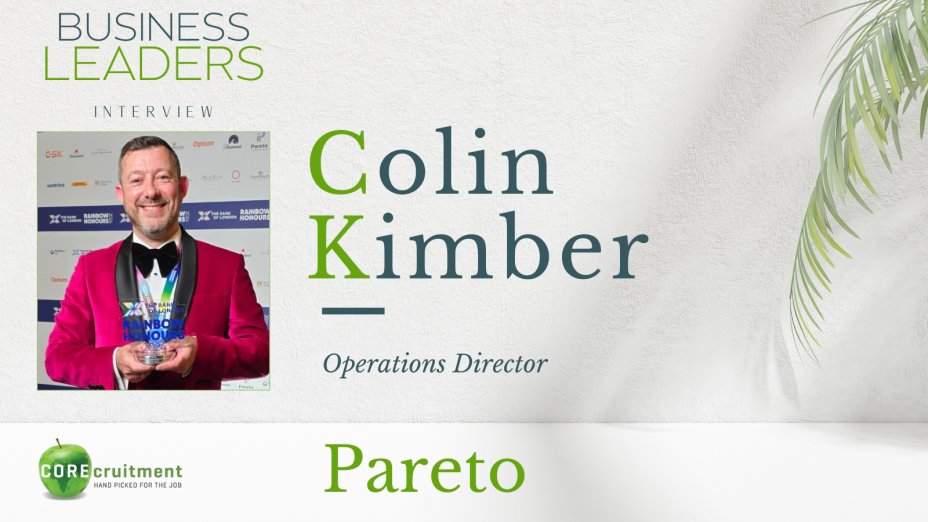
Business Leaders interview: Colin Kimber
Tell us a little about yourself and your business.
My name is Colin Kimber. I’m Operations Director at Pareto Facilities Management. We are a 10-year-old start up with a mission to “Change the face of FM”. We do this through our Social Impact lead, Customer Centric approach which rests on a solid foundation of Technical Competency. I am also Co-Chair of LGBT+ in FM, a cross-industry network made up of many organisations. We come together to share best practice, support individual in our industry and assist organisations in progressing their EDI journey – in particular from an LGBTQIA+ perspective. I’m also part of the EDI Steering Group for The Institute of Workplace and Facilities Management.
What motivates you in your work and what do you find most fulfilling about being a business leader?
My primary motivators are linked strongly to helping people to achieve. Whether that’s my colleagues and team members or my customers, I really enjoy learning about their needs and doing what I can for them to be the best they can possibly be.
How did you develop your leadership skills and how would you define your leadership style?
I’ve always been a good communicator, so that’s where things began. I spent a lot of time developing my Emotional Intelligence, which has helped me accept both my strengths and weaknesses. This in turn helped me to connect to my own lived experience and that has guided my leadership development. I practice conscious role modelling – always taking a moment to assess whether a situation is an opportunity to teach or demonstrate best practice. Having recently asked my peer group for feedback on my leadership style, they described it as authentic. That’s encouraging, as I generally try to be myself at all times.
Innovating is crucial in our very diverse industry. How do you stay ahead of trends and incorporate them into your global strategy?
I listen to people – particularly those that possess some element of difference to me. A different generation, diverse group, industry – I find variety of perspective helps me to see things that I might not notice inside my personal bubble.
What do you consider to be the key component(s) of effective business operational development?
Openness to change, agility and being comfortable with the concept of being on a journey.
How do you approach identifying areas for improvement within a company's operations?
I tend to automatically be on the lookout for improvement, which I think has helped foster a safe environment for my teams to challenge themselves and the status quo. We also have a Key Account Management function within the business that supports digging deeper into our customer relationships to identify areas where tweaks can be made. That certainly helps guard against complacency. Customer relationships are always in motion and the key to developing real trust lies in creating an open dialogue that accepts this and relishes the challenge it presents.
Where do you think the most promising investments should be focusing on and/or made on?
For me the answer is always going to be focussing on Equity, Diversity & Inclusion. The Workplace is where we spend most of our time, so creating a welcoming environment for all can only have a positive effect on individual and business performance.
What is or are your biggest career achievement(s)?
The accolades I have received this year. I was named Inspirational Role Model of the Year at the 2024 Rainbow Honours, made No.79 on the Guardian Pride Power List 2024 and at The Workplace Leaders Top 50 2024, received the Contribution to the Industry Award. These all happened because of the work I do across the industry, so for me they bring together all aspects of my professional life – both work and voluntary.
Do you have examples where your leadership made a difference? If so, what were they?
My team have fed back that my openness about my own struggles with Imposter Syndrome over the years have helped them overcome challenges they are facing. Through Mentoring others, I have seen a number of people excel in their ongoing careers.
What’s the most important leadership lesson you’ve learned?
Two for me here: I am not always right and someone else’s version of perfect is just fine.
How did you identify and seize opportunities for advancement in your career?
I follow the fear these days. Earlier on in my career I kept an eye out for new skills to learn or opportunities to take on additional responsibility. Now its all about the fear – If something terrifies me, I do it.
Have you achieved everything you wanted in your career so far?
In some ways I have achieved more than I ever thought I would. The platform I find myself on now is challenging me to ask, “what if”. So, we shall see. I’m quite excited about the potential I see in the future.
How important is personal development to your success, and how do you approach it?
Extremely important – I am quite reflective. So am always looking at why things did or didn’t work – thinking about what could been approached differently and how that could have affected the outcome. I also feed myself with lots of outside ideas – Books, Articles, Documentaries. Feeding yourself new concepts definitely keeps things moving for me. I tend to stagnate if I go for too long on the same information.
How do you prioritise tasks when everything feels like a priority?
I’ve gotten pretty good at this over the years, but my boss still nudges me every now and then. I think we all struggle with this at times – especially if we have a broad scope of responsibilities. A simple answer to this would be that I look at the things that will have the most impact to the people around me and then get those things done first.
What was the hardest decision you have taken as a leader?
Stepping away from teaching and moving into the FM Industry. That was a real “standing on a cliff” moment for me. I jumped, and I’m glad.
What steps do you take to measure your own performance?
I do all the old school things – keep lists, ask for feedback, monitor business and operational performance. I also listen to my gut and pay attention.
What does success mean for you as a business leader?
Creating an environment where everyone can succeed, no matter who they are.
What challenges do you feel are coming in the next 12 months and what are you doing to address them?
There has been a change of government, so there is a degree of uncertainty as we see how things unfold, both from a business and individual perspective. That said, I am noticing a sense of hope in the people around me and that’s definitely a good thing. There has been a shift in focus around ESG and we are going to need to stay focussed on aligning ourselves with our customers’ needs in connection with that. At Pareto we are aligning our own actions in this area with what our customers’ requirements will be. EDI has also received some bad press over the past 12 months – removing this negativity and moving forward is going to present a challenge. I will be remaining visible and exploring ways to build on the platform I now find myself on.
If you had one piece of advice for aspiring leaders – what would that be?
Be yourself! I spent so many years deciding what those around me wanted and then changing myself to fit into that. That’s not a recipe for authenticity and certainly won’t make people feel at ease with you. True engagement follows on from that authenticity.
Author
Date Published: 1st August 2024
