
Business Leaders interview: David Phillips
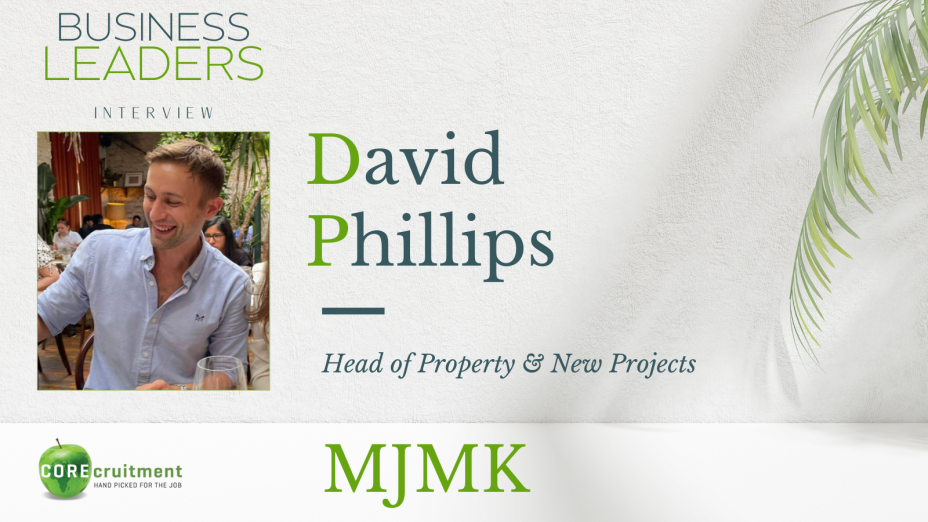
Tell us a little about yourself and your business.
I live in St Albans with three of the most wonderful people in the world, two of whom are under the age of 4. At work I lead all things Property & Projects at one of the most exciting restaurant groups in London, MJMK. Comprising the growing brand ‘Casa do Frango’ now at 4 units having opened two in two years, ‘Lisboeta’ in partnership with Nuno Mendes, ‘KOL’ a Michelin star restaurant by Santiago Lastra (freshly awarded 17th Best Restaurant in the World) along with two concepts launching in the autumn- ‘AngloThai’ with Chef John Chantarasak and ‘FONDA’ with Santiago Lastra.
What motivates you in your work and what do you find most fulfilling about being a business leader?
I’m motivated by creating and maintaining the best hospitality environments in the world, working with people who are truly passionate about what they do.
Whether it’s working with teams to pull together a new interior design concept, negotiating the legals on a lease for a new location, or scoping out cleaning requirements and debating the location of an AC condenser – working with people in those areas who genuinely care and put the work into creating something excellent is what gets me out of bed.
How did you develop your leadership skills and how would you define your leadership style?
I was lucky enough to be trusted with very large teams early in my career which gave me the opportunity to develop my management approach in a variety of circumstances. Having the benefit of a Graduate Scheme with a lot of formal, corporate Management training helped give me the confidence to manage people of all levels, backgrounds and ages which I was a part of my role I came to genuinely love.
Formal training helps a lot with forming management frameworks to build on and I would recommend anyone to get a basis in formal training through their career but ultimately nothing can beat getting to know your team, becoming personally invested in their growth and development, making sure you’re clear on expectations and abiding by those expectations yourself.
Innovating is crucial in our very diverse industry. How do you stay ahead of trends and incorporate them into your global strategy?
You only need to look at the food & drink we create in our restaurants for a demonstration of our approach to Innovation. It is not just about looking ahead but about constantly challenging what you have done and what you are doing.
I’ve found that relentlessly interrogating the way you do things is key – not being afraid to reimagine what great looks like if your previous imagination didn’t work and challenge yourself, your teams and our service partners to push for better and fresher approaches to problems. Being fortunate enough to work with some of the best and most knowledgeable people in their fields, from Service to Kitchen design, we rely on these people to bring and implement the best new ideas and technology.
What do you consider to be the key component(s) of effective business operational development?
Adaptability & Frameworks.
There are a few critical aspects to developing a business or department which should be set in stone, communicated thoroughly, enforced strictly and rarely changed to ensure stability. In my experience, examples of these would be key HR and Finance processes. In a Growth business, everything else should be a framework. Each area of a business or department should have a way of doing things but in a growth business, you could and should never cement a non-core process as you need the ability to flex your approach, change a process to suit the business environment and need at the time.
This flexibility within a framework means you’re rarely caught short by a macro environment change or business need.
How do you approach identifying areas for improvement within a company's operations?
"When the data and the anecdotes disagree, the anecdotes are usually right." - Jeff Bezos
Start with data, back it with conversation. Data is a great way of analysing an area of weakness in the business but speaking to your team and customers about their lived experience is invaluable.
Where do you think the most promising investments should be focusing on and/or made on?
Money is expensive so small business investment must be focussed on short/medium return value creation projects which either reduce operating costs (e.g. Energy optimisation) or increase revenue (new openings/extensions/space optimisations). Investment in the higher end of the market is high risk but established operators with proven history of delivering excellent quality and value, operators in this sector will do well.
There is no shortage of fly-by-night tenants in hospitality looking to capitalise on Landlords keenness to nail down long term tenants in a volatile market though genuinely good operators with a strong covenant are hard to come by. This means they are well placed to negotiate good value lease agreements in Prime locations which makes investment into those areas more appealing.
What is or are your biggest career achievement(s)?
Still in progress but delivering two of London’s most exciting high-end restaurants from concept to opening at the same time will certainly be up there!
Do you have examples where your leadership made a difference? If so, what were they?
I’d like to think my leadership has made a (positive!) difference in every team I’ve worked with but two instances spring to mind:
The First was taking the operational leadership of a failing major account in my earlier career, being told I will likely need to exit most of the team and find new people to turn it around before tender. After being in there for 6 months, I didn’t exit one senior employee, instead provided coaching, direction and leadership to provide a better service. We turned it around, re-won the tender and it became one of the most profitable contracts in the business.
The second was being part of a team of only 5 Senior Leaders of a pub/hotel business not furloughed during Covid, Directing our response to the Tier System, regenerating outdoor pub spaces all over the country, carrying out more than 12 simultaneous refurbishments of hotel rooms and outdoor spaces in preparation for the year of the ‘Great Staycation’
What’s the most important leadership lesson you’ve learned?
Treat people how you want to be treated
How did you identify and seize opportunities for advancement in your career?
I spent almost my entire 20’s with imposter syndrome. I did not let myself get comfortable. I didn’t chase salary early in my career but chose roles which I knew would provide me the best opportunities for learning or advancement even if I wasn’t sure how I would do it. Eventually that pays off and you suddenly start to realise that the value of your output outgrows the effort of your input.
Have you achieved everything you wanted in your career so far?
I think if I answered yes to this I should pack up and go home!
How important is personal development to your success, and how do you approach it?
Huge. That’s not to say you need to spend thousands on training programmes and certificates, but you must invest in yourself.
Non-tangible development and daily learning is very important – I will listen to Audiobooks such as Dror Poleg’s ‘Rethinking Real Estate’ or Chris Voss’s ‘Never Split the Difference’ on my commute in the morning when my brain is engaged. (I’ll listen to a comedy podcast on the way home for a break though!) Podcasts such as ‘Humans of Hospitality’ gave a great insight too.
This should be backed up with professional and recognised qualifications where you have the opportunity to do so.
How do you prioritise tasks when everything feels like a priority?
Organisation & communication is everything.
If you don’t have a folder for the key aspects of every part of your role then I recommend you do it immediately.
When you’re being asked to deliver something where you know there is a risk it won’t be done on time or at all – say it. Work is a collaboration so make sure those around you, including your seniors, understand what you’re working on, what your current priorities are and how you intend to prioritise their request.
What was the hardest decision you have taken as a leader?
Reducing the size of your team is always the hardest possible decision. I invest in my teams professionally and emotionally so it’s always difficult if things have to change so restructuring is always the hardest part of any role.
What steps do you take to measure your own performance?
Output. Define objectives annually and quarterly and measure yourself against them and then every 6 months or at least annually it is good to pull together a summary of what you and your team have achieved over the past 6/12 months along with reflections on what can be done better over the next 6/12 months.
What does success mean for you as a business leader?
Happy people, Great places and Growth.
What challenges do you feel are coming in the next 12 months and what are you doing to address them?
With a change of Government there is an element of uncertainty which makes investment difficult, slows decision making and increases frustration. Building costs could increase as the planning sector becomes more deregulated and house building kicks off. Lead times will be longer and more up-front planning will need to be done to deliver good value projects.
The Prime Minister addressed UKHospitality this year to underscore the Labour Governments commitment to the sector and has hinted at replacing the Business Rates system. Thus, us a huge opportunity for the sector and could ensure the survival of mid-market operators who have struggled recently.
If you had one piece of advice for aspiring leaders – what would that be?
Take risk, be nice to people and work hard.
Author
Date Published: 1st August 2024
