
Business Leaders interview: Jeremy Buckle
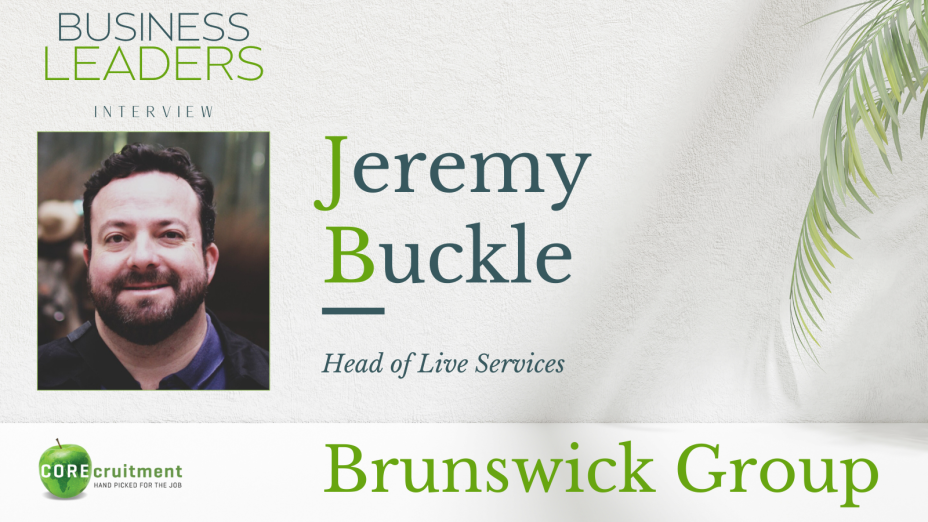
Tell us a little about yourself and your business.
Over the last 30 years I have worked on large-scale multifaceted projects including live events, theatre, television, media campaigns (digital, print and social), brand activations, venue management, hospitality and public outreach programmes across the globe. I specialise in launching and revitalising existing event programmes and brand campaigns such as The Big Bang Fair for the UK Government where I was awarded a Queens medal and the Rook Medal for services to promoting science and engineering. YoMo, A global community engagement program for the GSMA and the Mobile World Congress and the Global Sustainable Development Congress for Times Higher Education.
What motivates you in your work and what do you find most fulfilling about being a business leader?
I am passionate about creating engaging event programmes that effectively convene communities and bring networks together. In focusing on event startups, accelerated growth management or programme renewals, it allows me not just to design and deliver the event programme but build (restructure) the business systems and processes around the events to ensure success. My role is often 'white labelled' so as a consultant I come into the firm as one of the team and get to work with diverse mix from finance, HR, legal, sales & marketing, operations and production. I am able to lead the teams, pushing them to achieve, think differently, become agile and generate momentum building the sense of urgency and purposeful change. I really get a buzz out of the energy that this creates.
How did you develop your leadership skills and how would you define your leadership style?
Developed mostly through personal experience, I would describe my style as being a blend of visionary, coaching and transformational styles. I like to push the teams to realise the vision, mentoring to enable and celebrate success whilst not being afraid to try new things and learn / grow from them success or not. I have been lucky to have some amazing mentors early on in my career. They pushed for excellence, showed the effort required for attention to detail, the power of the follow through. This industry has some pretty big personalities and I have seen the good, the bad and the ugly of that. Emotional intelligence is a continual growth journey for me so always trying to be mindful of the diverse perspectives and styles that come with our diverse community.
Innovating is crucial in our very diverse industry. How do you stay ahead of trends and incorporate them into your global strategy?
Technology and creativity drive innovation. Making sure for every programme we try something new, adopt a new (or old) technology, new skills transferred from other sectors and even if tried before, allowing new data points to give it another go. Having worked across so many sectors, seen events from so many different angles, i have successfully adopted processes used in Theatre, finance, the NHS and even some sports to deliver event engagements more efficiently.
What do you consider to be the key component(s) of effective business operational development?
Accountability: every member of the team needs to take ownership for their roles and those below them. Give them the space to exceed and fail in it.
Ensuring you have the relevant resource: ensure you have enough resource and the right resource. That resource is a living being too, so it needs to be looked after as such.
Strategic visions are best when simple and relatable: The best strategies and visions for success are those that everyone can understand, relate to and contribute to.
How do you approach identifying areas for improvement within a company's operations?
Continual organic 360 feedback. It can be exhausting to adopt and requires agility to incorporate during programme execution, but technology can be applied here with great impact. Many programmes incorporate programmes for feedback that are overbearing and cumbersome resulting in box ticking administration rather than impactful process. The trick is to incentivise the teams to own the programmes demonstrating how engaging can make their job easier and then let the teams drive the process. If they don't drive it, then that’s the first place to review and address.
Where do you think the most promising investments should be focusing on and/or made on?
AI can transform a lot of the operational processes in events. the double check / sense checking utilisation of data to steer programmes as they unfold not just in post event reviews. I have seen programmes live and die by their ability to spot industry trends and opportunities as they roll out.
What is or are your biggest career achievement(s)?
Convincing Universal Talk Television to bring the Jerry Springer Show to a Valentines day 'desperate and dateless' event launching a dating website (back in the days before RSVP) in Australia. Stadium show with 25,000 people yelling 'Jerry', 'Jerry', 'Jerry' makes the Made in Chelsea of today look very tame. Beyond that, the launch of the event programmes mentioned above. This was a big one for me as I (single director limited company) went up against big TV and production studios and beat them. Because my model allowed the studio to keep their revenues and to focus on complimentary no competing business interests. Outside that, The Big Bang Fair. It has really made a national impact in achieving its objectives of getting more young people to follow subjects at school and careers in science and engineering. It brought complex stakeholder communities together and had to overcome so much opposition and disbelievers.
Do you have examples where your leadership made a difference? If so, what were they?
Each of the event launches I have mentioned above have required different elements of leadership to be successful. Abilities to relate and engage with hundreds of stakeholders, ability to bring a community together, create teams from scratch and unify existing teams. incite passion and pride in the day to day so you can form partnerships with those who can seem like competitors, form alliances that are win / win.
What’s the most important leadership lesson you’ve learned?
Three rules that drive all the commercial and operation decisions for my projects.
- Know your own weaknesses. Own them and to make sure that you resource up for them.
- Be honest, ruthlessly so on your progress, the (un)expected outcomes and (un)expected barriers. Proper Plan Bs can’t be formed without this.
- Think like your audience. Make sure you contribute to that community. Only then can you authentically engage with them.
How did you identify and seize opportunities for advancement in your career?
Making my own opportunities in life. The Jerry Springer appearance at 'LoveFest' was a crazy idea over a glass of red wine that tenacity, passion, enthusiasm and authenticity enabled a big studio to take a gamble on a win big. I was outside my comfort zone by a long way. But believing in my own abilities, accepting the support of those around me made that happen. The Big Bang Fair role, I was originally not even short listed to be interviewed. I realised early on that coming from a smaller events industry in Australia where you had to be a 'jack of all trades', not 'the king of one' meant my diverse experience (or lack of a specialism) as a perceived weakness, not a strength. I ended up convincing the EA on the other end of the line that my skillset was worth a meeting. I knew when i got the interview i would get the job.
Have you achieved everything you wanted in your career so far?
I am happy with what i have achieved so far. However, I think there is a critical role that our industry is best suited to play a leading role in - helping the world address some of the biggest challenges of our time. Socio-economic discord and political conflicts have been amplified by digital technology. The benefits of democratised and global connectedness have given way to echo chambers of extremism and made dysfunctional bipartisanship the norm. I believe there is a unique event programme out there just waiting to be realised that can negate all this, convening communities across the divide and unify where technology has divided. So, for me, the next one is to work out what that one is and making it happen.
How important is personal development to your success, and how do you approach it?
I was taught very early on to love what you do. You will do it for a big part of your life so make it count. So, for me, to succeed professionally, I have to succeed personally. They have always been connected.
How do you prioritise tasks when everything feels like a priority?
Look at the end goal / vision / objective and ask myself which of the tasks before me is most critical to deliver that. Finding the headspace to have that clarity of thought can always be a challenge. Plus ensuring that in that mix is your personal time. Very rarely do people achieve a work life balance in this industry but giving up trying only leads to imbalance that makes you completely ineffective.
What was the hardest decision you have taken as a leader?
Knowing when it’s time to go. Being able to be honest with yourself and admit you have given all you have and it’s time for new skills, new talents to take the programme forward.
What steps do you take to measure your own performance?
Make sure i am objective enough to have honest self-assessment of programme delivery against objectives and the perspective of the team. Have they got everything they needed from their leader? The biggest one is making sure i take the time and in the right mind to be honest - leave the baggage (emotions and excuses) in the bin at the door, and really critically assess my performance. If I’m not learning, I’m not growing and treading water is the worst place to be.
What does success mean for you as a business leader?
It means a lot because it makes all the failures count. It means that the team have got more out of it than just a pay check too.
Author
Date Published: 1st August 2024
