
Business Leaders interview: Ricardo Riera
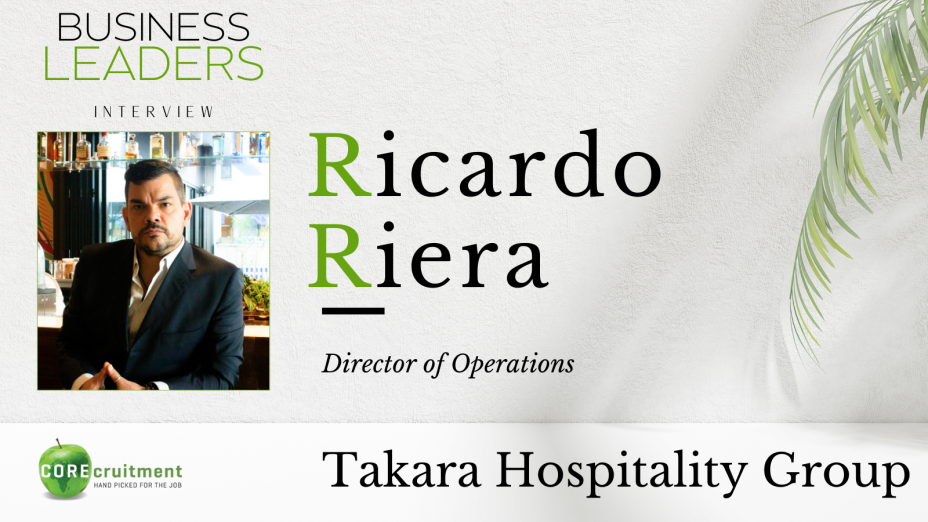
Tell us a little about yourself and your business.
My name is Ricardo Riera. I was born in Peru, and I have dual nationality, as my father was Spanish. I have been working in the hospitality industry for 24 years in cities such as Oslo, Barcelona, Dubai, Riyadh, Abu Dhabi, and Ibiza. Currently, I am the Director of Operations for one of the five biggest restaurant operators in Saudi Arabia.
What motivates you in your work and what do you find most fulfilling about being a business leader?
I take great pleasure in witnessing the growth of team members. I fondly remember several team members who joined my past offices with only basic knowledge and nervous smiles. Seeing them leave as managers, head chefs, or even opening their own venues is extremely satisfying to me. A leader who does not share knowledge is like a small child who does not like a toy but also does not want others to play with it.
How did you develop your leadership skills and how would you define your leadership style?
I consider myself a highly logical person, or at least I strive to be. When someone suggests a business decision, my first question is always, "Can you explain the basis for your assumption?" I value honesty and believe that clarity is essential in business. While I understand the importance of delivering a return on investment to shareholders, I do not believe in making hasty or illogical decisions, you should drive yourself solely by numbers. It is important to be transparent and avoid overpromising. I also strongly believe that micromanagement is detrimental to any organization, and I make every effort to avoid it.
Innovating is crucial in our very diverse industry. How do you stay ahead of trends and incorporate them into your global strategy?
It is important to read for at least 45 minutes a day to learn about what other people are doing and where your region is heading. This exercise helps to keep the most vital part of your body - your brain - engaged. I try to study cases from the hospitality industry in countries that are like the one I am performing my duties but have already gone through certain stages. Past trends tend to be repeated, and it is crucial to learn from them to avoid making the same mistakes.
What do you consider the key component of effective business operational development?
Proactivity is the most important virtue for anyone aspiring to be a manager and is a key component for business operational development in the market. Relationships are fundamental. Never close a negotiation abruptly; even if it is not successful, you never know whether you will need the other side in the future. Strategic planning is crucial. Set clear milestones and, above all, have achievable expectations. Assuming that customers will like your product just because you think is good, it is a mistake. No one has what I call "a universal palate."
How do you approach identifying areas for improvement within a company’s operations?
Contrasted data and more data: there is nothing more accurate than a well-calculated number. It should be an integral part of your daily operations, and you need to empathize with your colleagues and customers. Ask yourself at any given moment: if I were part of the target audience for my product, would I use it? If the answer is no, then go back to the drawing board and analyze your data.”
Where do you think the most promising investments should be focused on and/or made on?
If we are talking about a location and industry, it is Saudi Arabia's fast-casual hospitality. If we are discussing a part of your business, it is your human capital = your team.
What is or are your biggest career achievement(s)?
Being selected among the 50 most powerful people in F&B by Caterer Middle East in 2021, right after the pandemic. Was an extremely difficult year in terms of business, and was an extremely difficult list to make, as everyone did her or his best. When they told me I was the 3rd person with the most votes from F&B peers among 5000 nominees from 20 countries, I could not believe it.
Do you have examples where your leadership made a difference? If so, what were they?
When we began the BOCA restaurant project in DIFC Dubai (Michelin Green Star and 50 Best MENA) and I was chosen to lead it, the first thing we did was to establish a specific recruitment vision. We went above and beyond, selecting one by one the nationality, language skills, the color of the hair, and way of smiling, even if they were right or left-handed, and defined the kind of customer service we wanted to provide. Additionally, we aimed to differentiate ourselves in a competitive market. Despite skepticism from others due to the presence of well-established names like LPM, Zuma, and Roberto's, we remained committed to our vision. When I left the project two years ago, the restaurant had already garnered 27 awards and recouped its initial investment within the first 19 months of opening. This experience reinforced the importance of believing in one's vision and staying focused amidst external pressures.
What is the most important leadership lesson you have learned?
You are nobody without a team. You cannot do everything by yourself. Always tell the truth, even if it seems like the worst solution. Overthinking leads to nothing. Above all, remember that everything you do to others will come back to you."
How did you identify and seize opportunities for advancement in your career?
A professional should always be open to hearing what is out there, but also be aware of their current position. Never come to negotiate with a current employer with an offer in hand. If you believe your work is worth more than what you are currently getting, first prove it with numbers, then wait a couple of months to see their reaction, and then ask for those numbers to be matched. Do not remain silent about requesting what you deserve. If you do not see any results, simply make yourself available elsewhere.
Have you achieved everything you wanted in your career so far?
Professionally, maybe, but personally, definitely not. At 45 years old, I have at least 3 to 4 more years until I settle into my own business, which is something I am extremely clear about. After that, it will be about using all my knowledge in my career without any big ambitions, simply to have a decent life.
How important is personal development to your success, and how do you approach it?
It is extremely important to note that personal development goes hand in hand with gaining knowledge. I am constantly learning, and this does not just involve reading, as I mentioned earlier. I also believe in learning from other people. I find it incredibly satisfying to have discussions and gather opinions with colleagues, regardless of their job grade, about important business subjects. Ultimately, I believe that if you go to bed without learning anything, it has been a wasted day.
How do you prioritize tasks when everything feels like a priority?
Operations is all about organization and discipline. If you lose one of them, you lose control of the whole. I am an extremely organized person. I wake up at the same time, go to the gym daily, feed my cats, dry the dishes from the night before (which my wife loves), and then have my coffee, shower, and prepare for work. Even if it sounds "repetitive," it prepares your brain to organize your day. I take notes of everything, and I prioritize tasks accordingly. Always remember that if a problem has no solution, it is better to leave it hanging. I follow the stoic philosophy.
What was the hardest decision you have taken as a leader?
On a personal level, I once turned down a very lucrative job offer from the Cayman Islands because they would not allow me to bring my cats with me. The recruiter was shocked, but my wife and cats mean everything to me.Professionally, that was the day I resigned from every job I had held in the past. I relate this to leadership because I do not form personal relationships with my management line, but I do build strong business connections, and it is difficult to leave such amazing teams. Fortunately, most of them have followed me to my next roles, depending on their fit in the organizational structure. Receiving messages from them saying, “You’re the best I have ever worked with,” “I learned so much from you,” or “It’s not the same without you here,” helps me realize that I have made an impact and left behind valuable knowledge.
What steps do you take to measure your performance?
I am extremely critical of myself. In addition, I do not accept comments such as "Good job" or "You are the best". I believe that my performance, as well as every performance, should be measured by receiving wages on time for the work that was agreed upon with a company. I see my employers as clients for whom I provide a specific service for an agreed-upon amount, and I give my 100% to them every day. Nonetheless, I am accustomed to exceeding expectations, and seeing the surprise on people's faces when I achieve something requested for the next year in just a couple of weeks is something that I truly enjoy.
What does success mean for you as a business leader?
The smile of a satisfied patron. My mother, who also worked in hospitality and gave me a passion for the craft, always said, "People come to a restaurant for two things: they do not want to clean dishes and they want to be served. Everything you do in the middle is called love, and they will come back for that."Success clearly understands that whatever you sell should be sold with the most love you can give to the person you are selling it to. The rest will come naturally.
Author
Date Published: 7th August 2024
