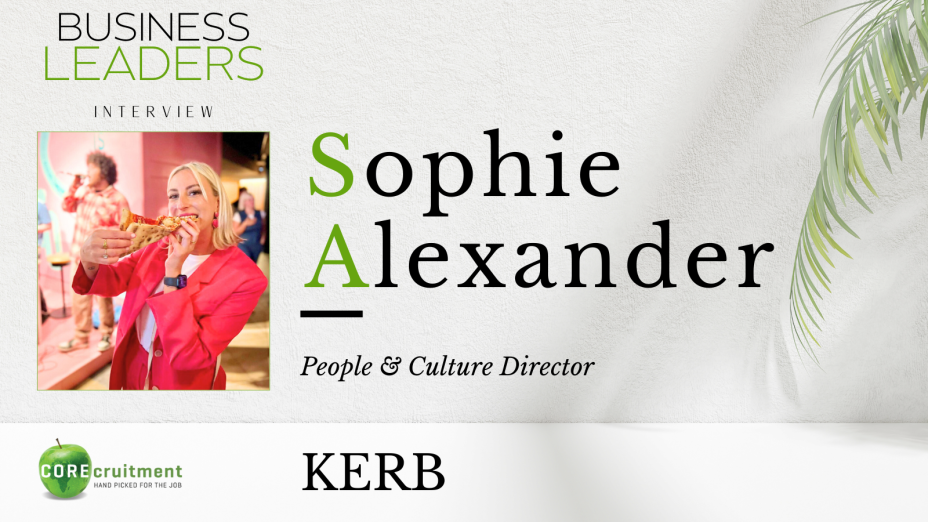
Business Leaders interview: Sophie Alexander
What motivates you in your work and what do you find most fulfilling about being a business leader?
The fact that KERB is so much bigger than food & drink - everything we do is about impact.
The more successful we are as a business, the more we can support people from disadvantaged backgrounds, remove barriers to employment & entrepreneurship, and accelerate the growth of new food businesses. There are loads of hospitality businesses I could work for, but the impact of what we do at KERB is what gets me out of bed in the morning.
How did you develop your leadership skills and how would you define your leadership style?
I study and read a lot of books. My favourite is “Radical Candour” by Kim Scott. She talks about three principles for building strong relationships with your team: make it personal, get stuff done, and understand why it matters. That’s my style. A lot of leaders and managers struggle with giving constructive feedback because people don’t like uncomfortable conversations, but I’ve learned how to thrive in that environment.
Innovating is crucial in our very diverse industry. How do you stay ahead of trends and incorporate them into your global strategy?
Networking events are important (CORE is very good at organising them!) - and I encourage all of my department to get out and about.
We’re also mindful about how we approach innovation. KERB has grown a lot over the last few years and naturally with size came more formality - we’ve evolved from a street food pop up in Kings Cross building site to an international food hall operator. It felt like we got quite serious and didn't fully recognise ourselves - so we’ve made a conscious effort to stay rooted in the fun and informality that has always made us great. That’s ultimately what people expect from street food too, so we want our team on the bars and stalls to be having as much fun as the people in HQ!
What do you consider to be the key component(s) of effective business operational development?
It’s all about having a really solid support service - particularly the finance, HR and marketing people. Those functions are the spine of our business. Without one of them, it all falls down.
How do you approach identifying areas for improvement within a company's operations?
Feedback. We’ve found a lot of success with our “make it better initiative” - an anonymous email hotline that goes straight to the CEO - we don’t filter out any questions and Simon has to answer each one at the company wide monthly team meeting. I also believe that you can’t ignore a gut feeling. Data is great, but emotional intelligence is better.
Where do you think the most promising investments should be focusing on and/or made on?
Sustainability and diversity, which we’re investing in a lot as a business - we have our own purpose & culture manager and sustainability officer.
We’re also implementing sustainability accreditation for our 150+ membership of independent street food businesses. It’s the beginning of a journey that we’re taking all of our traders on to ensure they have sustainability at the core of their operations. It’s great to see KERB alumni, like Pizza Pilgrims, become a B-Corp, and we want more of our traders to follow that example.
What is or are your biggest career achievement(s)?
Building a people team from scratch at KERB - from a one-woman band to a team of eight.
Opening in San Francisco too. I had to mobilise a team, on a different time zone, for an international food hall, without any international experience. It was a huge challenge but it’s been a big success - and it provides a blueprint for our upcoming opening in Berlin…
What’s the most important leadership lesson you’ve learned?
It’s okay to f*** up. Everyone is human and makes mistakes. As long as you put your hands up, take learnings and apply them accordingly.
How did you identify and seize opportunities for advancement in your career?
KERB always feels like a whirlwind, but I’m making more of an effort to ensure that we’re taking the time to seek that recognition where we deserve it - we’ve just been accredited in the Best Companies to Work awards which feels like a big moment for what our team has accomplished.
Have you achieved everything you wanted in your career so far?
No - I want to keep developing as a leader and challenge myself to branch out further. I’d love to expand my knowledge further outside the HR remit.
How do you prioritise tasks when everything feels like a priority?
Delegation is key. Any leader or manager must learn to know when it’s time to get out of the weeds - taking the time to train someone is key because of the long-term benefits that it brings.
What was the hardest decision you have taken as a leader?
When you realise it’s time for someone to leave. Letting people go is obviously the worst part of the job and it never gets easier.
What does success mean for you as a business leader?
A very happy, engaged, and motivated team. I strongly believe people should have the right to enjoy coming to work. I have a responsibility to make that happen.
Author
Date Published: 27th August 2024
