
IWD 2024 - Irina Orlandini Avrutskaya
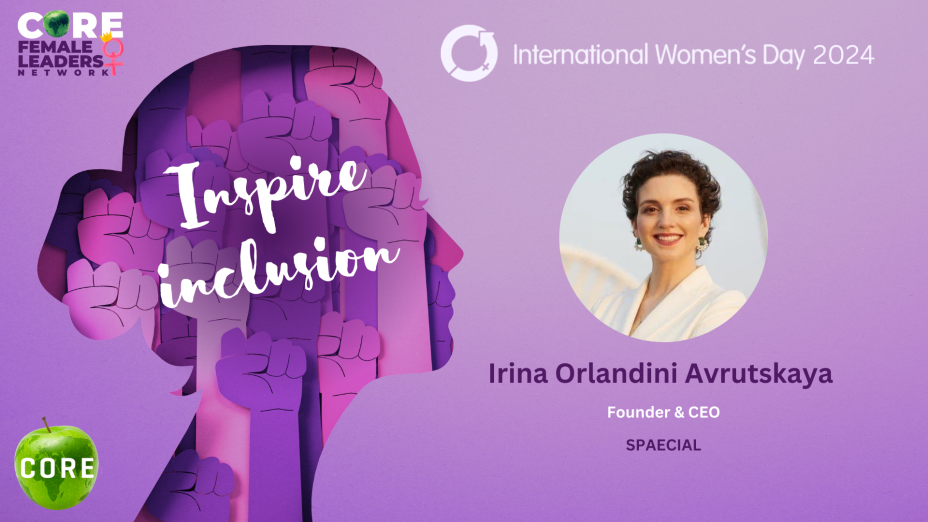
A little about your career journey leading to where you are now.
After earning a degree in Cultural Management, I initially worked as a producer for classical music concerts and ballet festivals. However, I soon realized that my true calling was outside this industry, leading me to transition into the restaurant business. At the age of 22, I became the marketing director for a restaurant and catering group, embarking on a path that emphasized strategic business growth. After spending 8 years in corporate roles with companies like Papa John’s, TGI FRIDAYS, and Costa, I founded my own consultancy company 10 years ago (now called SPACEAL visionary producers), leveraging my experiences to guide strategic growth and leadership in various hospitality and retail businesses.
What inspired you to pursue a leadership role?
My inspiration to pursue leadership came from my father, who led remarkable teams in developing advanced airspace control systems, and my maternal grandfather, who organized Soviet Expo Pavilions globally, becoming a true cultural ambassador in the 1960s.
What is or are your biggest career achievements?
My greatest career achievements revolve around my team's growing independence and their capacity for taking on responsibility. I've led over 500 consultancy engagements in 86 cities across 12 countries, achieving a success rate of over 87%. Building strong relationships with clients and partners, earning several awards, and importantly, maintaining the ability to spend quality time with my family, stand out as significant accomplishments.
How did you develop your leadership skills?
A strategic mindset has always been part of my approach; I naturally analyse situations and devise clear plans to transition business from point A to B. To enhance this skill, I pursued courses in strategic leadership, focusing on scenario planning and other forward-looking tools. However, mastering people management, delegation, and team development posed significant challenges for me. Addressing this, I undertook several courses and sought external expertise to learn how to construct an organization that could effectively execute my vision.
How do you define your leadership style?
Strategic, visionary, charismatic, transformational.
What’s the most important leadership lesson you’ve learned?
The most important leadership lesson I've learned is that relationships end and sometimes you should end them, and it's crucial to know how to let people go in a healthy and respectful manner.
Have you achieved everything you wanted in your career so far?
I haven't achieved everything I want in my career—far from it. There's no ceiling to what my team and I can accomplish. We continuously set new objectives, driven by both our business goals and a mission-oriented perspective. Beyond my current career achievements, I'm committed to making significant contributions to Future Science and playing a role in advancing the Space Travel industry.
How important is personal development to your success, and how do you approach it?
Personal development is a continuous journey for me. Each year, I create a self-improvement plan that aligns with both my personal ambitions and the strategic direction of my company.
How do you prioritise tasks when everything feels like a priority?
When prioritizing tasks, I delegate those that I find less fulfilling to handle on my own.
What was the hardest decision you have taken as a leader?
The hardest decision I've taken as a leader was to leave my family and my team for four months to start a business in a new country.
What steps do you take to measure your own performance?
To measure my performance, I rely on business KPIs like turnover, profitability, number of projects, and customer satisfaction. Additionally, I set personal KPIs based on the percentage of yearly goals achieved. Over the past two years, I aimed for 50 and then 35 goals, achieving around 55% of them. This year, I've set 25 goals, targeting a 70% completion rate. I also monitor the percentage of projects I'm actively involved in and the number of leads I generate for the business, aiming to reduce these figures to ensure I'm focusing on strategic growth and letting enough space for my team to thrive.
What does success mean for you as a business leader?
Freedom and the capacity to dedicate more time to creative and scientific endeavours. The happiness and fulfilment of my team members. Building enduring relationships with clients.
What advice would you give to someone starting off their career as a future business leader?
Leadership effectiveness often hinges on balancing key areas of involvement: business strategy, team development, key accounts, and personal development. Each leader must find their own equilibrium within these domains to optimize both personal and organizational growth.
My personal observation is that in the UAE, where efforts to balance gender representation in the business world are well pronounced, female leaders may often experience accelerated.
The key challenge for many would then be to really believe in themselves and not to lose the special traits and skills that only women can bring into the business world.
Author
Date Published: 17th January 2024
