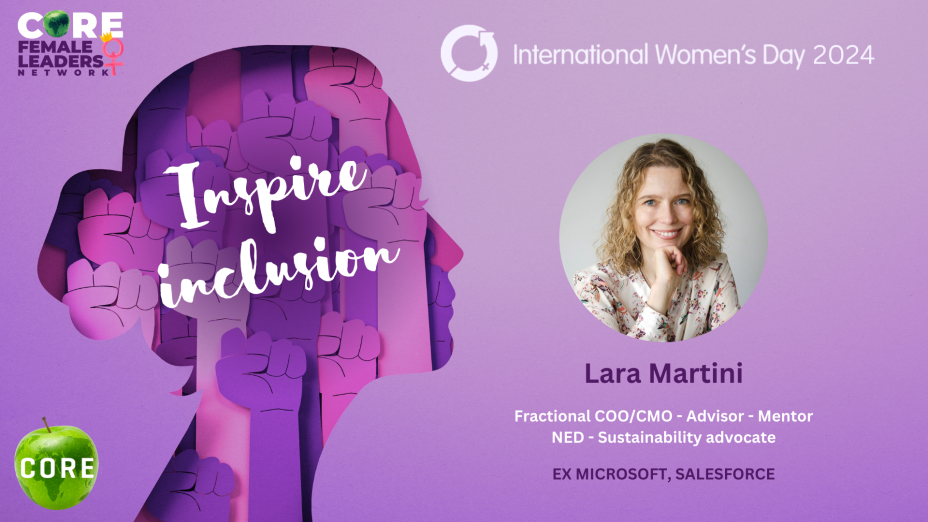
IWD 2024 - Lara Martini
A little about your career journey leading to where you are now.
I’m quite curious, like to think big picture, and to act when I see a need. I’ve been cleaning up beaches after an oil spill, coordinating volunteers during the COVID pandemic, and hosting refugees. The same values inspired my career.
I’ve joined Microsoft after graduating in Communications, as I saw the opportunity for technology to really improve lives and create opportunities, especially in emerging markets. I’ve stayed in the company nearly 20 years. Staying on gave me the ability to move geographically, leaving Italy for France, then Istanbul, global roles, Brazil, and the US. In parallel, I also shifted functions from marketing to strategy, sales, and operations leadership roles. Microsoft was followed by Salesforce, another company with excellent values, where I led customer engagement and later internal enablement for EMEA.
In both companies, I was fortunate to work with excellent people, build long lasting friendships and connections, and keep learning, including an MBA.
In parallel, I started teaching, mentoring social entrepreneurs, and took on a first Board role. A few years ago, I decided to bring together my personal passion for the environment – I’m a sailor and manage a woodland – and my work. To prepare, I went back to studying, at Cambridge among others, and had some serious discussions at home and with mentors.
I’ve now added a few more Board roles, focusing on sectors such as the built environment, where social and environmental issues intersect. I’m also a mentor and advisor, and work as a fractional executive with some brilliant green-tech and ed-tech businesses.
Freelancing is fantastic, because you really get to dive deep into different businesses, work with exceptional people, learn and add value every day.
What inspired you to pursue a leadership role?
It’s the ability to make a difference. There’s an African proverb “if you want to go fast, go alone. If you want to go far, go together”. I find working with people more rewarding than alone, and the opportunity to lead – whether managing people whether directly or indirectly, is a privilege. Learning always goes both ways, regardless of hierarchy, and it makes me happy when I can look back and see a team has achieved more than we thought possible, or to have been able to inspire or open doors for others.
What is or are your biggest career achievements?
I can think of a lot of individual situations – being recognised as business unit of the year, beating growth targets, developing a new business, successful mergers… but I think the most meaningful for me is to have hired and developed good people who are now excellent business leaders themselves, and still friends. And, personally, to have been able to flex a few times, leading very different businesses, global teams, and now shifting from a corporate career to freelancing and supporting entrepreneurs. I’m very proud of being able to add value in different settings and keep adapting, learning, and experiencing new things.
How did you develop your leadership skills?
I had some great managers, especially early in my career at Microsoft, who were excellent role models. The rest is a bit of reflection, a bit of MBA discussions, and a lot on the job – listening to my team members and to feedback and seeing what works. Not everyone is the same. Managing a team in France isn’t the same as in Brazil, Turkey, or the UK. Junior people need different guidance than experienced hires and taking the leadership of an established team much more complex than hiring. So, it’s about listening to each team and team member, having good mentors to turn to for situational advice.
How do you define your leadership style?
I enjoy seeing others grow and building long term connections – I’m still in touch with many people I hired and feel happy every time I see them grow and flourish. For me, these relationships are built on trust, but also on keeping people accountable to be their best selves, by removing barriers, allowing responsible risk taking, and understanding what motivates each individual and what support they need. I don’t believe in star-shaped teams where everyone refers to the manager. I like teams that bring complementarities and where everyone learns and collaborates. My role is to build teams that can thrive without me, and where everyone keeps learning.
What’s the most important leadership lesson you’ve learned?
I’ll go with two. The first is to allow your team members to try new things. I like to encourage my team to be prepared and show conviction in their proposal and when they do, allow them to move forward. Even if I’m personally not fully on board. It allows the team to grow, take calculated risks to innovate, and has given space for some excellent ideas to take shape.
Connected to it, I believe a leader should always offer their trust first. When you see the best in your team members, you allow them to thrive and do their best work. Trust sets in motion a positive reinforcement virtuous loop – and allows bad news to travel and be sorted fast, if there are any.
Have you achieved everything you wanted in your career so far?
Thankfully not! It’s a moving goal post. As a student, I set out to become a marketing leader in an international company. As I was making my way there, which I did, I grew interested in strategy and operations, which became my next move as Senior Director at Salesforce. In parallel, I discovered the world of social entrepreneurship, and from joining an accelerator to advisor roles, became more and more involved. Little by little, corporate life shifted from the only woman and the youngest in the room, to being a leader. And that’s when I moved into Non-Executive Board Roles, where I’m often the youngest. I also went back to studying again – an MBA, then sustainable investing with the CFA, and a stay at CISL in Cambridge. Interests change, but I’m hoping on a long journey still.
How important is personal development to your success, and how do you approach it?
I’m very curious and it has served me well, you can learn from very disparate disciplines and see the connection or look at things from different angles. Every year, I also set aside some time and investment to learn. I try and assess what I will need to stay relevant in my role and dedicate at least a few hours a week to those. Then, any skills I need to develop or prove for career growth, such as a new formal course. And at least one topic that’s not related to work or not now. I also believe in learning with and from others – from job shadowing someone to learning together as a work team, or as a family.
How do you prioritise tasks when everything feels like a priority?
The Eisenhower matrix is a classic, and always works. It also helps to sop regularly for a few minutes, maybe at the beginning of the week and of each day, and list what you really want to get done that day. Then allow some flexible time for any last-minute urgencies, a personal call, or chatting with a colleague. Important things, both at work and at home – including time to think and exercise - should be in your calendar. I work across multiple projects and companies, so being able to give them full attention is important. It means setting expectations right and knowing what I’ll be working on when.
What was the hardest decision you have taken as a leader?
There are so many. Most are trade-offs – what are you giving up, to do something different? During the 2008 financial crisis, I cancelled all marketing activities for my business unit to allocate the remaining budget to customer projects, allowing our channel partners to maintain their teams and a level of income, and ensuring customer adoption. It allowed us to achieve best growth worldwide in the two subsequent years. But it wasn’t as easy as it seems in hindsight, and it was done in alignment with the team and all key stakeholders. People decisions – whom to hire, letting go – are also never easy and must be done thoughtfully.
What steps do you take to measure your own performance?
That’s a great question, especially when you’re freelancing. First, I like to ask for feedback – for instance, ask my customers and mentees what they found most useful, and anything different they would like. Those feedback loops are self-evident in a company environment and must be maintained. I also ask my mentors, people I trust want the best for me and can see whether I’m developing enough.
I like setting targets. You can’t know whether you hit the mark without any. I look for quantity, such as new customers, targets met, and so on, but also at quality. For instance, am I able to stay connected with people, and make time to learn and improve? How much of what I do is relevant, and am I spending too much time on things that are not relevant or could be done differently? Finally, I like to have a few longer-term indicators, such as doing things for the first time, adopting new practices, and so on.
What does success mean for you as a business leader?
For me, success equates to impact. Am I helping my customers and making a difference? Am I helping people grow? I’ve invested in the business of one of my old interns when she turned into an entrepreneur, am still friends with old colleagues, manages and some of my team members, and some of the companies or business practices I initiated are still around. That, for me, is success. When you see people thrive and build teams to the point you’re no longer necessary and can move on, because they can keep going without you. And, hopefully, when the world is a little better because of it.
What advice would you give to someone starting off their career as a future business leader?
Find your passion, but don’t be blindsided by it. Stay curious to opportunities and willing to explore, neither life nor careers are a straight line 😊 Try to always build solid relationships with the people around for, show you care, and focus on customer value and on helping and developing others as well as yourself.
Author
Date Published: 17th January 2024
