Lesbian Visibility Week 2023: Jane Grammer
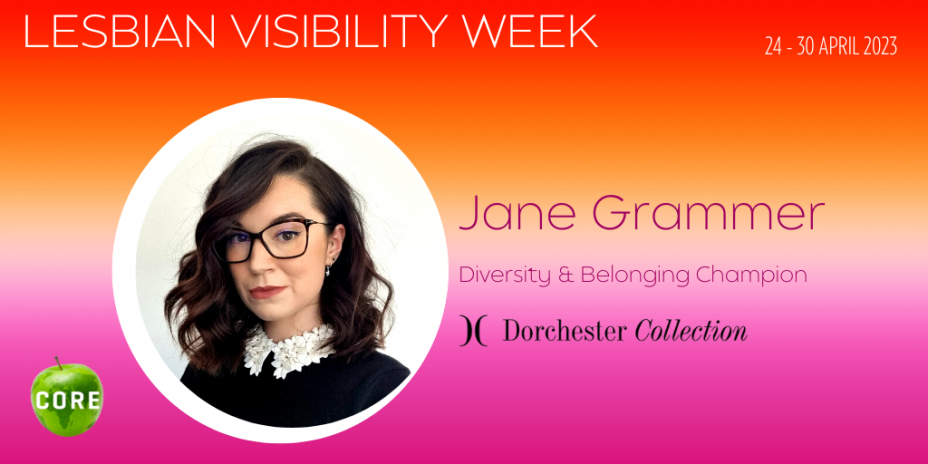
Jane Grammer
Diversity & Belonging Champion
Dorchester Collection
What does “being visible” mean to you?
For me, being visible means feeling safe to be open about by sexuality and who I am because it is accepted and celebrated. But it’s also about being believed, too. My bisexuality has been questioned and even denied by others - including friends - in the past because I didn’t “look bi” or because of my current and previous relationships with men. Even when I’ve opened up about my past relationships with women, I was told I was lying, “going through a phase”, “exploring” or doing it for attention which caused years of confusion, shame and guilt.
What are you expecting from this year’s lesbian visibility week?
For employers, increased awareness of the challenges LGBTQI+ women face, and practical steps organisations can take to support their LGBTQI+ women employees and customers. For the community, showing solidarity with all LGBTQI+ women and making it known that there is a large supportive community out there. For anyone who is questioning or struggling to come to terms with their identity I hope LVW helps them feel valid. I hope it also shows that safe spaces exist just for queer women where they will be accepted for who they are.
What are the key challenges LGBTQI women face today?
With all the anti-LGBTQI and anti-trans rhetoric and bills dominating the news over the past year, it’s feeling like a scary time to be an LGBTQI+ woman and non-binary person today. While progress is being made in some countries, it seems that others are becoming increasingly anti-LGBTQI+ after years of progress. I think the biggest challenge will always be stopping the spread of misinformation and stereotypes that are fuelling this wave of anti-LGBTQI+ efforts and continuing to make progress towards LGBTQI+ equality for all women and non-binary people. This is undoubtedly having a negative impact on peoples’ mental health. When mental health services are severely lacking in the UK on the NHS, getting access to affordable or free mental health services where medical professionals are qualified to treat LGBTQI+ patients is another challenge.
Additionally, I think starting a family is another big challenge for LGBTQI+ women and non-binary people. The adoption process can be challenging, the high cost of IVF makes it inaccessible if you aren’t eligible on the NHS and/or it’s not included in health insurance and surrogacy can be a very complex process.
What can organisations do to support Lesbian Visibility Week?
Listen to your LGBTQI+ women and non-binary employees. This is a really great opportunity for organisations to start having conversations with their LGBTQI+ women and non-binary employees to better understand the unique challenges they are experiencing, both at work and in their personal lives and what they can do to support them, whether that’s policy changes or additions to benefit packages. Every organisation is going to be in a unique place in their journey, so what one organisation does is going to be different to another, but no matter where you are, the most important thing you can do is listen, and act on the feedback you receive.
How important have queer role models been to you and did you have any growing up?
I didn’t really start questioning my sexuality until I was in university. In school, I thought some girls were pretty and I felt an attraction to them like I did with boys, but I thought that was normal for all girls. I eventually learned that wasn’t the case but because I was raised Catholic in rural Ireland where it wasn’t very accepting of the LGBTQI+ community, I never acted on those feelings. But I began to explore my sexuality in university which is when I first shared with someone that I thought I was bi. However, I promptly returned to the closet when they said I wasn’t actually bi and just experimenting. At the time, I felt very confused about my sexual identity and I felt a lot of shame too. I didn’t have any bi role models then but it was only when people like Kristen Stewart, Miley Cyrus and Cara Delevingne came out as bi or pan that I began to feel comfortable with my identity and felt normal.
Have you ever been treated differently at work because of your sexuality?
I haven’t but until I started my current role in September last year, I had never worked for an organisation where I felt comfortable being open about my sexuality. I’d experienced biphobia in my personal life so I was fearful of experiencing that at work also. I was afraid of both people scrutinising my sexual identity and feeling uncomfortable working with me. There was definitely some anxiety around conversations about the LGBTQI+ community at work in case I outed myself and I even completely denied my identity and told people I was straight which made me feel like I was lying to myself. Luckily, I work in a very LGBTQI+ inclusive organisation with many LGBTQI+ role models and allies at all levels so I feel very comfortable being open.
What would your advice be to other women who might be struggling to come to terms with their sexuality?
Based purely on my own experiences, trust yourself and your instincts. Try not to get too caught up in whether or not your sexuality fits into a neat box or matches how others describe their own identity. It can feel very validating to find a label that aligns with your sexual identity, but equally, it can feel isolating when you don’t. But just because you can’t find the right label, that doesn’t mean your sexual identity isn’t valid or real.
Author
Date Published: 24th April 2023
