
IWD 2025 - an interview with: Dr Awuese Oku
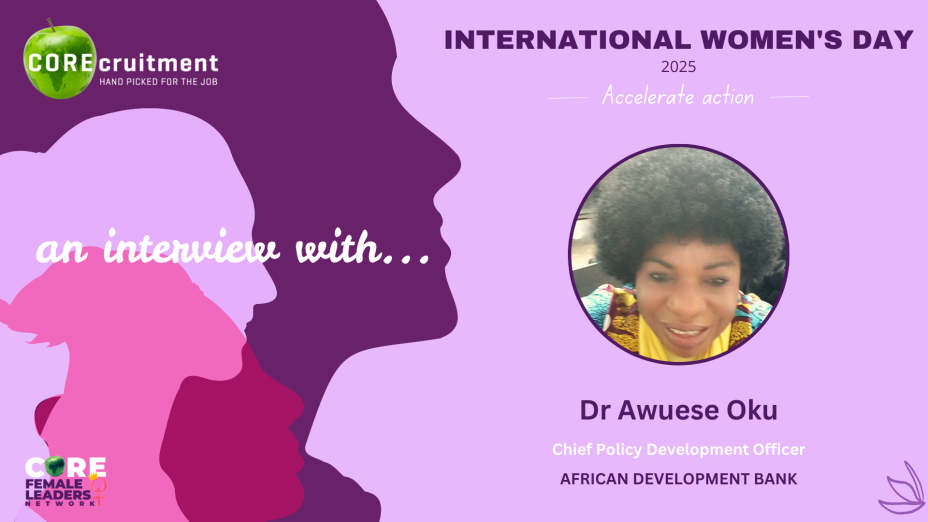
Tell us a little about your career journey leading to where you are now.
My career journey has been shaped by a blend of curiosity, persistence, and a deep commitment to growth. I started my career as a graduate Assistant at Ahmadu Bello University, Nigeria, and quickly learned the value of continuous learning. From there, I did a few career jumps before ending up in the development arena. Early in my development career, I was involved in a USAID/OTI project that worked in Sierra Leone after the war to reintegrate sex slave girls and boy soldiers into the community for purposes of reconciliation and nation-building. This project was very challenging; it exposed me to the depravity of gender and child exploitation. As a team leader on the project, my resilience was tested; however, it also forced me to think creatively about solutions. Over time, I was fortunate to be mentored by some amazing leaders who helped me hone my skills and navigate opportunities. After that, I had the opportunity to become the Operations Manager for the USAID/BASICSII Nigeria project, which I also doubled working in Arlington, Virginia. The project empowered community members to take an active role in improving the health of children in areas of immunization, nutrition, and malaria. One key moment in my journey was when Polio was finally kicked out of Nigeria. Further along the way of my career, I played an active role in the Management of the Millennium Development Villages. These experiences on the field shaped and solidified my commitment to working on enabling gender equality in society.
Gender equality enables Nations' development and economic prosperity and gets rid of deprivation. Today, I am in a position where I coordinate my organization’s internal gender compact and policies and mentor others. I am humbled by the path that my career has led me; from the University to Federal Ministry of Information Nigeria; Central Bank Nigeria, International Consulting, USAID, British Council, the UN System, ActionAID and now the African Development Bank. Along these paths, I have learnt lessons on empathic connections and management; but above all, I have learnt that a society with different levels of deprivation is stunted in growth.
What does the International Women’s Day slogan “accelerate action” mean for you?
“Accelerate action” is a call to move beyond discussion and into tangible, real-world change. For me, it means stepping up, not just by advocating for equality but by actively creating opportunities for others, particularly women, to succeed. One of the projects I designed. was implemented and was successful; the process is not found in any economic or investment textbook. USAID wanted to support women small and medium scale entrepreneurs as usual the target was women with bankable guarantees. The project was to set up a revolving support system where beneficiaries would pay back the resources advanced for others to benefit. I studied the document and communicated that this project, while good, will have limited impact if implemented as designed. The USAID director had a listening ear. She gave me the liberty of redesigning the proposal and submitting it. We worked with the market women’s associations and other community-based women's organizations to design the project. The target group was indigent women in the community with no bankable guarantees. The accountability of managing the project was entrusted into the hands of the Market Women’s Association. Not one woman defaulted. Almost 20 years later, this initiative is still ongoing. So, to me, accelerate action is supporting adaptable policies that promote gender equity, break down barriers in the workplace and the communities, offer mentorship to and open doors for younger women. It is about fostering meaningful and sustained change. This year, as we celebrate International Women’s Day, it is a reminder that while progress has been made, there are still a lot of glass ceilings to be broken, and we must all be catalysts for that change.
How important is it for women to lift each other up, and what does that mean to you?
Lifting each other is essential because it creates a strong, supportive community that empowers women to excel in ways that might otherwise seem impossible. When women support each other, it is not just about giving advice or sharing opportunities; it is about fostering an environment of collaboration and encouragement. To me, this means recognizing the unique strengths and talents that each woman brings to the table and offering guidance when needed. Whether it is offering a listening ear, advocating for another woman’s work, or helping to open doors, lifting each other creates a network of strength that can overcome any challenge. I think one skill that is prevalent in the boys’ club and that women must learn is the ability to close doors. In the boys’ club, rumors about a person get shut down immediately; the door closes, and everyone moves on. With us women, sometimes we fuel the rumors even when it relates to women that we have never had an interaction nor worked with. Women will progress more when we can act as door closers for others, especially when they are not at the table.
How important is diversity across senior leadership teams?
Diversity at Senior leadership levels is critical because it brings a variety of perspectives that ultimately lead to better decision-making. When leadership teams are diverse, they are better equipped to understand the needs of a wider range of customers, employees, and stakeholders. Diverse leadership also fosters innovation, as different backgrounds and experiences can spark creative solutions. Beyond the business benefits, diversity reflects fairness and equality, ensuring that leadership teams represent the communities they serve. It is not just the right thing to do, but it also makes good business sense. Organizations with diverse leadership are more likely to adapt and thrive in today’s global and dynamic landscape.
As a successful leader, how do you think (business) leaders can accelerate action toward closing the gender gap and ensuring equal opportunities in the workplace?
Business leaders can accelerate action by actively creating and supporting an inclusive culture that values diversity at all levels. This starts with setting clear goals and measuring progress, such as committing gender parity in hiring, promotions, and pay. Additionally, leaders should invest in mentorship programs where women are given the tools, networks, and support to thrive. It is also crucial to address unconscious bias in decision-making and ensure that policies and practices do not unintentionally disadvantage women. Leaders must model the behaviour they want to see, by example with inclusive leadership and actively encouraging a dialogue about equality. Lastly, ensuring equal access to training and development opportunities is key to leveling the playing field and enabling women to ascend to leadership roles.
Can you share your top tips for entrepreneurial/managerial/leadership success?
- Stay adaptable: The business world is constantly changing, so being able to pivot and embrace new ideas or approaches is critical for success.
- Lead with empathy: Understanding the needs, challenges, and strengths of your team fosters trust and collaboration. Empathy is a cornerstone of strong leadership.
- Never stop learning: Whether it is through formal education, Network activities, or simply staying curious, continuous learning enables a competitive edge that yields sustained growth.
- Build a strong network: Surround yourself with individuals who challenge you, support you, and provide diverse perspectives. A solid network assists navigation of tough decisions and provides the support needed in challenging times.
- Delegate effectively: No one is a super machine. Delegate effectively; this means delegating to people’s capabilities. You cannot request a very good driver to fly the company’s helicopter if he is not a licensed pilot. Trust your team and empower them to take ownership of their roles and turn in the required deliverables.
- Focus on the long-term vision: While it is easy to get caught up in short-term gains, always keep the bigger picture in mind. Sustainable success comes from strategic planning and resilience.
What’s the most important piece of advice you’d give to a woman thinking of starting a career at the leadership level?
The most important piece of advice is to believe in your worth and capabilities. There will be challenges, and sometimes doubt may creep in, but your value is not determined by others’ perceptions—it is defined by your skills, experience, and unique perspective. Build your confidence by seeking out mentors and peers who can guide and support you along the way. Have men in your ally ship. Network! Focus on developing a growth mindset, where failures are seen as learning opportunities, but remain committed to your goals. Lastly, take risks to advocate for yourself and other women. You deserve a seat at the table, and it is critical and crucial to carve out that space for yourself. Finally, have a faith anchor; you will need it.
Have there been any role models through your life (work or professional) who have helped shape you as a leader?
Absolutely. Throughout my career, I have been blessed to have several role models who have shaped my leadership style. One standout figure is Mrs. Maureen Akintayo, who was my principal at a consulting firm I worked with. At that time, not many Women owned and managed Consulting firms. Her ability to boldly enter and possess a good niche in what was the enclave of men with confidence and yet with humility had a resounding impact on me. She taught me the importance of leading by example, making tough decisions with integrity, and, most importantly, building a culture where people feel valued and heard. She mentored me and passed onto me the ability to lead with both strength and empathy. She taught me the importance of networking and always improving my knowledge. She used to tell me that today’s knowledge belongs to tomorrow’s archives, so study to show yourself approved; a workman that needs not to be ashamed when you know. She would say, “You cannot pitch to an aviation company if you do not know anything about planes”. So, I read everything from medical, financial, and investment journals to Mining booklets and everything in between. If it is printed material that is not profane, I read.
Another significant influence was the late Professor Joseph Mangut and Professor James Boachie-Ansah, who showed me the power of resilience and the importance of staying calm under pressure. Their guidance has shaped my understanding of leadership as something that involves inspiring and empowering others to reach their full potential.
Through the landscapes and seasons of life, I have been fortunate to have many mentors, some faith-based, who have invested their time, resources, and personal worth in me to enable my daily transformation. As I look back on this investment, I have taken up the mantle of coaching and mentoring the younger generation of people around me, hoping that they, too, will pay it forward someday.
Author
Date Published: 5th March 2025
