IWD 2026 - Interview with Izzy Curtis
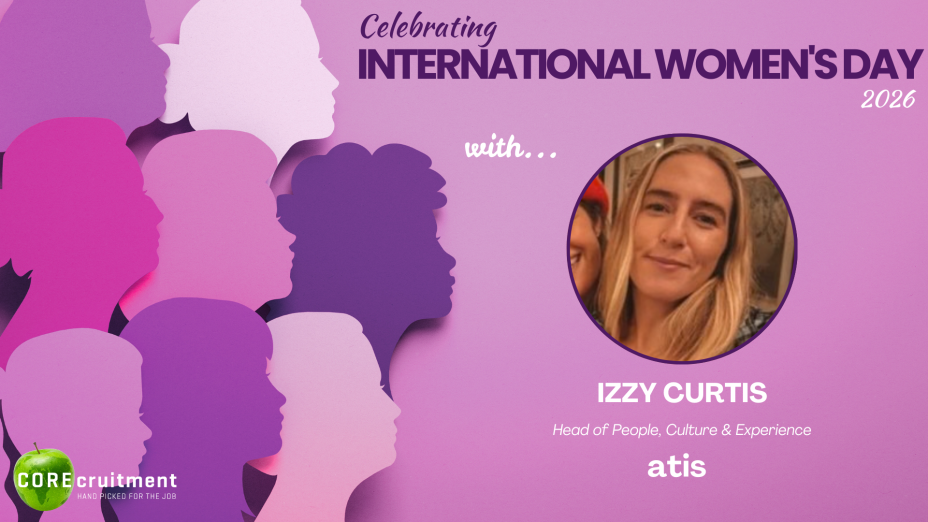
Our CORE International Women’s Day Interview Series tells the stories of leaders who lead with purpose, generosity, and impact.
In this interview, we are talking to Izzy Curtis, Head of People, Culture & Experience at atis
atis are a London-based healthy fast-casual food chain founded in 2019 specialising in premium salads and grain bowls made with seasonal ingredients. The brand focuses on fresh, customizable meals with proteins like chicken, salmon, and plant-based options, targeting office workers and health-conscious customers. It has grown rapidly across central London with sites in areas such as Soho, Covent Garden, and Liverpool Street.
Could you share a brief overview of yourself, your career journey and how it has brought you to your current role?
My route into hospitality was slightly unconventional. I studied Anthropology and Archaeology at university, and in my final year I specialised in the Anthropology of Food, writing my dissertation on how nostalgia and trust influence food systems.
That research sparked a fascination with not just what people eat, but why they eat it; the cultural, emotional and social dynamics behind food.
After university, I worked in a pub to save for culinary school, and from there moved through catering and casual dining before spending time in restaurant and hotel consultancy across India and Nepal. Those experiences gave me exposure to very different operating models, leadership styles and customer expectations.
I eventually found my home in QSR, where pace, people development and operational excellence intersect, and that’s what led me to atis. My current role allows me to combine commercial focus with culture-building, which has really been the thread throughout my career.
What does the International Women's Day slogan "give to gain" mean for you personally, and how does it translate into your approach to leadership?
When I first read “Give to Gain,” I immediately thought about ego, and how important it is not to let it shape how you lead.
Earlier in my career I learned that the moments where I stepped back and elevated others were the moments that built the strongest teams and the best culture.
If ego is driving your decisions, it becomes difficult to truly give, because you’re constantly filtering everything through “How does this benefit me?”
For me, leadership means asking a different question: “How does this benefit my team? How does this strengthen the wider business?” When you remove ego from the equation, you create space for trust, development and collaboration.
In my experience, when you invest in your people - whether that’s giving time, credit, opportunity or honest feedback - the return is exponential. Engagement improves, standards rise, and culture strengthens.
So, for me, “Give to Gain” is about servant leadership. When you focus on lifting others, everyone, including you, ultimately gains.
Workforce: 53.1%, Top Level Leadership: 28.8%, Gender Pay Gap: 20% Worldwide, (12% - 18% Europe & North America, 16%-19% UAE, 5% New Zealand…) What do these numbers represent to you?
The leadership figures are disappointing, but not surprising. I remember crying on holiday in my twenties while reading The Feminine Mystique by Betty Friedan, a second wave feminist seminal text, highlighting the unhappiness of housewives in the 1950s/60s. At the time I couldn't articulate why it affected me so deeply, but I can now. It’s because, seven decades on, equality for women in the workplace, and beyond, still isn’t where it should be.
Those statistics aren’t abstract. They represent missed opportunity, untapped talent, and systemic barriers that still exist.
Since my late twenties, I’ve consciously chosen to work for organisations where leadership is balanced and where strong female role models are visible. In a challenging job market, that can be difficult, but representation at the top shapes culture, progression, pay equity, and belonging.
I would encourage women, men and gender-diverse people in hospitality to actively seek out organisations where leadership reflects the diversity of the workforce. Change happens faster when we’re intentional about where we invest our talent.
What trends do you see shaping the future of leadership for women in business?
One of the biggest leadership challenges ahead will be how we respond to the rapid acceleration of AI and automation, and how we ensure people continue to feel relevant in a world where job security can feel increasingly fragile.
At the same time, we’re seeing an interesting social shift. Social media was designed to create connection, yet many people feel more disconnected than ever, with lives increasingly lived online rather than within communities.
I believe strong leadership in the future will focus heavily on rebuilding that sense of connection at work. Creating environments where people feel valued, relevant and part of something meaningful.
Many women leaders already bring a strong emphasis on empathy, collaboration and culture-building, and those qualities will become even more critical as organisations navigate technological change. The leaders who succeed will be the ones who can combine innovation with humanity.
As a successful leader, what is your top tip for fostering a workplace culture where employees feel encouraged to give feedback, share knowledge, and gain growth opportunities?
My top tip is simple: hire the right people.
At atis we were able to get remarkably far without a huge amount of formal “people” structure because we were extremely selective about who we hired and promoted into management roles. We prioritised people who were genuinely kind, honest and open communicators.
From day one our operational framework was strong, which meant we could give those leaders the support they needed to thrive and build strong teams around them.
As we’ve grown, we’ve reached the point where great culture can’t rely on instinct alone - it needs structure. That means clear development pathways, accessible feedback channels to senior leadership, both private and public, and regular opportunities for knowledge sharing through training and workshops.
When you combine the right people with the right structure, you create an environment where feedback feels safe and learning is constant.
What is one piece of advice you would give your younger self at the start of your career?
I’d probably give myself a few short, sharp pieces of advice.
First, don’t tolerate poor behaviour, particularly in environments where strong personalities can sometimes cross the line. Stand your ground. And if you need to go and have a cry in the loo afterwards, that’s absolutely fine!
Second, enjoy the fun parts of hospitality while you can. The late nights, the lock-ins, the brilliant people. Those moments build some of the strongest friendships of your career.
And finally, the fundamentals: work hard, be on time, ask lots of questions, and build relationships. Hospitality is an industry powered by people, and the connections you make early on will shape your entire career.
Author
Date Published: 5th March 2026
