IWD 2026 - interview with: Jude Hughes
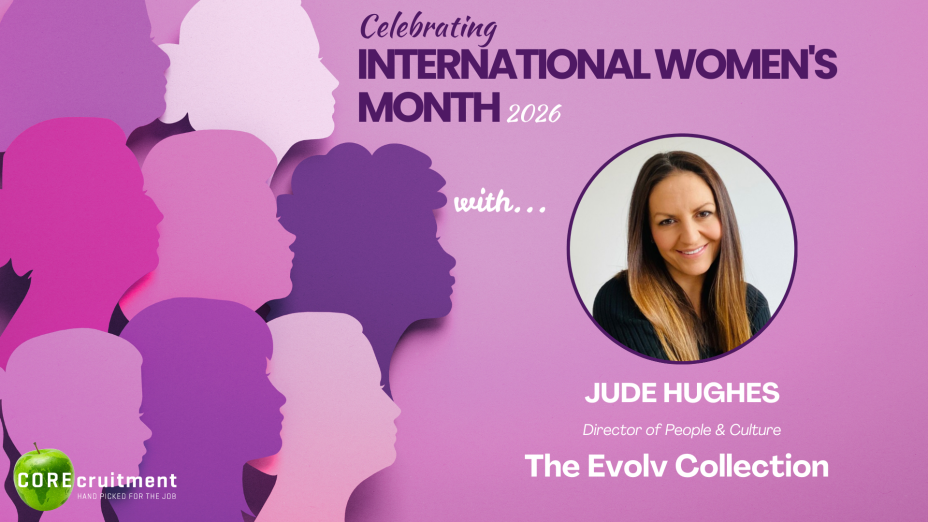
Our CORE International Women’s Day & Month Interview Series brings to light leaders who demonstrate how giving time, knowledge, and opportunity creates lasting impact.
We are talking here with Jude Hughes, Director of People & Culture at The Evolv Collection.
Could you share a brief overview of yourself, your career journey and how it has brought you to your current role?
My BA degree was in English and Sociology, but I was always interested in people – what drives behaviour, what builds culture, why some environments thrive and others don’t. After a painful couple of months in recruitment sales, I realised I was very bad at cold calling(!), I got my first role in HR at a distribution warehouse which I can politely say was a baptism of fire, but I loved it. I went on to complete my Master’s in HR Management.
The early part of my career with Aramark was incredibly formative. It was fast-paced, commercially driven and very operational - not “theoretical HR” at all. I was working across multi-site contracts like the BBC and Goldman Sachs, dealing with everything from TUPE transfers to union relationships to productivity models. It taught me quickly that if you can’t talk margin, risk and growth as confidently as you talk engagement and policy, you don’t get a seat at the table. That commercial grounding has shaped everything in my career since.
Moving into hospitality with D&D London was another step up. The sector is high pressure, people-heavy and brand-sensitive, and I found that environment really energising. I progressed from Senior People Partner to Head of People Operations, leading a team and influencing at board level. It was also where I became much more conscious of female leadership – not in a performative way, but in recognising the importance of visible, credible women in senior operational environments that have historically been male-dominated. I have been lucky enough to have worked for, and with, some inspirational women along the way.
I stepped into the Director of People & Culture role at Evolv Collection following a period of significant change (and a new company name). It feels like a natural culmination of the journey so far. I now sit at executive level, shaping the full people strategy for a premium hospitality group – everything from workforce planning and leadership development through to culture transformation and employer brand. It’s broader, more strategic and more future focused.
As a female leader, what’s mattered most to me isn’t just progression, but impact and proving that commercial acumen and people-first leadership aren’t mutually exclusive.
What does the International Women's Day slogan “give to gain" mean for you personally, and how does it translate into your approach to leadership?
For me, “give to gain” is quite simple - you don’t get strong teams, loyalty or performance by holding everything tightly to yourself or feeling threatened by high performance. You get it by investing in people first.
Throughout my career, especially in hospitality which can be pretty high-pressure and operationally intense, I’ve seen that when you give your time, your trust and your honesty, you gain credibility and followership. When you give clarity, people give you performance. When you give development and stretch opportunities, you gain capability and succession. It’s not fluffy HR – it just makes commercial sense.
As a female leader, it also resonates on a different level. Early in my career, the people who gave me exposure to the right conversations, who backed me in difficult employee relations cases, or who trusted me with big transformation projects – they accelerated my growth massively. That’s stayed with me.
I am conscious if this in my leadership approach now, I’m deliberate about giving visibility and opportunity, to give colleagues the opportunity to join conversations they might not normally be in. What you gain back is a more confident leadership pipeline, better decisions because more voices are at the table, and a culture where people don’t feel they have to fight to be heard.
How important is it for you to actively sponsor (not just mentor) each other, and what does that active support look like in practice?
It’s important to be clear on the distinction between mentoring and sponsoring. Mentoring is advice. Sponsorship is advocacy.
I’ve had mentors throughout my career who’ve helped me think things through, build confidence and navigate difficult situations. That’s valuable. But the moments that really shifted my trajectory were when someone senior said, ‘I’ll put her forward’ in a room I wasn’t in. That’s sponsorship and influence being used on your behalf, by someone who has your back.
As a female leader in hospitality, I think active sponsorship is critical because talent doesn’t always self-promote – and women in particular are too good at being modest, and not always visible. If we don’t actively pull each other into the right spaces, the same voices keep dominating.
In practice, for me, active sponsorship looks like a few very deliberate things:
- recommending someone for a stretch role or project before they ask for it.
- naming them in succession conversations and backing that up with evidence.
- challenging assumptions if someone is overlooked because they’re ‘not ready’ – and most importantly asking what development would make them ready.
- giving very direct feedback so they’re truly prepared when the opportunity lands, even when it is a challenging conversation.
Commercially, it makes sense. When you actively sponsor high-potential women, you strengthen your leadership bench, improve decision-making diversity and build a culture where progression feels achievable. That has a tangible impact on retention and performance. It’s part of our job.
Can you share a specific instance where you have given your time, resources, or influence to help other women advance in their career, and what you "gained" from that experience
One example that really stands out actually links back to my MA dissertation, as it focused on the glass ceiling at Executive level – and specifically why, in functions like HR where the workforce is predominantly female, the very top roles were still disproportionately male at the time. I explored the structural barriers, but also the quieter pressures: confidence gaps, sponsorship gaps, and the very real impact that pregnancy and motherhood can have on perceived ambition.
That research stayed with me – and then I lived it myself. I have two young children, and I’ve navigated senior roles while being a full time, working mum. I understand the invisible pressure: the guilt, the logistical juggle, and the well documented societal expectation to work like we don’t have children, and parent like we don’t have jobs. The mental load can be exhausting.
At Evolv Collection, I am committed to creating a culture where flexibility is accessible for all – mums and dads alike. We focus on output, support our people with empathetic managers, and ensure policies reflect real-life needs, so everyone can thrive both at work and at home.
I am also very open with my colleagues about my own challenges of balancing senior leadership and being a mum, because sometimes what women need is solidarity and proof that it’s possible, albeit not perfect.
Today, over 50% of the Evolv Exec team are female. That didn’t happen accidentally. It’s the result of being intentional about pipeline, visibility and sponsorship. We have a culture where ambitious women don’t feel they have to choose between credibility and family. Personally, I gained a sense of alignment. The values I wrote about academically many moons ago, are now embedded in how I lead.
I genuinely believe attitude and determination matter enormously. Talent is everywhere, but when you combine determination with the right support and someone willing to open the door, progression accelerates.
What trends do you see shaping the future of leadership for women in business?
Looking ahead, a few big trends are really shaping what leadership looks like for women in business, and hospitality right now.
One is DEI and inclusion work. We all know the term has become controversial in the US, causing some companies to rethink or rebrand their programmes, and even attract regulatory scrutiny. However, in the UK a lot of employees, and women in particular, still see DEI as important and organisations continue to value the outcomes, even if the language shifts.
Also, health and life-stage support are becoming a workplace issue, not just a personal one. Things like perimenopause and menopause are finally out in the open in discussions about talent retention and performance. Supporting women through those transitions with practical flexibility and benefits is going to be a differentiator in keeping respected and experienced leaders in the workplace.
As a successful leader, what is your top tip for fostering a workplace culture where employees feel encouraged to give feedback, share knowledge, and gain growth opportunities?
Build a culture where people feel safe but also stretched. That starts with finding your professional tribe.
I genuinely believe that when you’re surrounded by peers and a team you wholly respect and trust then everything becomes easier. When there’s mutual respect, honest feedback isn’t threatening. It’s developmental, and it’s a sign that someone is invested in you.
Transparency at leadership level is crucial. If I expect my team to be open, I have to model it. That means asking for feedback and not getting defensive. Admitting when I’ve got something wrong. Sharing context around decisions so people understand the ‘why’. It is a real frustration when I see meeting minutes or presentations saying: ‘because the CEO or HR says we have to...’!
Finding your tribe also means being intentional about who you build around you. I’ve always tried to create teams where there’s high trust and high standards. You can disagree robustly, but you leave the room aligned. That’s when growth really happens, when people feel supported, even when they’re being challenged.
So, my advice would be to build a team you respect, create psychological safety without lowering the bar, and normalise honest conversations.
What is one piece of advice you would give your younger self at the start of your career?
Very simply, you don’t have to be liked by everyone to be successful.
Early on, like many women in the workplace, I was so focused on pleasing people – saying yes, smoothing edges, avoiding conflict – that I sometimes lost sight of what actually mattered. I thought being agreeable was the same as being valuable. It isn’t. What truly builds a lasting career is credibility and trust. The people who matter most, respect clarity, consistency, and integrity far more than constant accommodation.
I would tell my younger self that it’s ok to set boundaries. It’s ok to have an opinion. It’s ok if not everyone warms to you. Trying to be universally liked is exhausting and ultimately limiting. Focus instead on doing excellent work, communicating honestly, and following through on stated intentions. Reputation is built on reliability, not approval.
I’d also say to stop overthinking. Work is important, but it is not the entirety of life. Not every email needs to be perfect. Not every meeting defines your trajectory. Try new things. Take measured risks. Stretch beyond what feels comfortable.
And most importantly – remember that life is bigger than your job. Having a family has kept me grounded in what truly matters: perspective, gratitude, and presence. Careers evolve and job titles change. Life is transient and far shorter than we imagine.
Do meaningful work but enjoy the journey. Invest in relationships but be brave enough to grow. And don’t forget to have fun along the way!
Author
Date Published: 17th March 2026
