
IWD 2026 - interview with: Ratti Dujda
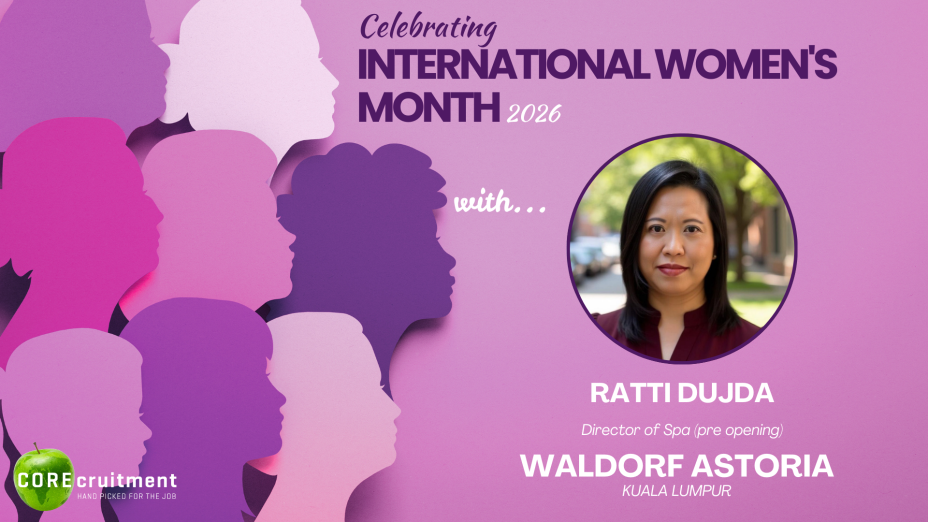
Our CORE International Women’s Day Interview Series curate perspectives from leaders who understand that progress is built through shared success.
Here, we speak to Ratti Dujda, Director of Spa (Pre-opening) – Waldrof Astoria Kuala Lumpur
What do you see as the biggest challenges currently facing the landscape, and how should businesses respond?
One of the biggest challenges in the industry right now is pressure - financial pressure, operational pressure, and pressure on people. Guest expectations continue to rise, while teams are often expected to deliver more with fewer resources.
From my experience working on various spa pre-openings, I have learned that when leaders respond by tightening control or pushing harder, the long-term cost is high. What works is the opposite approach: giving teams clarity, realistic structures, and the right level of support from the beginning.
When you give people clear direction and the tools to succeed, you gain consistency, confidence, and stronger results. That balance is what allows businesses to remain resilient in difficult environments.
What will distinguish leading service providers over the next decade?
The service providers who stand out in the next decade will be those who understand that meaningful experiences are created through intention, not excess.
In luxury wellness, this means giving guests experiences that feel authentic, calm, and relevant rather than overwhelming. It also means giving teams space to connect with guests rather than rushing them through rigid processes.
When organisations give thought to simplicity, sustainability, and cultural sensitivity, they gain trust and loyalty from both guests and employees. That trust will be a defining advantage moving forward.
What skills or mindsets will be most important for the next generation of hospitality leaders?
The most important mindset will be adaptability, supported by emotional intelligence. Leaders need to be comfortable navigating uncertainty while remaining present and composed.
Hospitality is built on human connection. When leaders give time to listen, to understand different perspectives, and to communicate clearly, they gain stronger alignment and more engaged teams.
Having progressed from frontline roles to director level, I have seen how powerful it is when leaders remain open and curious. Giving yourself permission to keep learning allows you to grow alongside your teams.
How do you balance commercial performance with staff wellbeing and culture?
I do not believe commercial success and wellbeing are separate goals. In reality, one depends on the other.
In pre-opening environments, I focus on giving teams strong foundations, such as clear SOPs, achievable targets, and proper onboarding. This reduces anxiety and creates confidence early on.
When you give people structure and support, you gain stability, better retention, and higher service standards. A healthy culture is not something you add later; it’s something you build from day one.
What innovations excite you most right now?
I am most interested in innovations that give teams time back whether through better systems, improved workflows, or clearer communication.
Technology that supports training, scheduling, or guest flow allows teams to focus on what really matters: delivering thoughtful, personal service.
Experientially, I am drawn to wellness concepts that give guests space to slow down and reconnect. When experiences are designed with intention, both guests and teams gain a deeper sense of purpose.
What does “Give to Gain” mean to you personally as a leader?
For me, “Give to Gain” is about understanding that leadership is an exchange, not a position.
Throughout my career, especially during pre-openings, I have seen that when you give people your time, trust, and patience, you gain commitment, accountability, and pride in their work.
By giving guidance rather than control, and support rather than pressure, teams feel empowered. The result is a healthier working environment and stronger performance over time.
How important is sponsorship compared to mentorship?
Mentorship offers advice, but sponsorship requires action. Sponsorship means giving someone visibility, opportunity, and belief. Often before they fully believe in themselves.
When leaders give their influence in this way, they gain stronger succession, deeper loyalty, and more confident future leaders.
This kind of support is especially important for women in leadership, where opportunity often matters more than encouragement alone.
Can you share an example of giving your time or influence, and what you gained from it?
During several pre-opening projects, I worked closely with team members who were stepping into leadership roles for the first time. I gave them time, space to make decisions, and support when things did not go perfectly.
What I gained was a more capable and confident team, and an operation that ran more smoothly because responsibility was shared rather than concentrated.
Giving trust created ownership and ownership always leads to better outcomes.
What legacy do you hope to leave for the next generation of women leaders?
I hope to show that leadership doesn’t require sacrificing empathy, authenticity, or yourself in the process.
Too often in our industry, dedication is measured by how much we give up our time, our boundaries, even our sense of self. I do not believe work should consume who we are or become our entire identity.
If future women leaders feel able to lead in a way that feels honest, setting clear boundaries, offering care without self-neglect, and knowing when to step back, they will gain confidence, longevity, and real influence.
That balance is what sustains people, teams, and ultimately the industry itself.
Author
Date Published: 18th March 2026
