IWD 2026 - Interview with Zoe Holland
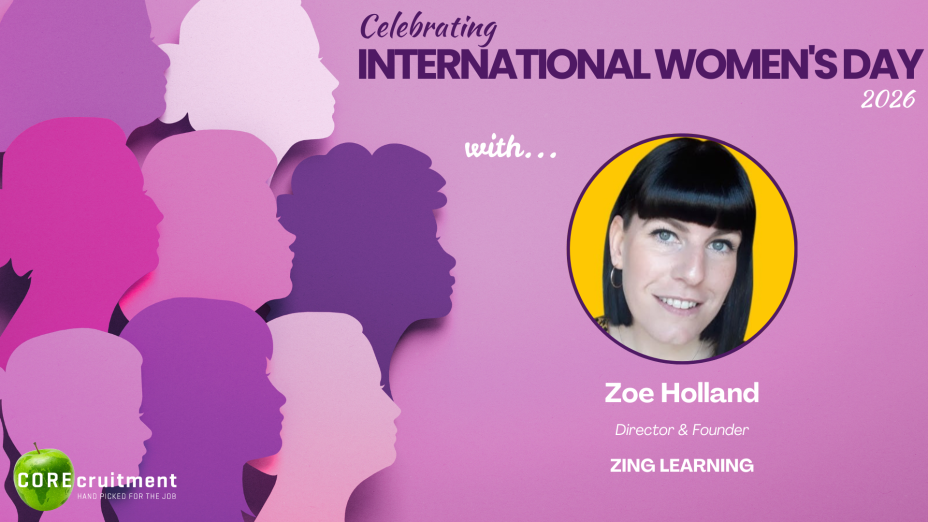
- Our CORE International Women’s Day Interview Series reflects the “give to gain” mindset by amplifying leaders who lift others as they rise.
- in this interview, we speak to Zoe Holland, Director & Founder - ZING LEARNING.
Could you share a brief overview of yourself, your career journey and how it has brought you to your current role?
I'm Zoe Holland, the founder of Zing Learning, an organisational development consultancy that focuses on transforming culture, enhancing leadership, and embedding inclusion. I didn't start my career in some fancy corporate graduate programme. Instead, I began in hospitality, working my way up from waitress to general manager, then to Head of HR, and eventually moving into learning and diversity, equity and inclusion. That journey taught me a lot about people, pressure, and what truly makes teams work.
Those years on the front line gave me firsthand insight into human behaviour, motivation, and workplace culture—more than any textbook ever could. I saw directly how leadership plays out in real life, not just in theory, and how small changes in how you treat people can drastically improve performance and well-being.
Now, almost twenty years later, I've had the privilege of working with fantastic organisations like Google and ITV. Throughout it all, my goal has stayed the same: to help organisations create truly inclusive workplaces where everyone can thrive. And I love that I get to do work that genuinely makes a difference in people’s lives.
What does the International Women's Day slogan "give to gain" mean for you personally, and how does it translate into your approach to leadership?
It resonates deeply for me, though I'll be honest – I've always been a bit suspicious of transactional framing when it comes to supporting others. You shouldn't help people because you'll get something back; you should help people because it's the right thing to do.
That said, what I've learned (often the hard way) is that when you genuinely invest in others' success, the gains are inevitable but often unexpected. I've given hours of free advice, made introductions, championed people I believed in, and what I've "gained" isn't a neat ROI calculation. It's a network of brilliant people I trust, a reputation built on integrity, and honestly? The knowledge that I'm part of something bigger than my own success.
In my leadership approach, this translates to radical generosity with knowledge and opportunities. I don't hoard information or contacts. If I can open a door for someone, I will. And that abundance mindset has built a business (and a person – me) that people actually want to work with.
How important is it for you to actively sponsor (not just mentor) each other, and what does that active support look like in practice?
I think women often get more mentorship than sponsorship, and that's not a coincidence. It's easier for people in power to have friendly chats about your "growth areas" rather than actually advocating for you behind closed doors. For me, active sponsorship means recommending women for speaking gigs I could have taken myself, introducing talented women to my network with a clear "you should work with her," calling out organizations with all-male panels or leadership, using my platform to lift up other voices, and sometimes just saying in a meeting,
"Actually, Sarah just said that," when someone claims her idea. I've been lucky to have sponsors who've done this for me, and I believe it’s part of my job to do the same for others. Because the truth is, the system won't change if we all just mentor each other into accepting it as it is.
Can you share a specific instance where you have given your time, resources, or influence to help other women advance in their career, and what you "gained" from that experience?
Last year, I spent hours coaching this woman who was really talented at her job but kept getting passed over for promotions. She was doing that classic thing many of us do – working harder, being "helpful," and just waiting to be noticed. Meanwhile, some less qualified men were confidently asking for what they wanted.
I didn't just give her advice. I helped her redo her promotion pitch, practised tough conversations with her, and most importantly, I reached out to her CEO (someone I'd worked with before) to tell him that losing her would be a huge mistake. I put my reputation on the line for her skills.
She got the promotion, and I got lots out of it too - she's now in a position to support other women, her team’s more dynamic, and honestly? Seeing someone step into their power and realise their worth—that's not just a "win," it’s a real privilege. Plus, she sends me great wine at Christmas, so that’s a bonus.
Workforce: 53.1%, Top Level Leadership: 28.8%, Gender Pay Gap: 20% Worldwide, (12% - 18% Europe & North America, 16%-19% UAE, 5% New Zealand…) What do these numbers represent to you?
These numbers really show how systemic filtering works. Women make up just over half the workforce but somehow seem to disappear as you go up the ranks. It's almost like there's a pattern here.
What really gets me is that we've been talking about these stats for decades. We know the problem; we have the data. Yet year after year, organisations keep spinning the same tired "pipeline problem" excuse while doing little to actually break down the barriers women face.
These numbers reflect choices—organisational choices about who gets developed, sponsored, given the benefit of the doubt, and whose potential is recognised. They’re the result of thousands of micro-decisions made by people who probably see themselves as fair.
And the gender pay gap? That really grinds my gears because it's a clear sign of how differently we value women's work. And before anyone argues that women pick different careers, why are the careers women "choose" systematically paid less? Funny that.
These aren't just numbers. They're women's careers, earning potential, and retirement security. They're the difference between financial independence and vulnerability. So yeah, this is a problem we should’ve tackled yesterday.
What trends do you see shaping the future of leadership for women in business?
I'm noticing some interesting shifts lately! First off, there's a growing awareness that simply "fixing women" isn't the solution. The real future lies in fixing the systems. Organisations are slowly realising that telling women to "lean in" while keeping rules and structures built by and for men just doesn’t make sense. We're starting to see more approaches that look at the bigger picture, a broader view of gender equity, though putting these ideas into practice is still a work in progress.
Second, neuroinclusion is becoming a real gamechanger for leadership. As we learn more about neurodiversity, we're challenging old-school leadership models that favour certain communication styles and ways of working. This shift benefits everyone, but especially women who've been told they're "too much" or "not enough" their whole careers.
Third – and this part is pretty exciting but also a bit worrying — more women are saying "enough is enough" to traditional corporate structures and are starting their own businesses and networks. The pandemic sped up this trend. Women are creating new ideas of success that don't require giving up their lives or their identities.
But here's the reality check: backlash is real. As women make progress, resistance grows stronger. We're seeing efforts to roll back diversity, equity, and inclusion initiatives, and some are even trying to label equality work as "divisive." The cultural pushback against progress is definitely there. The next generation of women leaders will need to be strategic, tough, and refuse to accept crumbs as real progress.
As a successful leader, what is your top tip for fostering a workplace culture where employees feel encouraged to give feedback, share knowledge, and gain growth opportunities?
Stop saying you want feedback and then punishing people for giving it. I know that sounds harsh – but it's the most common issue I see. Leaders say they want honest feedback, then get defensive, make excuses, or worse, subtly retaliate. Employees aren't stupid – they notice.
If you genuinely want a culture of feedback and knowledge-sharing, you need to model vulnerability. That means:
Actually acknowledging when you get things wrong. Not in a performative "ooh, I'm so humble" way, but genuinely saying "I made a mistake, here's what I learned, here's what I'll do differently."
Responding to feedback with curiosity, not defensiveness. When someone gives you difficult feedback, your response should be "tell me more", not "let me explain why you're wrong."
Rewarding knowledge-sharing, not knowledge-hoarding. If your promotion criteria reward people who gate-keep information to make themselves indispensable, don't be surprised when that's what you get.
Creating actual psychological safety. This isn't about being nice. It's about making it genuinely safe to take interpersonal risks, challenge ideas (including yours), and admit uncertainty without career consequences.
Have you had mentors or role models who influenced your career? How did they help?
I tend not to know who the role models are until later. Sometimes it's the person who demonstrated incredible resilience. Sometimes it's the leader who admits they didn't have all the answers. Sometimes it's the person who called out problematic behaviour when it would have been easier to stay silent (seen far too many times in my work).
But my biggest influence? Sara Gomez, a director I worked under in retail. Sara didn't do any of that "be more like the men" nonsense or adopt aggressive posturing that people confuse with strong leadership.
She was warm, collaborative, brilliant at coaching – and her results were phenomenal. What she showed me was that all those supposedly "soft" skills – listening, building relationships, developing people – that's not fluffy stuff. That's the actual work of leadership.
What really stuck with me was watching her navigate male-dominated environments without ever pretending to be someone she wasn't. She stayed authentically her and made everyone around her better.
I've been lucky to work with other people like this over the years. People who've proved that collaboration isn't weakness and that caring about your team whilst holding high standards isn't contradictory – it's just good leadership.
What they've taught me is that we don't need to "fix" women to fit outdated leadership models. We need to fix the systems that undervalue the exact capabilities that make great leaders.
What legacy do you hope to leave for the next generation?
I want women to look back and think "Thank god we don't have to deal with that crap anymore."
I want the next generation to inherit a world where women don't have to choose between career and family – not because we've created some slightly better "female-friendly" policies, but because we've actually restructured how work works. Where neuroinclusion is just inclusion – we design organisations for different brains and ways of being instead of forcing everyone to mask and conform.
Where we've stopped making bloody "business cases" for treating half the population fairly because organisations have finally cottoned on that this shouldn't need justifying. And where leadership looks completely different – less command-and-control nonsense, more collaborative intelligence. Less "strong decisive leader who never shows weakness," more "capable human who builds brilliant teams."
But honestly? If my legacy is that I helped some women believe in their worth, challenged some systems that needed challenging, and made a few organisations genuinely better places to work – I'll take that. Grand legacies are overrated. Small, sustained impact adds up.
Also, I'd quite like to be remembered for calling out crap when I saw it. That is important to me.
What is one piece of advice you would give your younger self at the start of your career?
Stop waiting for permission.
Younger me spent so much time trying to be "ready enough," qualified enough, experienced enough. I waited to speak up because surely someone more senior had better insights. I didn't pitch for opportunities because I didn't tick every box in the job description. I made myself small and helpful and agreeable because I thought that's how you got ahead.
What I'd tell her now: Your perspective matters. Your experience in hospitality – dealing with actual humans in high-pressure situations – is as valuable as someone's MBA. When you have something to say, say it. When you see an opportunity, go for it. The worst they can say is no, and you're already telling yourself no, so what have you actually got to lose?
Also, the people who seem most confident? Half of them are winging it, too. They're just doing it louder.
And finally - build genuine relationships, not a network. The people you help without expecting anything back, the colleagues you celebrate, the connections made over honesty rather than transaction – those are the relationships that will sustain your career and your sanity.
Author
Date Published: 27th February 2026
