
Leadership Interview Series: Boyko Manev
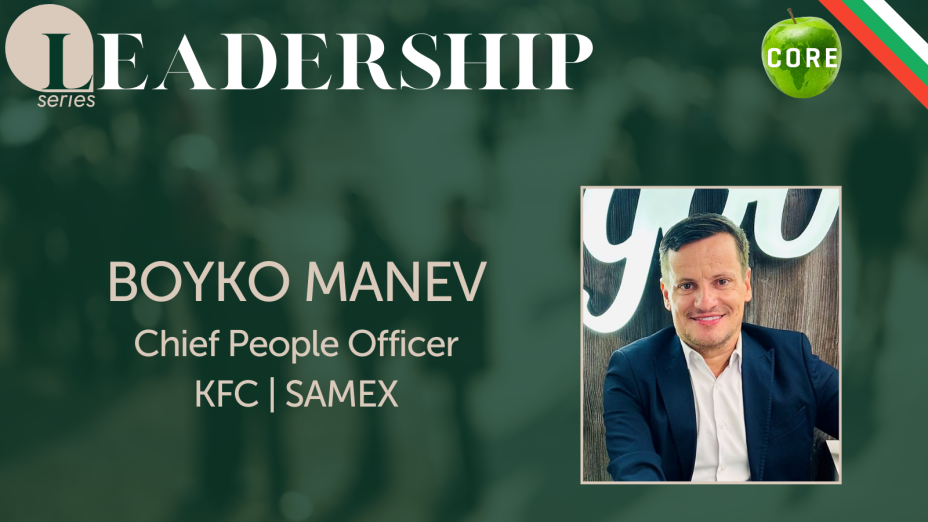
The CORE Leadership Series brings inspiring industry leaders to the forefront through meaningful, in-depth conversations
We are here speaking with Boyko Manev, Chief People Officer at KFC | SAMEX.
Tell us a little about yourself and your business.
I am a hospitality and quick-service restaurant professional with international experience across Europe, the US, and Asia. Currently, I serve as Chief People Officer for KFC | SAMEX in Bulgaria and for Radina Group Hotels, while also leading my own consulting business, Boyman Consulting.
Across all my roles, my focus is the same: building strong teams, scalable people systems, and leadership cultures that directly support business performance. I strongly believe that people strategy is not a support function — it is a growth driver.
What initially inspired you to pursue this career?
Hospitality is one of the few industries where you can see the direct impact of leadership on people and results every single day. Early in my career, I realized that great operations fail without great people — but great people can often compensate for imperfect systems.
That realization sparked my long-term interest in leadership, HR, and organizational development. I wanted to understand how to build environments where people perform, grow, and stay.
What motivates you in your work and what do you find most fulfilling about being a business leader?
What motivates me most is impact. Seeing people grow into leaders, teams stabilize under pressure, and businesses perform better because of strong people decisions is extremely fulfilling.
Leadership, for me, is about responsibility — not authority. When people succeed because you created the right conditions, that is real leadership.
What are the biggest challenges currently facing your industry, and how should businesses respond?
The biggest challenges are talent shortages, rising costs, and increasing pressure on margins — combined with higher expectations from both customers and employees.
Businesses must respond by becoming more disciplined and more human at the same time: investing in training, using data to make better decisions, and creating clear career paths. Short-term fixes no longer work; sustainability comes from systems and culture.
How do you stay updated on industry trends and changes?
I stay close to the business. I regularly engage with operations teams, leaders, and frontline employees. I also follow international hospitality and HR networks, industry reports, and professional communities.
Most importantly, I test ideas in real environments. Trends only matter if they work in practice.
Where should the most promising investments be focused?
People development, leadership capability, and technology that improves efficiency and transparency.
Training managers, building internal talent pipelines, and investing in systems that support decision-making deliver long-term returns far beyond any short-term cost savings.
What skills or mindsets will be most important for the next generation of hospitality leaders?
Adaptability, emotional intelligence, and strong execution skills.
Future leaders must be comfortable with change, able to lead diverse teams, and disciplined in turning strategy into daily action. Empathy without accountability — or accountability without empathy — will not work.
What are your biggest career achievements?
Leading people strategy for large, complex organizations across hospitality and QSR, while building teams that consistently deliver results.
Another important achievement is my book “If I can do it — you can do it too”, which has inspired many professionals to believe in their potential and take responsibility for their own growth.
What’s the most important leadership lesson you’ve learned?
Not every decision will make you popular — but every decision must be fair, transparent, and aligned with the business.
Leadership requires clarity and courage. Avoiding difficult decisions is often more damaging than making the wrong one.
Are you expecting consumer expectations to shift this year?
Yes. Consumers expect speed, consistency, value, and experience — all at once.
This puts pressure on operations, which is why well-trained teams and clear processes are more important than ever. Customer experience always starts with employee experience.
How do you balance commercial performance with staff well-being?
By treating well-being as a performance enabler, not a cost.
Clear expectations, proper staffing, training, and fair leadership reduce burnout and turnover. When people feel respected and supported, results follow naturally.
What has been the most pivotal moment in your career?
Working internationally early in my career was a turning point. It exposed me to different leadership styles, cultures, and standards — and taught me that there is no single “right” way to lead.
That experience shaped my belief in flexibility, learning, and constant self-development.
Who or what has influenced your leadership approach the most?
The leaders I worked with — both good and bad — and the teams I’ve led.
Every experience taught me something: what to repeat, what to avoid, and how leadership decisions affect real people.
What advice would you give emerging leaders?
Take responsibility early. Don’t wait for perfect conditions or titles.
Learn the business deeply, invest in people, and stay disciplined. Leadership is built through consistency, not moments. And most importantly — stay curious and humble.
Author
Date Published: 3rd January 2026
