
Leadership Interview Series: Patrick Shields
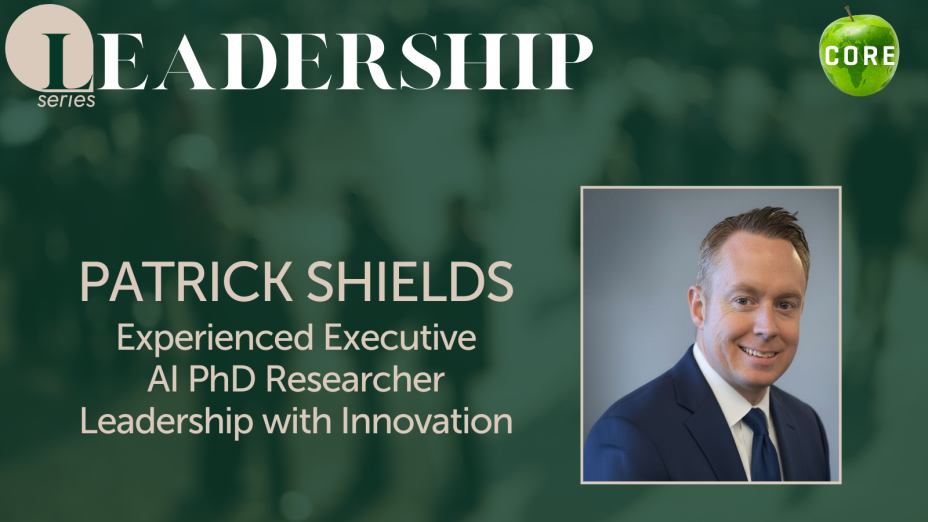
The CORE Leadership Series highlights outstanding industry leaders through insightful, in-depth interviews
We're talking to Patrick Sheilds, Experienced Executive and AI PhD Researcher - Leadership with Innovation
Could you briefly introduce yourself, your role, and your current focus within the hospitality landscape?
I’m an experienced Management Executive, having spent a number of years working in Ireland, the US, Canada and Australia, at senior operational and board level within independent and luxury hotel environments. Alongside this experience, I am currently completing a PhD focused on how organisations adopt Artificial Intelligence, with a particular emphasis on leadership, culture and people dynamics rather than the technology alone. My current concentration is on helping businesses of all types navigate change responsibly, balancing performance, people and long-term resilience. Since 2024 I have been a Director on the Board of Dungarvan and West Waterford Chamber, and I have been delighted to champion several initiatives in the last year where I have mentored individual members and delivered workshops and information sessions on all things AI. I am now entering the Research phase of my Doctoral work, which will involve structured engagement with senior management teams across hotels in Ireland over the coming year. The PhD that I have undertaken is a scholarship as part of Munster Technological University’s TU RISE program. The scholarship is co-funded by the Government of Ireland and the European Union through the ERDF Southern, Eastern & Midland Regional Programme 2021-27.
What is or are your biggest career achievement(s)?
I completed an internship in the United States for 18 months upon graduating from the Hospitality Management program at Munster Technological University (MTU) in 2004. The practical experience gained at a large resort hotel in the US gave me the confidence to set out to achieve a Hotel General Manager position of my own by the age of 30. I was delighted to achieve that objective in 2014 when I took the reins of the Talbot Hotel Midleton, a role I fulfilled for just under 4 years before deciding to travel to Canada. If I was to pick one industry highlight, it was being promoted to General Manager of Sutton Place Hotel at Revelstoke Mountain Resort, British Columbia in 2017 from the parent group’s Senior Management Development Program. More recently, leading high-pressure, high-standards hospitality teams at the very top end of the market for over 6 years has been a stand out. Overseeing operations which held multiple Michelin stars and a Michelin key over several years required consistency, judgement and trust at every level of the organisation. In early 2025, transitioning from full-time executive leadership into academia, while keeping connected with industry, has been a significant personal and professional milestone and I am very grateful for that opportunity.
Thinking about the (current) macro-economic and social environment (cost pressures, labour market, changing customer expectations, sustainability), what shifts do you believe will redefine “success” for our sector in the coming year or years?
Success is shifting from short-term performance toward organisational resilience. Cost pressures, labour challenges and changing guest expectations mean that leadership capability, decision-making quality and employee engagement are becoming competitive advantages. Businesses that can adapt quickly, communicate clearly, retain medium and long term team members and maintain trust internally will outperform those chasing growth without that foundation. The cost of doing business in Ireland for tight margin organisations like independent hotels is very challenging. Hotels and hospitality businesses will need to innovate to meet this challenge.
What innovations, technological, experiential, or operational, excite you the most right now?
Naturally, I’m particularly interested in how AI can support organisations through improved forecasting, planning, communication and decision support for managers. Equally important are the quieter operational innovations of clearer governance, better role design and more intentional leadership development. These often deliver more impact than headline technology alone. I engage with businesses constantly about this topic and have been asked to speak to teams about how this transition works in reality. It is very important hospitality businesses start having these conversations with their employees and leaders as there’s no benefit in waiting for this technological change to develop further. It’s here and it’s in everybody’s pocket, how it’s being used needs governance, policy and guardrails.
Where do you think the most promising investments should be focused on and/or made on?
People and leadership capability. That includes management training, decision frameworks and systems that reduce cognitive overload for teams, which can be a common issue within independent hospitality businesses. AI technology should be an enabler, not a distraction. Technological investments that improve clarity, accountability and consistency will deliver returns long after the initial spend. This needs to be rolled out with clarity and vision from leadership. It also needs to be taken as seriously by leaders as all other business KPIs. Effective Strategy, policy, induction, training & development for AI and technology are becoming non negotiables in this space. It doesn’t have to start off as complicated.
How do you balance the demands of commercial performance with staff well-being, retention, and culture building?
By recognising that they are not competing objectives. Sustainable financial performance depends on trust, fair remuneration, psychological safety and clarity of expectations. In my experience, when people feel supported and understand the “why” behind decisions, performance follows. I have always found it helpful to share high level business performance results with teams I’ve worked with. It’s understandable if family owned and independent businesses do not wish to share even high level figures for privacy reasons however, I feel that when your employees understand they real “why” behind revenues and costs it can only be helpful in aligning everyone with business objectives, as leadership seeks momentum and performance.
What skills or mindsets do you think will be most important for the next generation of hospitality leaders?
Judgement, adaptability and emotional intelligence. Someone once said, in senior leadership, particularly if you are the person responsible for that business, you are being paid by owners, not for your ability to read a spreadsheet, but for your judgement. Taking a step back, assessing situations from multiple angles or perspectives and taking your time over decisions where possible can assist in this greatly. Future leaders must be comfortable operating with uncertainty, making decisions with imperfect information and leading diverse teams through ongoing change. One might say I was either fortunate or unfortunate to grow a career in management at the time of the last major recession of 2008 to approximately 2012. I believe that time developed a certain capacity in a lot of up-and-coming managers to deal with change effectively, as we had no choice in the matter. I’ve always felt awareness is a very important element of intelligence. Technical competence matters, but mindset and self-awareness matter more.
How do you prioritize tasks when everything feels like a priority?
I focus on impact and consequence. That lens helps keep the focus on what genuinely moves the needle. It can take a long time to learn the art of delegation and young managers in particular may feel that the most effective way is to take everything on their own shoulders. It is vital to the success of your organisation, and to themselves, that they can effectively delegate and allow teams to support the operation, be empowered and grow in their own careers.
In a practical sense I always found it useful to prepare for the next day the night before by clearing emails, getting admin tasks completed and getting ahead on certain projects where possible. I wanted to be free to be visible and supportive of the team. Admin can’t be allowed to take away from that time, particularly in hospitality.
Who or what has had a major influence on your approach to leadership?
I’ve learned from every General Manager (GM) and Leader I’ve ever worked for. As it was my aim to achieve a GM role when I graduated, and due to my own keen interest in behavioural management, I was always looking for hints about what made those individuals effective. I was advised early in my career not to stay too long in any one hotel as my career progressed. Through travel and working with different people, I learned a huge amount about different leadership styles and managing through different circumstances. It certainly broadens the horizons as well as personal operational experience which is vital in hospitality management.
Looking back, what has been the most pivotal moment in your career, a turning point that shaped how you lead today?
Stepping into Doctoral research is certainly a significant turning point. I feel very blessed to be in this position. It comes at the perfect time in my life as I seek to achieve new objectives after a satisfying 20+ years in hospitality operations. I have a lot of study to do yet but having one year under my built at MTU is pleasing and I have been supported fantastically well by my Supervisors Dr. Angela Wright and Dr. Breda O’Dwyer as well as the Department of Organisation and Professional Development and wider MTU network. I came back to MTU part time in 2020, during covid, to complete a Masters in Strategy. I was the only student from the Hospitality industry in the course at the time and working alongside people from Pharma, Tech and IT brought me out of my comfort zone and broadened my leadership understanding. I’m very much enjoying my current research and look forward the future. I would be delighted to connect with anyone interested in this space https://www.linkedin.com/in/patrickjohnshields/
Author
Date Published: 7th January 2026
