
Leadership interview series: Wassim Ghaida
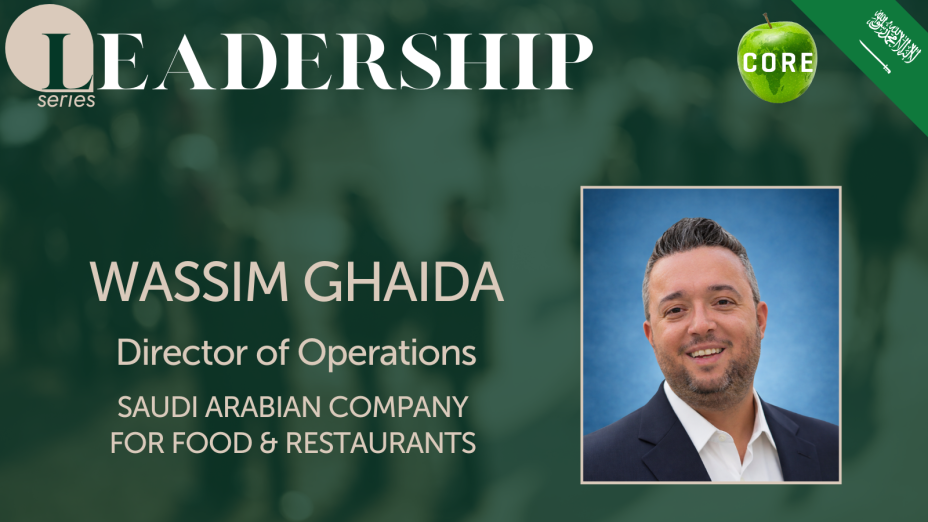
Our CORE Leadership Series gives a voice to exceptional leaders shaping the industry today
In this interview, we speak to Wassim Ghaida, Director of Operations at The Saudi Arabian Company for Food and Restaurants.
Tell us a little about yourself and your business.
Wassim Ghaida, Director of Operations at The Saudi Arabian Company for Food and Restaurants (a member of Al-Yemni Group). I oversee the Caribou Coffee franchise throughout the Kingdom of Saudi Arabia.
In addition to leading one of the region’s most recognised coffee brands, I am actively driving the development of multiple homegrown concepts and spearheading two B2B ventures, contributing to the Group’s continued expansion and innovation within the hospitality sector.
What initially inspired you or sparked your interest in pursuing this career?
What initially drew me to this career was the unique intersection of people, experience, and business. Hospitality isn’t just about products or transactions—it’s about creating moments that stay with people. Early on, I was inspired by how a well-run brand could build loyalty through consistency, culture, and genuine human connection.
As my career evolved, I became increasingly motivated by the challenge of scaling experiences, not just operations—taking a concept and adapting it to different markets, cultures, and consumer expectations while preserving its identity. That blend of creativity, strategy, and leadership ultimately shaped my path and continues to drive my passion for the industry today.
What motivates you in your work, and what do you find most fulfilling about being a business leader?
What motivates me most is the ability to create impact at scale in businesses that are sustainable, relevant, and people driven. I’m driven by the challenge of turning vision into execution, especially in fast-moving markets where adaptability and discipline make the difference between growth and stagnation.
What I find most fulfilling about being a business leader is developing people and teams. Seeing individuals grow into leaders, watching brands mature, and knowing that the decisions we make create opportunities for employees, partners, and the wider market is incredibly rewarding. Ultimately, leadership is about responsibility, long-term value, encouragement, and leaving behind something stronger than what I inherited.
What do you see as the biggest challenges currently facing the landscape where you are and how should/will a business like yours respond?
The food and beverage sector—particularly coffee—has undergone a clear shift from international concepts toward more localised, culturally rooted experiences. As global franchises have largely satisfied the demand for imported flavours, consumer preference is now moving toward brands that reflect local identity. In response, we localised key menu offerings to suit regional tastes and prioritised the nationalisation of our teams to deepen cultural connection.
A parallel challenge lies in the cost structure of international franchises, where procurement premiums place pressure on margins. While local competitors benefit from greater sourcing flexibility, franchise operators must carefully balance margin protection against price competitiveness. This reinforces the importance of strategic localisation—both in menu development and marketing—to maintain profitability while remaining relevant in a highly competitive market.
How do you stay updated on industry trends, customer expectations, and regulatory changes?
Technology is the short answer. Its impact today is far more profound than it was a decade ago. With significantly lower barriers to entry, advanced digital tools, real-time data, and robust reporting systems are now widely accessible. This allows business leaders to stay continuously connected to their operations, make faster, more informed decisions, and respond proactively in an increasingly dynamic and competitive environment.
Where do you think the most promising investments should be focused on and/or made on?
People are at the core—where every cycle begins and ends. Without strong teams, sustainable excellence is simply not achievable. Focusing on people does not mean overlooking other business fundamentals; it means investing deeply in every detail that enables teams to perform at their best. From something as simple as a well-designed uniform to the implementation of advanced operational systems, each element plays a role in empowering teams, ensuring comfort, and enabling consistent, high-quality execution.
What skills or mindsets do you think will be most important for the next generation of hospitality leaders?
The next generation of hospitality leaders will need a strong balance of adaptability, cultural intelligence, and data-driven thinking. As consumer preferences evolve rapidly, leaders must be comfortable with change while staying deeply connected to their markets and communities.
Equally important is a people-first mindset—the ability to inspire, develop, and retain talent in an increasingly competitive labour environment. Combined with technological fluency and a long-term, sustainability-focused outlook, these skills will define leaders who can build resilient brands and meaningful guest experiences in the future.
What is or are your biggest career achievement(s)?
My greatest achievement is people. Many of those who started with me two decades ago have grown into far greater roles than where they began, just as I have—and we remain connected to this day. Several individuals I hired into entry-level positions more than a decade ago are now my peers. Having worked with talent from 52 nationalities, I’ve gained not just experience, but extended families across borders. That human legacy is what matters most to me.
What’s the most important leadership lesson you’ve learned?
Be humble. Listen with intent. Move with confidence.
I started from the ground up—washing dishes in the back of a hotel in Beirut in 2004. I didn’t progress because I was a superhero, but because people believed in me and gave me opportunities. I honoured that trust by working hard, learning relentlessly, and proving—both to myself and to them—that their belief was well placed. And so I go.
Are you expecting consumer expectations to shift this year?
2026 will mark a clear shift. Ongoing global political and economic instability is expected to place significant pressure on logistics and supply chains, driving costs higher and ultimately impacting food prices. As a result, consumers will increasingly gravitate toward localized offerings—brands that can meet expectations while maintaining quality and value within a more moderate cost structure.
How do you balance the demands of commercial performance with staff well-being, retention, and culture building?
Balancing commercial performance with people and culture starts with understanding that they are not opposing goals—they are interdependent. Sustainable results come from teams that feel valued, supported, and equipped to perform.
We focus on building clear systems, realistic targets, and transparent communication, while continuously investing in training, tools, and work environments that enable teams to succeed. When people feel respected and empowered, retention improves, culture strengthens, and commercial performance follows naturally.
Looking back, what has been the most pivotal moment in your career, a turning point that shaped how you lead today?
I learned this lesson the hard way. In my mid-twenties, I believed I was at the centre of everything—that success depended on me alone and that outcomes should serve my interests first. That mindset eventually came back as a harsh wake-up call, dismantling what I had built.
That moment reshaped my leadership philosophy. I realised that real strength lies in teams, not individuals—in trusting others, empowering them, and building systems that scale beyond any one person.
Who or what has had a major influence on your approach to leadership?
I often refer to them as “the two Waleeds”—Mr. Waleed Abdullah and Mr. Waleed Al Kassis.
Throughout my journey, I’ve worked with many leaders who shaped my career and personal growth. However, these two individuals were instrumental in every meaningful step I took from the age of 27 to where I am today. Their leadership styles left a lasting imprint on me and consistently brought out the best in my abilities. I remain deeply aware that I may not have matched the level of support and belief they showed in me—but their influence continues to guide how I lead and grow.
What advice would you give emerging leaders who want to shape the future of hospitality?
Stay grounded, stay curious, and never lose sight of the human side of hospitality. Build your foundation on discipline and consistency but remain flexible enough to evolve with changing consumer expectations and market realities.
Invest early in people—your teams, your partners, and yourself. Learn the business from the ground up, listen more than you speak, and focus on creating systems and cultures that can grow beyond you. In hospitality, long-term success is built on trust, humility, and the ability to deliver meaningful experiences, not just short-term results.
Author
Date Published: 12th January 2026
