
Leadership series: Clive Ellul Hawthorn
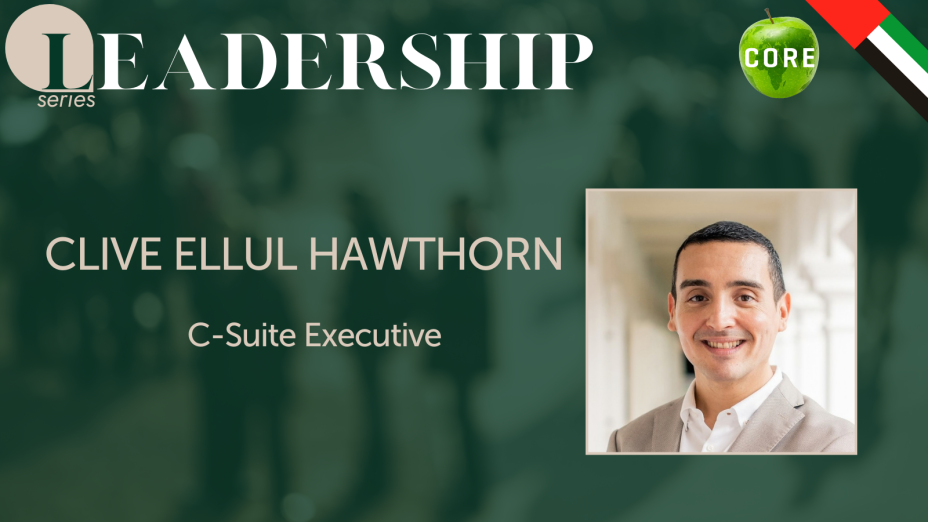
We spotlight exceptional industry leaders in our CORE Leadership Series via comprehensive interviews.
In this interview, we talk to Clive Ellul Hawthorn, C-Suite Executive and founder of Clive Ellul Hawthorn, an Executive Advantage Club and advisory practice.
Could you briefly introduce yourself, your role, and the core mission of your work?
I am a global C‑suite executive and commercial architect with twenty years of experience building growth engines, creating new categories, and leading transformation across SaaS, marketplace businesses, Telco, media, International Education & EdTech, and luxury hospitality.At the heart of my work is a simple mission: to design systems that bring clarity, create momentum, and give organisations a real competitive edge. Whether I am responsible for a multi‑hundred‑million‑dollar P&L or advising a founder, my focus is always on bringing brand, product, commercial strategy, and customer experience together into one coherent engine that can scale.Across every role, the goal is consistent. I try to remove friction, elevate the experience, and build engines that outperform the category they operate in.
Thinking about the macro‑economic and social environment, what shifts will redefine “success” in the coming years?
Success will increasingly depend on a company’s ability to turn complexity into clarity. We are entering a period where cost pressures, labour shortages, and fast‑changing customer expectations make small optimisations insufficient. What is needed now is a deeper redesign of how organisations operate.The companies that will lead are the ones that build predictive, insight‑driven commercial engines, treat customer behaviour as a strategic asset, and bring brand, product, and revenue together into one operating system. They will also be the ones who design experiences that feel effortless, intelligent, and emotionally meaningful.In short, the future belongs to organisations that behave like connected ecosystems rather than isolated teams.
What innovations — technological, experiential, or operational — excite you most right now?
The innovations that excite me most are the ones that shorten the distance between a customer’s intent and the value they receive.Three areas stand out.
First, AI‑driven personalisation that adapts to behaviour in real time.
Second, unified identity layers that allow brands to understand a customer across every channel rather than in disconnected fragments.
Third, experience‑intelligence systems that combine data, behavioural insight, and emotional understanding to create journeys that feel natural and intuitive.What inspires me is not the technology itself, but what it makes possible: brands that act with precision, empathy, and anticipation. This is where SaaS, travel tech, luxury, and even entertainment now intersect.
What will distinguish the leading service providers over the next decade?
Three qualities will separate the leaders from the rest.The first is experience orchestration. Not just delivering service, but shaping journeys that feel personal, intuitive, and emotionally resonant.The second is data maturity. Not collecting more data, but structuring it in a way that is connected, meaningful, and actionable.The third is the strength of a brand system. Brands that behave consistently across markets and channels will outperform those that rely on disconnected tactics.The organisations that win will be the ones that treat brand, product, and commercial strategy as one integrated system rather than three separate agendas.
What skills or mindsets will be most important for the next generation of leaders?
Three mindsets will matter most.The first is systems thinking, which means being able to see the whole picture rather than isolated parts.
The second is narrative control, the ability to shape perception with clarity and consistency. The third is adaptive execution, which is the skill of moving quickly without losing coherence.Technical skills will always matter, but the leaders who shape the future will be the ones who can connect ideas across industries rather than optimise within a single one.
What is the most important leadership lesson you have learned?
The most important lesson I have learned is the value of push–pull leadership. It is the ability to know when to create momentum and when to create space.Earlier in my career, I thought leadership was about intensity and direction. Over time, I realised that high‑performing teams do not scale through pressure. They scale through precision. Some situations need a clear push: pace, clarity, and decisive action. Others need a pull: stepping back, giving people ownership, and allowing the system to guide the work.Push without pull creates dependency. Pull without push creates drift. The balance creates autonomy, accountability, and performance that compound over time.This principle shapes how I lead today. I focus on creating the conditions where teams can operate with confidence and clarity, and I pay close attention to when I should step in and when I should step out.
Looking back, what has been the most pivotal moment in your career?
The most pivotal moment was my transition out of the travel industry after Covid. I had spent most of my early career in travel, and the pandemic forced a complete reset across the entire ecosystem. It pushed me to ask a deeper question: was my value tied to a sector, or to the systems I knew how to build?Moving into SaaS, telco, media, and Higher Ed and EdTech broadened my skillset in ways I could not have predicted. It proved that the principles of commercial architecture, category creation, audience behaviour, experience design, and revenue‑engine transformation apply across industries.That shift did more than expand my range. It reframed my identity. It confirmed that my craft is building engines that scale, regardless of the sector. It is why I now operate confidently across multiple verticals and bring cross‑industry insight into every C‑suite and advisory role.
What do you see as the most significant challenges and opportunities shaping the service industry?
The biggest challenge is fragmentation. Data is fragmented, customer journeys are fragmented, and brand experience is often fragmented too. But that challenge is also an opportunity. Organisations that bring their commercial, brand, and operational systems together will unlock disproportionate value. The future is not about doing more. It is about doing less but doing it in a way that is integrated and coherent.
How has your leadership philosophy evolved in recent years?
My leadership philosophy has shifted toward situational leadership and a deeper comfort with ambiguity.The last few years have shown that volatility is not an exception. It is the environment we operate in. Leaders today need to be able to shift between directive, coaching, and empowering modes. They need to make decisions with incomplete information, create clarity when the landscape is unclear, and stabilise teams while still driving momentum.The most effective leaders are not the ones who always have the answers. They are the ones who can navigate uncertainty without passing that uncertainty on to their teams. They adjust their style to the maturity, context, and emotional state of the people in front of them.In practice, that means leading with range, adaptability, and emotional precision. It means building systems that stay steady even when the environment does not. And it means seeing ambiguity not as a threat, but as a space where strong leadership creates real value.
What advice would you give emerging leaders who want to shape the future?
Build range. Do not specialise too early. Take thoughtful risks, whether that means changing industries or moving into new markets.The leaders who will shape the next decade will be the ones who can move between sectors, understand audience behaviour, and design systems that scale.Learn to think in frameworks rather than functions. And above all, develop the ability to turn complexity into clarity. It is one of the most important leadership skills of the modern era.
Author
Date Published: 5th March 2026
