
Leadership series: Dory Hermoso
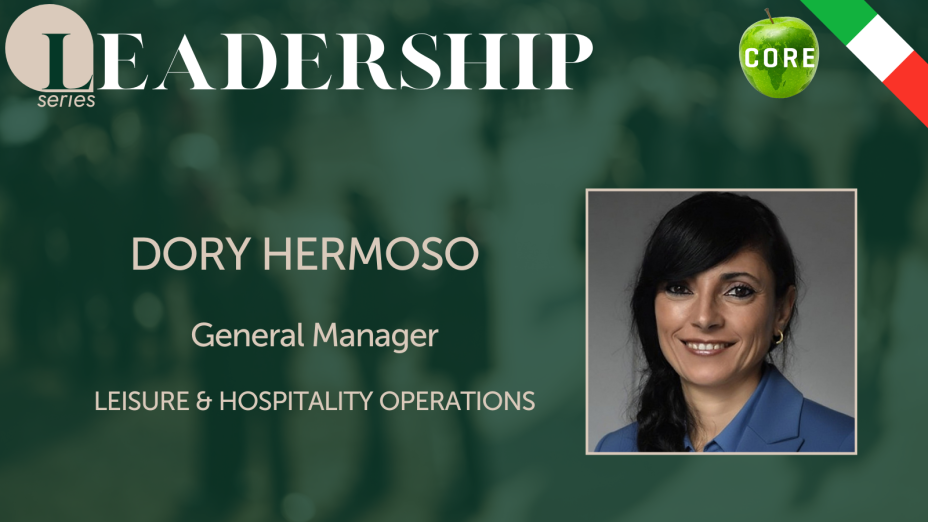
Discover exceptional industry leaders through powerful, in-depth interviews in our CORE Leadership Series.
We are here talking to Dory Hermoso, General Manager – Leisure & Hospitality Operations
Tell us a little about yourself and your business.
I have spent more than 25 years working in the leisure and hospitality industry, particularly in theme parks, water parks and resort environments. My career began in the theme park sector, where I was involved in the opening of a Warner Bros. theme park alongside the Six Flags team. It was an intense and formative experience, and probably the moment when I realised this was the industry I wanted to dedicate my career to.
Since then, I have had the opportunity to work in different countries and on international projects, taking part in park openings, improving existing operations and developing teams. Over the years I have worked across many operational areas, which has given me a strong understanding of how a park functions from the inside. In time I took on roles in operations leadership and later as General Manager, leading teams and complex projects in different international environments.
In recent years I have focused more on water parks and resort projects, particularly those where safety, operational quality and the guest experience all need to work together. I enjoy working with clear structures, quality systems and well-trained teams, because in the end it is the people who make a project work.
What continues to motivate me most is seeing a project evolve from concept into a successful operation, with a committed team and guests genuinely enjoying the experience.
What initially inspired you to pursue this career?
What attracted me to this sector is the combination of emotion and operational complexity. Parks and resorts are designed to create enjoyment, but behind that experience there is a huge amount of planning, safety management, logistics and teamwork.
My first experience participating in the opening of a theme park was very revealing. I realised that creating a place where thousands of people spend a great day with their families requires an enormous amount of work behind the scenes, and that fascinated me from the beginning.
Over time I discovered that what I truly enjoyed was the day-to-day operation: organising teams, improving processes and making sure everything runs safely and efficiently.
What motivates you in your work and what do you find most fulfilling about being a business leader?
What motivates me most is seeing how projects and teams evolve over time. When an operation begins to run smoothly, when processes become stronger and the team gains confidence, you can really feel the difference in the working environment and in the quality of service.
But probably the most rewarding aspect is seeing people grow. When someone who started in an entry-level role develops into a supervisor or department manager, you feel that the effort invested in the team has truly paid off.
Parks and resorts ultimately operate through people, and building strong teams is one of the most important aspects of leadership.
Thinking about the current macro-economic and social environment, what shifts will redefine success in the sector?
I believe success in our sector will increasingly depend on the ability to adapt. Operating costs are rising, the labour market is becoming more demanding, and, at the same time, visitor expectations continue to grow. This means operators must become more efficient while maintaining high standards of quality.
We are also seeing a shift in what guests expect. People are no longer looking only for attractions or facilities; they want to spend time in places that are well designed, well organised and offer a balanced mix of leisure, dining and relaxation.
Projects that manage to integrate all these elements successfully will be the ones that perform best in the coming years.
What do you believe will distinguish the leading service providers over the next decade?
I believe the difference will lie in the ability to create projects that are both well designed and well operated.
For many years the focus was mainly on the attraction or the physical installation itself. Today, visitors expect much more: they want a pleasant environment, well organised services and a high-quality experience throughout their visit.
This is why projects that integrate leisure, wellness, entertainment and hospitality within the same concept will have a strong advantage.
Operational quality will also be a key factor. A project may look spectacular from an architectural perspective, but if the day-to-day operation does not work well, visitors notice it very quickly.
At the same time, projects must also be economically sustainable. Owners and investors expect results, often within relatively short timeframes, so the real challenge is finding the right balance between delivering a strong guest experience, maintaining operational efficiency and ensuring the project remains financially viable.
How has your leadership philosophy evolved over the years?
Over time I have learned that leadership is not about controlling everything, but about building a system that works.
Early in my career I was very focused on supervising every detail. With experience you realise that what really matters is building strong teams, setting clear standards and trusting people to do their work.
When teams understand expectations and have the right tools, operations run much more smoothly.
Working in international projects has also taught me how important it is to understand cultural differences and adapt leadership styles to each environment.
How do you balance commercial performance with staff wellbeing and team culture?
For me these are not opposing priorities. A well-organised and motivated team usually produces better results.
I try to ensure that operations have clear structures, well-defined procedures and objectives that everyone understands. That clarity helps reduce uncertainty and stress within the team.
At the same time, it is important that people feel their work is valued and that they are part of the project. When that sense of belonging exists, commitment and responsibility tend to grow naturally.
What would you consider to be your biggest career achievement?
Throughout my career I have had the opportunity to be involved in several important projects, particularly park openings and operational restructuring processes.
One aspect I value most is having contributed to the development of large international projects where the challenge is not only launching complex facilities but building a strong operation from day one: creating teams, establishing procedures and ensuring that everything functions safely and efficiently.
Another achievement I value is the opportunity to develop people who later moved into greater responsibilities within the organisation. Seeing professionals who started in operational roles grow into department managers or senior leaders is something that gives me great satisfaction.
Projects evolve over time, but people continue their careers, and contributing to that development is probably one of the most meaningful achievements.
What skills or mindsets will be most important for the next generation of leaders?
Future leaders will need a combination of technical knowledge and human skills.
On one hand, they must understand the financial, technological and operational aspects of the business. At the same time, they will need to manage diverse teams and operate effectively in international environments.
The ability to listen, take responsibility for decisions and remain calm in complex situations will become increasingly important.
What is your long-term vision and the legacy you would like to leave?
I would like to continue contributing to the development of leisure and hospitality projects that are well designed and well operated, where service quality and safety remain a priority.
Beyond individual projects, I believe the real legacy lies in people. If the professionals who have worked with me continue to grow and apply strong operational standards in their own careers, that would be the most meaningful outcome.
Our industry still has significant potential to evolve, and I hope to continue contributing to that progress in the years ahead.
Author
Date Published: 5th March 2026
