
Leadership series: Dr. Dharshana Weerakoon, DBA
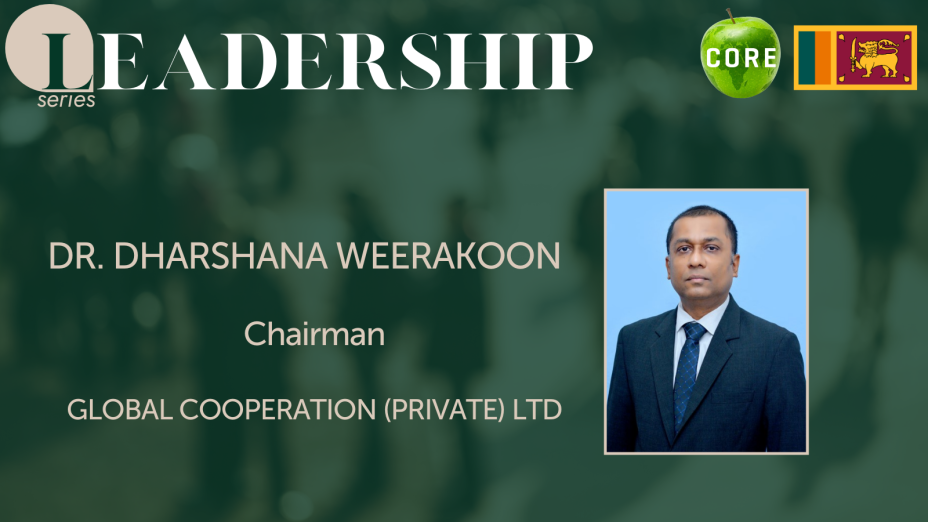
Through carefully conducted interviews, the CORE Leadership Series examines leadership excellence across the industry.
Tell us a little about yourself and your business.
My name is Dr. Dharshana Weerakoon, DBA. I am the Chairman of Global Cooperation (Private) Limited, a Sri Lanka–based holding company overseeing a diversified portfolio of businesses across technology services, retail operations, digital transformation, and advisory services. While the Group operates across multiple sectors, a significant part of our work supports service-led industries such as hospitality, retail, and customer-centric operations.
At Group level, we focus on building structured operating models that enhance service quality, consistency, and customer experience. Through our subsidiaries, we help organizations strengthen frontline performance using systems, technology, and governance. Our belief is that excellent service is not incidental—it is intentionally designed, measured, and continuously improved.
What motivates you most about being a business leader in the service sector?
The service sector is ultimately about people serving people. What motivates me most is creating environments where teams are empowered to deliver consistent, meaningful service rather than working in reactive or fragmented ways.
In hospitality and services, leadership decisions directly affect guest satisfaction and employee morale. Seeing teams grow in confidence, professionalism, and pride in their work is deeply rewarding. Strong service leadership, in my view, creates shared value for customers, employees, and the wider community.
How will current macro-economic and social pressures redefine success in hospitality and services?
Hospitality and service businesses are facing rising costs, labour constraints, sustainability expectations, and increasingly discerning guests. As a result, success can no longer be measured solely by revenue growth or occupancy levels.
Future success will be defined by operational resilience, productivity per employee, and the ability to deliver consistent experiences under pressure. Organizations that adopt technology intelligently, manage costs transparently, and invest in people development will outperform traditional models. Discipline, adaptability, and guest focus will be critical.
What will distinguish leading hospitality and service providers over the next decade?
Leading providers will differentiate themselves through a combination of operational excellence and emotional intelligence. Guests will increasingly priorities authenticity, reliability, and personalized experiences over traditional notions of luxury.
Technology will play an important role, but only as an enabler of better service, not a substitute for human interaction. Organizations that empower frontline teams with the right tools, data, and decision-making authority will deliver more memorable experiences. Culture, consistency, and clarity of brand promise will be key differentiators.
What skills or mindsets will be most important for the next generation of hospitality leaders?
Future hospitality leaders must be adaptable, commercially aware, and deeply people-oriented. They will need to understand systems and data while remaining closely connected to frontline realities.
Emotional intelligence, resilience, and cross-functional thinking will be essential as operating environments become more complex. Leaders who can inspire teams, manage change calmly, and uphold service standards under pressure will stand out. A commitment to continuous learning will be critical.
What is the most important leadership lesson you’ve learned in service-driven businesses?
One of the most important lessons I have learned is that consistency matters more than charisma in service businesses. Guests remember reliability and follow-through, not promises.
Clear standards, simple processes, and values-driven leadership create predictable excellence. When systems are well designed, teams perform confidently without constant supervision. Effective leadership is therefore less about visibility and more about building frameworks that support daily execution.
What are the most significant challenges and opportunities shaping the service industry today?
Talent availability and retention remain the most significant challenges facing the service industry. Hospitality roles are demanding, and younger generations increasingly seek purpose, development, and flexibility.
At the same time, this presents an opportunity to redesign service roles through technology, training, and clearer career pathways. Organizations that professionalize hospitality careers and invest in leadership development will gain a sustainable advantage. The industry must reposition itself as a long-term profession rather than a short-term job.
How do you balance commercial performance with staff wellbeing and culture?
In hospitality, commercial performance and staff wellbeing are closely interconnected. Poor culture quickly translates into poor guest experience.
We focus on structured operations, realistic performance targets, and continuous skills development. When expectations are clear and workloads are manageable, teams remain engaged and productive. A strong culture reduces turnover, improves service quality, and supports sustainable profitability.
What innovations excite you most in hospitality and services right now?
I am particularly excited by innovations that improve productivity while preserving the human element of service. These include smart POS systems, demand forecasting tools, digital guest engagement platforms, and workforce optimization solutions.
Such technologies reduce administrative burden and allow staff to focus on guest interaction. Innovation should simplify work, not complicate it. When implemented thoughtfully, technology becomes a silent partner in delivering better service experiences.
How are you embedding sustainability in hospitality and service operations?
Sustainability must be practical and embedded into daily operations rather than treated as a branding exercise. This includes energy efficiency, waste reduction, responsible sourcing, and financially sustainable operating models.
In hospitality, sustainable practices also strengthen cost control and operational resilience. Guests increasingly value responsible operators, making sustainability both a moral responsibility and a commercial imperative. Long-term thinking is essential.
What is your long-term vision and legacy within the service industry?
My long-term vision is to help build service organizations that are professionally managed, technologically enabled, and genuinely people-centric. I aim to contribute to raising service standards across emerging markets and positioning them competitively on the global stage.
My desired legacy is the development of strong leaders, scalable systems, and institutions that endure beyond individual leadership. Ultimately, I hope to leave behind organizations that deliver
Author
Date Published: 3rd March 2026
