
Leadership Series: Francesco Picaro
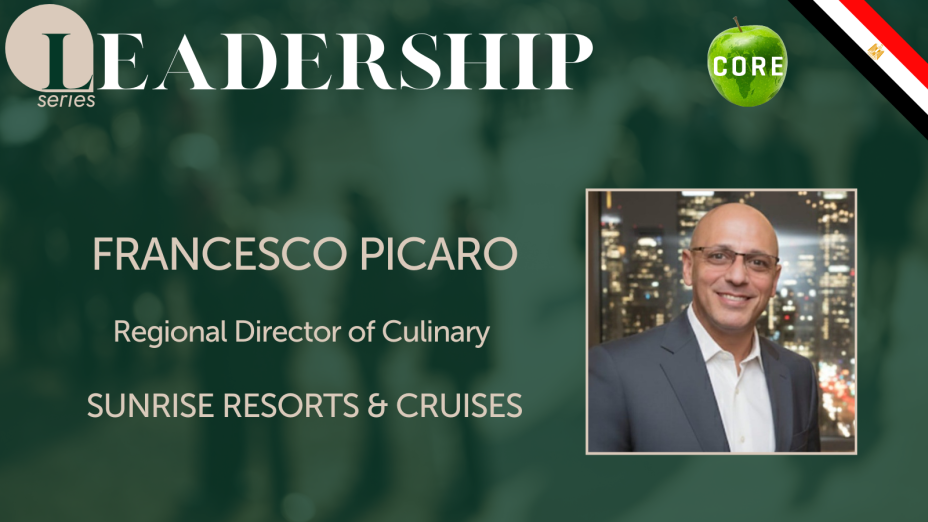
We celebrate remarkable industry leaders by sharing their stories through our CORE Leadership Series.
In this edition, we are talking to Francesco Picaro, Regional Director of Culinary at SUNRISE Resorts & Cruises.
Could you briefly introduce yourself, your role and the core mission of your organization within the landscape?
I am a hospitality executive with extensive experience leading complex, multi-outlet luxury resort and cruise-oriented F&B operations. My background combines culinary expertise with operational restructuring, commercial oversight, and strategic growth management. At corporate level, my mission is to build scalable, performance-driven environments where operational excellence, financial discipline, and elevated guest experience coexist. I focus on strengthening organizational structure while ensuring long-term brand positioning and sustainable profitability.
Thinking about the current macro-economic and social environment, what shifts will redefine success for our sector?
Success is increasingly defined by resilience and structural intelligence rather than pure revenue growth. Operators must integrate cost control, talent retention, sustainability, and data-driven decision-making into their core strategy. In hospitality luxury sectors, guests are investing in curated, experience-driven journeys. Organizations that balance experiential differentiation with operational governance will lead the market.
What distinguishes leading service providers over the next decade?
Three pillars will define leadership in our sector: operational standardization at scale while preserving brand identity; experience architecture through immersive, story-driven guest journeys; and strong internal talent ecosystems that reduce dependency on external recruitment cycles. Future leaders will align brand storytelling with operational precision.
What do you see as the most significant challenges and opportunities shaping the sector?
The greatest challenge remains leadership depth within mid-management levels. Scaling operations without strengthening leadership maturity creates volatility. The opportunity lies in structured corporate frameworks — harmonized SOPs, centralized procurement intelligence, predictive cost management, and cross-functional performance analytics. Organizations that combine agility with corporate discipline will gain competitive advantage.
How has your leadership philosophy evolved in recent years?
Earlier in my career, my focus was heavily operational. As my scope expanded, I realized sustainable performance is built on systems, not individuals. Today, I believe structure drives stability, stability enables innovation, and innovation strengthens competitive advantage. Corporate leadership requires building frameworks that continue to perform beyond individual presence.
How do you balance commercial performance with culture and retention?
At corporate level, culture must be intentionally engineered. Clear KPIs, transparent communication, leadership accountability, and structured development pathways create alignment. High-performing culture is not separate from commercial performance — it is a driver of it. Retention reduces volatility, improves consistency, and strengthens brand reputation.
Where should the most promising investments be focused?
Investment should prioritize data-driven operational intelligence systems, leadership development academies, sustainable supply chain partnerships, and continuous concept innovation within F&B and experiential offerings. Technology must enhance strategic decision-making while preserving the human element of hospitality.
Sustainability is a growing priority. How are you embedding meaningful practices?
Sustainability must move beyond narrative into measurable performance metrics. This includes waste reduction targets, energy optimization, responsible sourcing frameworks, and vendor accountability integration. Embedding ESG principles into procurement, budgeting, and reporting processes ensures sustainability becomes operational rather than symbolic.
What is your long-term vision and legacy within the industry?
My long-term vision is to contribute at corporate level to building organizations that are financially resilient, operationally intelligent, experience-driven, and talent-centric. The legacy I aim to leave is one of elevated standards, structural clarity, and leadership pipelines that continue delivering excellence long after implementation.
Author
Date Published: 16th March 2026
