
Leadership series: Marco Refrigeri
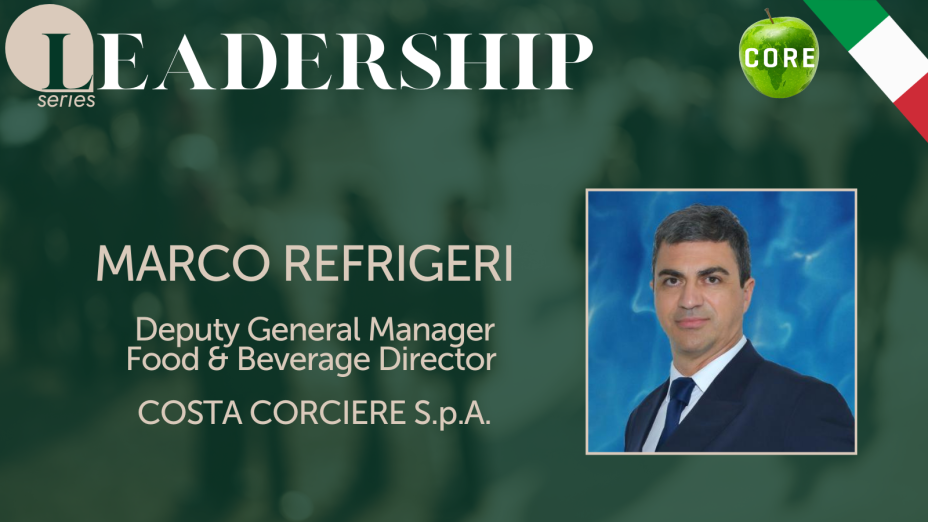
Our CORE Leadership Series documents the perspectives of influential and inspiring industry figures.
Tell us a little about yourself and your business.
I am Marco Refrigeri, a hospitality executive with over three decades of international experience across luxury hotels and global cruise operations. Currently serving as Deputy General Manager and Food & Beverage Director with Costa Cruise Line, I oversee large-scale, multicultural operations within one of the most complex ecosystems in hospitality. My focus is the alignment of guest experience, financial performance, regulatory integrity, and sustainability. At scale, success is not accidental; it is the result of disciplined systems, strategic clarity, and cultural cohesion.
What initially inspired you to pursue this career?
My early exposure to hospitality revealed a unique intersection of human connection and operational precision. Working in high-standard environments shaped my understanding that exceptional service is never improvised; it is engineered through structure, culture, and leadership. Over time, what sustained my commitment was the opportunity to operate at increasing levels of complexity, where strategy, people, and performance converge.
What motivates you in your work?
I am motivated by transforming complexity into structured, measurable excellence. Leading large organizations requires clarity of vision, governance discipline, and the ability to align diverse teams behind common objectives. What I find most fulfilling is building leadership capability within others and creating systems where performance, engagement, and profitability reinforce one another. Sustainable results are achieved when culture and strategy move in the same direction.
Thinking about the macro-economic and social environment, what shifts will redefine success?
Success will increasingly be defined by resilience, governance maturity, and long-term value creation rather than short-term yield. Organizations must embed agility into their operating models, strengthen human capital sustainability, and demonstrate measurable ESG integration. Stakeholders now evaluate brands not only on financial returns but on transparency, accountability, and social alignment. Data-driven personalization and disciplined cost management will differentiate leaders, but ethical positioning and adaptability will determine longevity.
How do you stay updated on trends and regulation?
I maintain close alignment with corporate leadership and governance structures to ensure strategic coherence between shipboard execution and organizational direction. Data analytics, performance metrics, and direct stakeholder engagement inform decision-making, while regulatory vigilance remains constant in a maritime environment. Continuous benchmarking and structured review processes ensure innovation is implemented without compromising standards or compliance.
Where should investments be focused?
Strategic investment should prioritize leadership development, intelligent digital integration, and operational sustainability. Human capital remains the most significant differentiator, particularly in complex service models. Digital tools must enhance predictive decision-making and operational transparency. Sustainability initiatives must deliver both environmental progress and measurable economic return. Long-term competitiveness depends on the disciplined alignment of these three pillars.
What will distinguish leading service providers over the next decade?
Leading organizations will distinguish themselves through strategic coherence. Personalization will be expected, not exceptional. Technology will be foundational, not promotional. Sustainability will be audited, not advertised. The defining characteristic of future leaders will be their ability to integrate governance, innovation, and human leadership into a unified operating model that delivers relevance and resilience.
If you could influence one thing about the future, what would it be?
I would advocate for business models that evolve in parallel with societal expectations. Organizations that institutionalize adaptability, invest in leadership capability, and embed responsibility into their governance frameworks will remain relevant. Evolution must be proactive rather than reactive.
What skills will be most important for the next generation of leaders?
Future leaders will require strategic judgment, emotional intelligence, financial literacy, and the capacity to operate within complexity. Adaptability and ethical clarity will be as important as commercial acumen. The ability to balance performance with long-term responsibility will define credible leadership.
What are your biggest career achievements?
Rather than a single milestone, my achievement lies in sustained impact across progressively complex environments. From leading large multicultural teams to contributing to crisis governance during COVID and commissioning new vessels, each stage reflects structured improvement in performance, resilience, and organizational capability. Consistency of delivery in dynamic conditions defines my professional trajectory.
What is the most important leadership lesson you have learned?
Leadership is earned through credibility and granted by teams. Authority may come with position, but influence is built through consistency, transparency, and disciplined decision-making. The most effective leaders remain intellectually curious and grounded in operational reality.
Have you achieved everything you wanted?
No, and that is intentional. Leadership is a continuum. My objective is to continue operating where strategic impact, innovation, and governance intersect, contributing at a level where experience translates into institutional strength.
How do you prioritize when everything feels urgent?
Prioritization begins with governance hierarchy: safety, compliance, and stakeholder impact come first. From there, I assess long-term consequence over short-term pressure. Delegation and accountability structures are essential. Leadership is not about managing volume, but about sequencing decisions with discipline.
Have you faced hard decisions?
The COVID period required decisions that balanced health security, financial sustainability, and human morale simultaneously. Transparency, decisiveness, and alignment with regulatory authorities were critical. Crisis leadership reinforced that credibility during uncertainty defines institutional resilience.
What are the most significant challenges and opportunities shaping the sector?
The sector faces heightened regulatory scrutiny, rising cost structures, and shifting consumer expectations toward transparency and personalization. Simultaneously, opportunities exist in digital intelligence, experiential differentiation, and authentic sustainability integration. Organizations capable of aligning operational discipline with innovation will lead the next phase of industry evolution.
How has your leadership philosophy evolved?
My philosophy has evolved from execution-focused to strategically balanced. Performance remains essential, but sustainable leadership requires patience, perspective, and emotional regulation. Stability at the top creates confidence throughout the organization. Leadership is not imposed; it is conferred by those who choose to follow.
What values are essential for leadership teams today?
Accountability, adaptability, and integrity are fundamental. Leadership teams must model transparency, make evidence-based decisions, and maintain composure under pressure. Culture reflects leadership behavior.
How do you balance commercial performance with wellbeing?
Performance and wellbeing are interdependent. Long-term profitability is achieved when engagement, development, and accountability coexist. Strategic clarity combined with a strong culture creates sustainable financial outcomes.
What innovations excite you most?
Intelligent automation and predictive analytics that enhance decision-making while elevating guest experience are particularly compelling. Technology should remove friction, improve transparency, and allow leaders to focus on strategic value rather than administrative complexity.
How are you embedding sustainability?
Sustainability is embedded structurally through data-driven resource optimization, waste reduction systems, and operational efficiency models. The objective is measurable environmental improvement aligned with financial discipline. Sustainability must be economically viable to be sustainable.
What is your long-term vision and legacy?
My vision is to contribute to building an organization defined by disciplined growth, governance integrity, and embedded sustainability. I would like the legacy to reflect clarity of direction, operational excellence, and responsible value creation that endures beyond individual leadership tenure.
What advice would you give emerging leaders?
Develop depth before visibility. Master fundamentals, understand governance, and build credibility through competence. Embrace innovation with discipline and prioritize long-term consequence over short-term recognition. The leaders who will shape the future balance profitability with responsibility, act with integrity, and make decisions that withstand time without seeking personal heroism.
Author
Date Published: 3rd March 2026
