
Leadership series: Mehmet Sami Temim
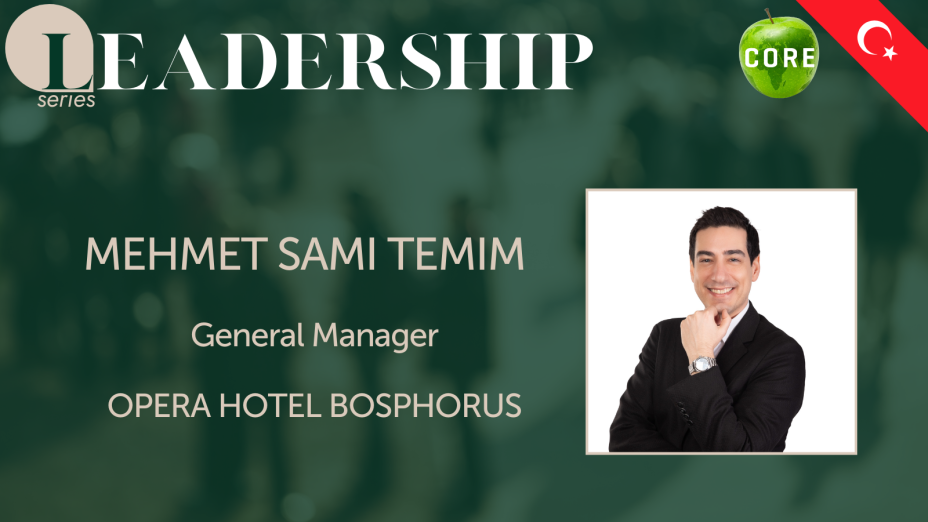
Our CORE Leadership Series documents the perspectives of influential and inspiring industry figures.
We are here talking to Mehmet Sami Temim, General Manager at Opera Hotel Bosphorus
What initially inspired you or sparked your interest to pursue this career?
Hospitality appealed to me early because it’s one of the few industries where business performance and human connection are inseparable. I liked the idea that you can build a career around creating experiences that people genuinely remember, while still working with clear commercial goals, operational discipline, and measurable outcomes.
I started out close to the guest journey and quickly became fascinated by what happens behind the scenes: how a small detail in service flow changes satisfaction, how the right positioning changes demand, how culture affects consistency, and how leadership shows up in the moments that aren’t visible to guests. Over time, I gravitated toward roles where I could connect the “front of house” reality with sales, marketing, and revenue strategy.
What kept me in the industry for nearly 25 years is that it never becomes routine. Customer expectations evolve, markets shift, competition gets smarter, and every day you’re balancing people, product, and profit. That constant change is challenging, but it’s also what makes the work meaningful.
How do you balance the demands of commercial performance with staff wellbeing, retention and culture building?
I don’t see commercial performance and staff wellbeing as competing priorities; I see them as cause and effect. In a service business, culture is not a “soft” topic; it’s a performance system. If people are exhausted, unsupported, or don’t feel proud of where they work, the guest feels it immediately, and the numbers follow.
Practically, I try to balance this in three ways. First, clarity: teams perform better when the targets are simple, transparent, and connected to a purpose they understand. Second, consistency: fair scheduling, predictable standards, and leaders who are present on the floor reduce stress and improve retention. Third, development and recognition: I invest in training, coaching, and promoting from within whenever possible, because growth creates loyalty and stronger service quality.
I also believe in protecting the basics, adequate staffing levels, realistic workloads, and respectful communication, because you can’t build a luxury experience on burnout. When you get the culture right, commercial results become more sustainable and far less volatile.
Looking back, what has been the most pivotal moment in your career, a turning point that shaped how you lead today?
A turning point for me was moving from leading commercial functions, where success is often measured through numbers and short-term wins, into full operational leadership, where the outcome depends on how well you align people, processes, and guest experience every single day.
That shift taught me that strategy only matters if it can be executed consistently by the team. I learned to slow down and listen more, to spend more time on the floor, and to build stronger communication rhythms across departments. When you’re responsible for the entire operation, you realise that leadership is less about having the best ideas and more about creating the environment where teams can deliver those ideas under pressure.
It also shaped my view of resilience. In challenging periods, market fluctuations, cost pressures, staffing dynamics, you don’t “manage” your way out with a spreadsheet alone. You lead through trust, transparency, and calm decision-making. That experience made my leadership style more people-focused, but also more disciplined, because culture without structure doesn’t scale.
What’s a lesson you learned that still influences your decisions?
One lesson that still guides me is: short-term fixes usually create long-term costs, especially in hospitality.
It’s tempting to chase quick wins: reduce a cost line too aggressively, accept business that doesn’t fit the product, push teams to stretch beyond what’s sustainable, or compromise on maintenance and training. Often those decisions look good for a month, but they quietly damage guest satisfaction, staff morale, and brand reputation, then you spend twice as much trying to recover.
So today I make decisions with a longer lens. I ask: “Will this still feel like the right choice in six months?” and “What will it do to the guest experience and the team’s ability to perform consistently?” That doesn’t mean I avoid tough calls, I make them when needed, but I try to make them in a way that protects trust and standards.
In my experience, consistency beats intensity. The strongest businesses aren’t the ones that sprint occasionally; they’re the ones that can deliver quality every day, with teams that want to stay and grow.
Author
Date Published: 5th March 2026
