
Leadership series: Miguel Teixeira
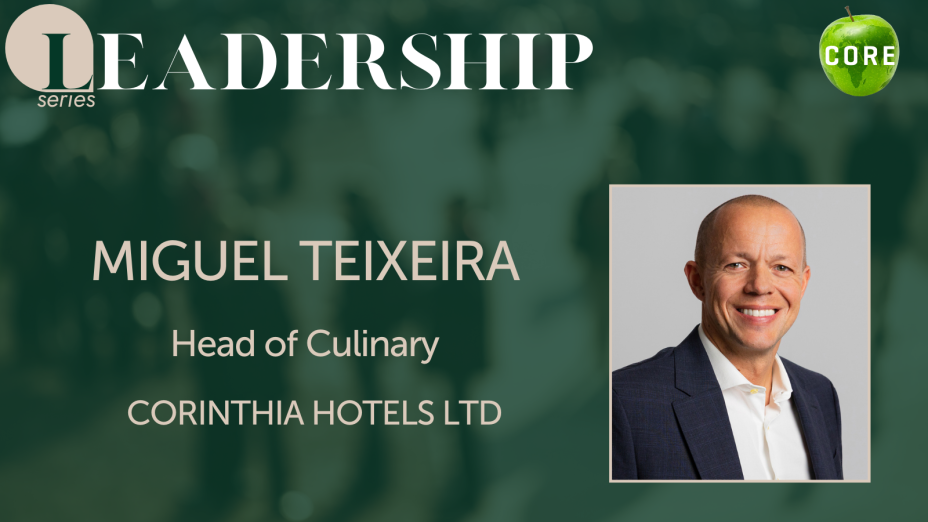
Our CORE Leadership Series puts inspiring industry leaders in the spotlight through exclusive interviews.
We are here talking to Miguel Teixeira, Head of Culinary – Corinthia Hotels Ltd
Corinthia Hotels Ltd are a Malta-based luxury hotel management and development company founded in 1962. Headquartered in Floriana, Malta, they operate an international portfolio of prestigious properties in major cities including London, Budapest, Lisbon, Prague, St Petersburg, Tripoli, Bucharest and Brussels, as well as several hotels and resorts in Malta, and has additional locations either open or planned in destinations such as New York, Riyadh, Doha and the Maldives
Tell us a little about yourself and your business.
I am the Culinary Director for Corinthia Hotels, responsible for the global culinary and F&B strategy across our portfolio.
I lead restaurant concepts, pre-openings, partnerships, and performance optimisation, ensuring our outlets are commercially strong, operationally structured, and aligned with our luxury positioning.
My focus is build distinctive concepts that drive revenue, protect margins, and elevate the guest experience across all properties.
What initially inspired you or sparked your interest to pursue this career?
My passion for this career started very early, through my family’s bakery business. I grew up surrounded by production, discipline, early mornings, and the energy of serving customers daily. That environment shaped my understanding of quality, consistency, and hard work from a young age.
From there, I transitioned into hospitality — and for the past 23 years I’ve been fully immersed in it. What began with a culinary foundation evolved into leadership roles, restaurant development, and global F&B strategy. The combination of creativity, operational structure, and business performance is what continues to drive me today.
What motivates you in your work and what do you find most fulfilling about being a business leader?
What motivates me most is building and launching new restaurant concepts — turning a vision into a commercially successful and operationally strong reality. The full journey, from strategy to execution, is what drives me.
Guest satisfaction is extremely fulfilling. Seeing teams proud of their work and guests genuinely enjoying the experience confirms that the concept and structure are working.
Collaborating with an outstanding portfolio of partners and colleagues across multiple properties worldwide. Sharing my experience while continuously learning from such diverse and talented professionals is one of the most rewarding aspects of my role.
Thinking about the (current) macro-economic and social environment (cost pressures, labour market, changing customer expectations, sustainability), what shifts do you believe will redefine “success” for our sector in the coming year or years?
The labour market and evolving customer expectations are, without question, two of the biggest forces redefining success in our sector. Both are shifting rapidly, and they require constant attention and adaptation.
From a talent perspective, success will no longer be defined simply by attracting people, but by retaining, developing, and engaging them. Strong culture, clear career paths, leadership transparency, and operational structure will become competitive advantages.
On the guest side, expectations are changing faster than ever. Customers want authenticity, value perception, sustainability, and personalised experiences — not just luxury for the sake of luxury. Concepts must be agile, digitally aligned, and emotionally engaging.
At the same time, cost pressures and sustainability requirements mean that financial discipline and operational efficiency are essential. In the coming years, success will be defined by those who can balance experience, people, and profitability — without compromising brand integrity.
How do you stay updated on industry trends, customer expectations and regulatory changes?
Today, access to information is far easier than when I started — industry reports, digital platforms, social media, networking events — everything is instantly available.
However, the pace of change is so fast that being fully updated at all times is almost impossible.
For me, it’s about staying actively engaged rather than trying to know everything. I travel frequently, visit restaurants, speak with partners and peers, attend industry events, and most importantly, listen to our teams and guests. Operational reality often tells you more than any report.
Continuous exposure, curiosity, and open dialogue are the most effective ways to stay relevant in such a fast-moving industry.
Where do you think the most promising investments should be focusing on and/or made on?
The most important investment should be in people. A building is a building — it can be beautiful, iconic, or perfectly designed — but without the right team, it is just an empty space.
Investment in recruitment, training, leadership development, and retention strategies will generate far greater long-term returns than purely aesthetic upgrades. Engaged, well-trained teams drive guest satisfaction, operational efficiency, and financial performance.
Technology and systems are important, but they should support people — not replace them. In our sector, the human element remains the true differentiator, especially in luxury hospitality.
What skills or mindsets do you think will be most important for the next generation of hospitality leaders in the UK?
Flexibility and the ability to adapt quickly will be critical. The industry is evolving at a pace we haven’t seen before — economically, socially, and technologically — and leaders must be comfortable operating in constant change.
Beyond that, commercial awareness will be essential. Future leaders must understand margins, cost control, and performance metrics just as well as service and guest experience.
Emotional intelligence is equally important. Managing diverse teams, retaining talent, and building strong cultures requires empathy, clarity, and decisive communication.
In short, the next generation must be agile, commercially sharp, and people-focused — capable of making fast decisions without losing long-term strategic vision.
What is or are your biggest career achievement(s)?
My biggest achievement is simple: being able to do what I genuinely love for 23 years — and still doing it with the same energy and a smile.
Beyond titles or projects, sustaining passion in a demanding industry like hospitality is something I value deeply. Building teams, opening restaurants, overcoming challenges, and continuing to grow year after year is what I consider my greatest accomplishment.
What’s the most important leadership lesson you’ve learned?
The most important leadership lesson I’ve learned is that our space ends where someone else’s begins.
As leaders, we must understand boundaries — respecting expertise, empowering others, and avoiding unnecessary interference. Strong leadership is not about control; it’s about trust, clarity of roles, and alignment.
When people feel ownership and responsibility within their space, performance improves, collaboration becomes stronger, and results follow naturally.
Have you achieved everything you wanted in your career so far?
I believe I’ve achieved a great deal and I’m proud of the journey so far.
However, I don’t see this as a point of arrival. I’m always driven to do more and to do better — to refine concepts, strengthen teams, improve performance, and elevate standards.
For me, growth is continuous. The moment you feel you’ve achieved everything is the moment you stop evolving — and in hospitality, evolution is essential.
Are you expecting consumer expectations to shift this year?
I’m not expecting a drastic shift in consumer expectations this year — but adjustments and steady evolution are certain.
Guests are becoming more selective and value-conscious, while still expecting quality and authenticity. Personalisation, transparency, and sustainability will continue to gain importance, but in a more pragmatic way.
It’s less about radical change and more about refinement. Operators who pay attention to these subtle shifts and adjust quickly will stay ahead.
What values or behaviours do you consider essential for leadership teams today?
Respect — today and always — is the foundation. Everything starts there. Without respect, no structure, strategy, or vision will truly work.
Humility is equally essential. Leaders must recognise that they don’t have all the answers and remain open to learning. Being considerate, listening actively, and valuing different perspectives strengthens teams.
Motivation and empowerment are critical — giving people ownership, trusting them, and allowing them space to grow.
And today more than ever, flexibility is key. The environment changes quickly, and leadership teams must adapt without losing clarity or direction.
Author
Date Published: 19th February 2026
