
Leadership series: Neil Shorthouse
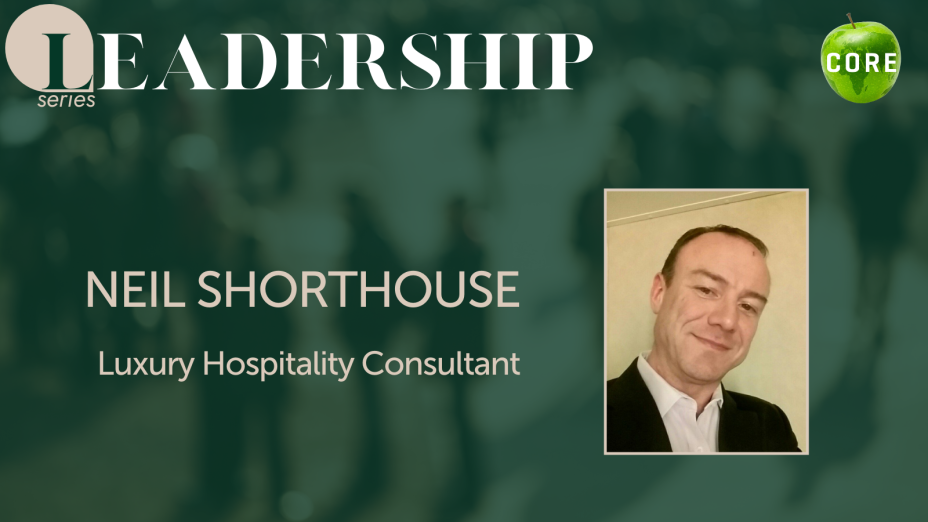
We explore the people behind industry leadership through in-depth interviews in our CORE Leadership Series.
We are here talking to Neil Shorthouse, luxury hospitality consultant.
You have worked extensively across international hospitality markets. What do you see as some of the common challenges faced?
With a career spanning over 30 years in the industry, and starting at sea, I realized that I had a transferable skill set, although may still do not see the full value nor postnatal of an industry that is global and growing year on year.
I started my career at sea back in 1998, as part of the launch crew for Disney Cruise Line, onboard Disney Magic. After a number of years, with other luxury brands, I wanted to see if I could take what I had learnt onboard from an Assistant Purser through to a HR Manager and use this knowledge and experience in a land base role. The transition from working on a ship to working in the Maldives, was an easy one. From the Maldives to the Middle East, S.E Asia and back to the UK.
Although some companies feel that a lack of knowledge of UK knowledge and expertise means that you are unable to perform nor deliver, even though your broader knowledge and expertise, our ways than your peers.
We face an evolution of technology and Ai, and although this is seen as a crucial element, skill set and understanding for our next generation of leaders. It will leave us with a gap about how we deal with people in person, face to face vs sending emails, messages that are often miss-understood or highlights a lack of understanding of what our guests want or need. Plus, they will lack the ability to openly communicate, express feelings, and challenge instead it will be done in front of a screen.
Through your work in advisory training, and development initiatives, what kind of impact do structured education, and professional courses have on long-term service excellence within our industry?
Ultimately it is a balance on how the training is delivered and considering you are training different skill sets, whereby the level of learning differs from each individual participating. Finally having a structured programme doesn't always necessarily work as you must take into consideration the working environment, which can include language used, and explanations so that your audience fully understand the context and result.
It's also important to ensure whatever programmes are delivered, that you are not delivering something that is too complex of nature for them to understand. That it fits the audience and resort’s own culture and DNA. Ultimately whatever training is done should always have an element of fun as this is where I find individuals learn more. Also bringing into play their own personal experiences both within the resort and within their home countries, this can enhance the learning experience for all participants’.
We must be careful when we talk about service excellence as we need to remember and to take into consideration that every business is different in how it operates. Although the way in which we treat guests should always be the same whether it is from an unintrusive service to a more personal informal yet formal service style that is provided.
The challenge also comes when you are advising, providing support and guidance to businesses or individual’s that not all leadership teams are ready or willing for change. This does have a direct impact on their teams and how they perform at times. You must start with the very basics for them to understand or start at the end and work from the beginning to achieve the end goal. Also the follow up and check-ins with individuals following training is as important as the training itself, an example when I deliver my leadership programme there is always a post programme evaluation three months of follow-up broken down into two six week segments to ensure that the participants are achieving their own goals, and to see the impact that they are having on their own teams.
What do you believe will distinguish the leading service providers in the UK over the next decade (e.g. niche market, luxury, sustainability, experience-driven, hybrid models…)?
For anyone or any organisation to stand out and be different, a pioneer or even a trail blazer. If we look at sustainability, especially within the hospitality sector, we are doing what everyone else does, and yet not looking to work with such industries as Cruise. Who have been follow the strictest guidelines, policies that are a legal requirement – yet on a global scale, not specific to a region. Then we have the Maldives, which by its very location, nature and remoteness, must be able to constantly be innovative, creative and forward thinking when it comes to sustainability, in every form from the work force, local transportation, culture and all whilst ensuring they deliver a world leading destination for tourists. Ultimately sustainability should just be a matter of cause in today’s world.
Technology will play a factor in service delivery, yet we cannot lose the true heart of hospitality when it comes to interaction with guests. Yes, some what they seamless experience on arrival / departure and less human contact, however for some it is an integral’s part. Also, what happens when technology goes wrong, do team members know how to do a manual check-in, deal with a guest complaint in person vs via a live chat or even a chat-bot that is triggered by algorithms vs how that person feels.
If you could influence one thing about the future of hospitality in the UK (policy, regulation, social trend, business model…) what would it be, and why?
The art of being human, and how we treat each other both in the business world and in our private life. Getting away from reliance on auto-mated messages, that are potentially manned by individuals who have no idea about how hospitality works or are driven by profit instead of developing a true relationship.
If we are not careful, we end up with individuals, that cannot deal with emotions, not listen to a guest fully without judging or remaining unbiased, and providing the solution that is right for that person and the business.
Personality is key within hospitality, if we lost this then we lost the true are of being a human.
What skills or mindsets do you think will be most important for the next generation of hospitality leaders in the UK?
An open mindset, that is driven by the needs of your guests, as well as your own team-members, ensuring that they understand, how to treat each other. Yes, we are in a world that is driven by adapting and changing needs that impact us all. However, if technology fails, what do we have to fall back on, what skills sets will they have on how to deal with a real person face to face, who has a complaint. They cannot be told to, go online and follow a process or speak with a compute red generated person, who does not actually exist.
They have to be able to understand, and know how each works, along with the consequences when it does not work. If your team use an app to secure shifts, see hours worked, payments due, and this goes down. What do you do, also be prepared for the unexpected, it may never happen, yet when it does you are ready. In stead of sitting behind desks hiding from guests, it is vital that they get out and spend time to fully understand guests needs, dynamics and what dives them to choose.
Our armed forces, cruise and other transportation sector, all train for the unexpected, yet when something does happen, they are prepared and ready – yet unfortunately some of industries are not!
Any organisation who is prepared for all eventualities, is pro-active, seeks to understand the ‘human element’ will go further, this is also important when we talk about technology and its use.
What is or are your biggest career achievement(s)?
Being selected to launch a cruise line back in 1998, for Disney Cruise Line. Moving from the Cruise Industry as a HR Manager to take on a Cluster Director HR role in the Maldives, based on experience vs having a formal qualification. Supporting the Ministry of Tourisms in the Maldives during COVID and helping to write the return to safe tourism document used by the industry. Appointment as Chair of a Multi-Academy Trust oversewing the entire Trust and a multi-million-pound budget, along with supporting other educational trusts within the Southeast. Being appointed a Fellow of the Institute of Hospitality in 2016 by my peers in the industry.
What’s the most important leadership lesson you’ve learned?
Never allow your own integrity to be over-shadowed by anyone or a company, it is not right for you then move on, no matter what. Being transparent, honest and allowing others to make their decisions and choices, without being influenced by others, who do not fully understand or have the full picture to make that decision. Ultimately talk with colleagues, peers, friends, family yet always have an open mind, never judge someone with knowing the full story, the damage done can be at times never repaired.
What do you hope your legacy will be both for your organisation and for the hospitality industry more broadly?
Ask me when I am dead! Seriously, it would be that I have inspired others to stand up and be heard, make decisions that are not always the right ones, yet allow someone to learn from their mistakes. The ability to listen, be non-judgemental, allow others to make their own choices, even when you want to interest don’t. Otherwise, this does not allow for the wright growth, support or even success.
That whoever, worked for me or with me had fun, and learnt one thing that they can pass onto someone, that also learns and ultimately creates a dominos effect of inspiration, learning, growth and fun.
What values or behaviours do you consider essential for leadership teams today?
Transparency, Honesty, Integrity and Trust
Author
Date Published: 3rd March 2026
