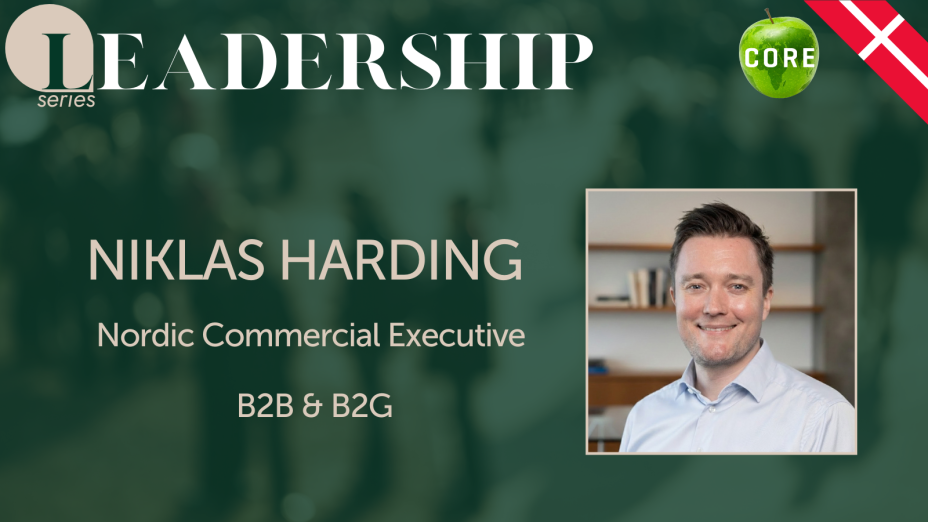
Leadership series: Niklas Harding
The CORE Leadership Series tells the stories of inspiring leaders making an impact across the industry worldwide.
We are here talking to Niklas Harding. a Nordic Commercial Executive with 15+ years of full P&L ownership across B2B and B2G service, subscription models and facility management in the Nordic region. Known for combining operational rigor with commercial edge, he has led significant growth and transformation programs across corporate, family-owned and PE-backed service businesses. A former elite badminton player with an early career background in music, Niklas brings an unconventional perspective to leadership that is both results-driven and deeply human.
Tell us a little about yourself.
I've spent 15+ years building and transforming commercial service businesses across the Nordics, primarily in B2B, B2G and facility management. I've held full P&L responsibility across family-owned and PE-backed structures, always at the intersection of commercial strategy and operational delivery. Outside of work I'm a competitive golfer, a former elite badminton player, and I have an early background in music production, which probably explains why I care as much about timing and rhythm in organizations as I do about strategy.
How has your leadership philosophy evolved over the past few years of rapid change?
It's become simpler and more human. I used to believe leadership was about having the right answers. Now I believe it's about creating the conditions where your team can find them. What I've seen consistently is that the organisations that navigate turbulence best aren't the most sophisticated, they’re the ones with the clearest direction and the highest degree of trust between leadership and the frontline.
What do you see as distinctive about Nordic leadership and is that model under pressure?
The Nordic model has genuine strengths: flat hierarchies, high trust, psychological safety and a real respect for work-life balance. These aren't soft values, they're competitive advantages. But the model is under pressure. PE ownership structures and a more performance-driven commercial culture are creating tension with the traditional consensus approach. The leaders I admire most have found the balance, maintaining the trust-based culture while adding the commercial decisiveness that growth requires. That balance is the defining leadership challenge in the Nordics right now.
What values or behaviours do you consider essential for leadership teams today?
Three things: intellectual honesty, the willingness to look at reality clearly and act on what you see. Decisiveness with humility, making clear calls under uncertainty while remaining open to being wrong. And commercial empathy, never losing sight of the human dimension behind every strategic decision. The best leaders I've worked with hold all three simultaneously.
How do you balance commercial performance with staff wellbeing, culture and retention?
I reject the premise that these are in tension. The fastest route to sustainable commercial performance is a high-functioning team that believes in what it's doing. That said, balance requires clarity. Wellbeing without accountability isn't culture, it's comfort. The best teams I've built have been both demanding and deeply human. You can hold people to high standards and still genuinely care about them. In fact, I think that's what people most want from a leader.
How do you prioritise tasks when everything feels like a priority?
I ask three questions: what protects the customer, what protects the team, and what is genuinely time-sensitive? Everything else gets sequenced. Prioritisation isn't about doing everything; it's about doing the right things in the right order and being honest about what has to wait.
What has been the most pivotal moment in your career?
Early in a general management role I inherited a talented but bruised organisation, low trust, high cynicism, energy spent on internal politics rather than customers. My instinct was to move fast and impose change. Instead, I slowed down and listened. What I found was that most problems weren't talent problems, they were clarity problems. That experience taught me that the most powerful thing a leader can do in a broken organisation isn't a restructuring. It's a promise kept. That lesson has never left me.
What is your biggest career achievement?
A commercial turnaround I led over roughly 14 months. Declining retention, a directionless commercial team, a reactive operation. We rebuilt the commercial engine from scratch, new segmentation, sharper value propositions, restructured team, disciplined pricing. The result was significant top-line growth and a meaningful EBIT improvement. But what I'm most proud of is that the team that came out the other side was stronger and more capable than when we started. Growth that doesn't build a company isn't sustainable.
What skills or mindsets will be most important for the next generation of Nordic leaders?
The ability to hold complexity without losing clarity, balancing short-term performance with long-term investment, global ambition with local execution. And genuine accountability: the willingness to own outcomes, not just activity. In consensus cultures there's a tendency to diffuse responsibility to the point where no one is really answerable for anything. The leaders who stand out are those who step into accountability willingly, even when it's uncomfortable.
What advice would you give emerging leaders who want to shape the future?
Get as close to the commercial reality as possible, as early as possible. Understand how your business or concept actually creates value, not from a strategy deck, but from the frontline. Talk to customers. Understand why you win and why you lose. And don't confuse activity with impact. Leadership is ultimately about earning trust, and that's a long game. Play it accordingly.
Author
Date Published: 5th March 2026
