
Leadership series: Ralph de Klijn
The CORE Leadership Series tells the stories of inspiring leaders making an impact across the industry.
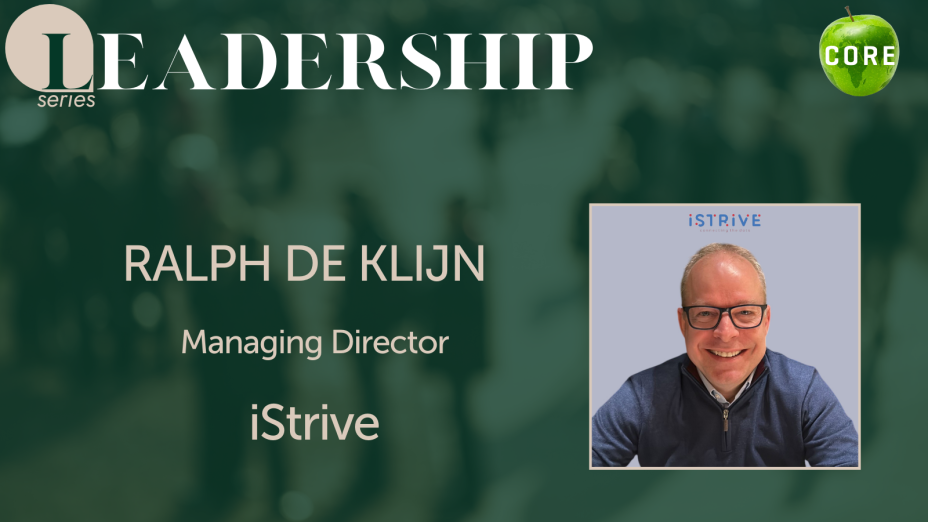
This is Ralph de Klijn, Managing Director at iStrive.
iStrive specialise in strengthening cruise, maritime and hospitality operations through clear strategy, practical expertise and hands-on support. They help brands elevate performance at sea and on land, whether launching a new ship, preparing a team, or refining the guest experience
Please tell us a little bit about you and your business.
I have worked in the cruise and hotel industries for more than 20 years, moving up from operational roles to corporate leadership roles on many major cruise lines. That path has taught me a lot about how to deliver at scale, what works, what doesn't, and where organisations tend to lose alignment. My goal with iStrive is to close the gap between planning and doing. We help cruise lines, investors, and hospitality companies get ready for business, improve their commercial performance, train and develop their staff, and design a great guest experience. The focus is always on giving real-world answers instead of just theoretical ones.
What made you want to do this job or get interested in it?
I was interested in the field because it moves quickly and is hard to predict. Every day is different, and how well you do depend on how well you can adapt.
Over time, that interest turned into a deeper understanding of how complicated operations, cultural diversity, and business performance are all connected. That combination, along with the difficulty of making it work all the time, has kept me interested in my job.
What motivates you in your job, and what do you like most about being a business leader?
Improvement and achievement. Seeing real progress, when teams come together, work becomes more consistent, and results follow, is what inspires me. You can tell right away if anything works in hospitality.
The best part is making situations where people know what their roles are, take responsibility, and work together to do better.
What do you think are the biggest problems in the area where you are now, and how should/will a business like yours deal with them?
The hardest part is getting things done. There are a lot of ideas, technology, and drive. The hard part is getting departments, strategy and operations, and expectations and delivery to all work together.
Companies that make their structures simpler, set clear responsibilities, and follow through will do well.
What changes do you think will change what "success" means for our industry in the next year or years, given the current state of the economy and society (cost constraints, the job market, changing customer expectations, and sustainability)?
Success in our field is becoming stricter and more planned. For a long time, growth was the main sign, but it's not enough on its own anymore. The focus is shifting to building businesses that are strong, run well, and can keep giving value over time.
The ability to combine good business performance with great operational performance while keeping the guest experience in mind will determine success. Companies that know how much they spend, invest in their workers, and always deliver "rather than sometimes" will do well. The focus is on sustainability, clarity, and control, not scale.
How do you stay on top of changes in the industry, customer needs, and the law?
It is very important to be aware of how things really are in the business. Taking part in initiatives, working with operators, and keeping direct relationships with people throughout the business all give you useful information. This gives you a much clearer picture than just reading headlines or reports.
At the same time, I work hard to stay up to date on bigger things, like changes in regulations, changing guest expectations, and new business models. The problem is not just learning things but figuring out what is really useful and can be used in the real world.
Where do you think the best investments should be made or focused on?
The best investments make a company work differently every day. People put too much effort into making small changes that don't really help the overall structure work better.
Adding a lot of value comes from making leadership stronger, making decisions easier with better systems, and creating simpler and more aligned operational models. Another important part is training and developing new employees. As the company grows, it is important to focus on hiring the next generation of crew members and giving them opportunities to grow in a way that will help them succeed. When those rules are in place, everything else gets better on its own, like the guest experience, the money coming in, and the team's performance.
What will set apart the top service providers in the next ten years? Will it be specialised markets, luxury, sustainability, experience-driven, or hybrid models?
The main difference will be how clear and consistent things are. The best operators will know exactly who they are, what they stand for, and how they give customers that experience.
Guests like it when things are real and reliable. They want to know what to expect, and they give businesses that always keep their promises more business. Companies that can bring together their product, people, and business strategy around a unique brand will do well. People who keep changing their minds or making their product more complicated will have a hard time keeping up.
What policy, law, social trend, or business model, would you change to make hospitality better in the future? Why?
I would put getting strategy and execution to work together better at the top of my list. What is planned at the top level and what can actually be done on the ground often don't match up.Closing that gap would have a big effect on the success of the business, the happiness of the customers, and the engagement of the team. When businesses make plans with a full understanding of how things work in the real world, they become more stable, efficient, and successful.
What skills or ways of thinking do you think will be most important for the next generation of hospitality leaders?
Leaders of the future need to be able to plan and carry out their plans. It's not enough to be good at one thing anymore. Being able to notice details while also giving direction is what makes a good leader.
It's just as important to be able to stay clear-headed in tough situations. The pace of change is picking up, and leaders who can simplify, focus, and communicate well will build much stronger companies than those who make things more complicated. But the company also has a duty to get newly promoted middle and upper management ready for success, not failure, which is still too common.
What is your biggest professional success or successes?
It's not about one moment for me; it's about how consistently you deliver over time. I've had the chance to lead some amazing teams, help make new breakthroughs, and now support organisations through iStrive. What stands out to me is my ability to create conditions that make teams work better together. The best achievements are the ones that have a lasting effect, when something continues to work well even after the first effort.
What is the most important thing you've learned about being a leader?
The most important thing to remember is that a leader's best tool is clarity. People do better when they know what is expected of them, how success is measured, and where they stand.A lot of problems in organisations come from unclear direction, not a lack of effort or skill. Simplifying and making things more open usually leads to a lot more than just starting new projects. It also gives those teams the power to make decisions.
Have you reached all of your career goals so far?
I'm happy with where I am, but I know I can always do better, and that's part of what drives me. The field is always changing, with new problems and chances to go after.
There is a strong sense of achievement, but also a clear understanding that there is more to learn, improve, and give.
How do you decide what to do first when everything seems important?
It all comes down to the effects and the results. Not everything is equally important, even if it seems that way at the time.
The main goal is always to find what will have the biggest effect on performance, stability, and long-term value. You can cut through the noise and put your time and energy where it is most needed when you have that clarity.
Have you had to make any tough choices as a business leader?
Yes, and a lot of the time, those choices have to do with people, partnerships, or direction. One of the hardest parts of being a leader is knowing when something isn't working anymore and having the willpower to do something about it.
Most of the time, putting off these decisions doesn't help the problem. For the health of the organization and the growth of its employees, it is important to deal with problems quickly, clearly, and fairly.
What do you want your legacy to be for your company and for the hospitality industry as a whole?
I want people to remember me for making things clear, helping people do better, and making places where people can succeed and thrive.
That is a big legacy if the organisations and teams I've worked with become more effective and work together better.
Could you please give a short introduction to yourself, your job, and the main goal of your organization in the hospitality industry?
At iStrive, our job is to help cruise and hospitality companies run their businesses better, make sure that their strategies are in line with their actions, and, in the end, get better results.
The goal is simple: to make businesses work better in a way that can be measured and is good for the environment.
What do you think are the biggest problems and chances that are affecting the service industry right now?
Costs are going up, finding and keeping good workers is getting harder, and running the business is getting more complicated. At the same time, there is a big chance to make the business better and make better decisions.
People who are disciplined and aligned in their work will see chances where others only see stress.
Do you think that what customers want will change this year?
Geopolitical uncertainty, rising travel costs, and ongoing pressure on air travel are all making consumers more careful and deliberate in their choices.
Guests are more aware of how they spend their money and what they want in return. Price isn't the only thing that matters anymore; dependability, clarity, and a consistent experience from start to finish are also important. In today's world, any change or inconsistency is much easier to see.
There is also a greater need for comfort. People who travel want to know what's going on, be able to change their plans, and be sure that their trip will go as planned.
For operators, consistency is now the norm. People who can lower friction, keep their promises, and give others a sense of control in an uncertain situation will stand out.
How has your way of thinking about leadership changed over the years, especially in the last few years when things have changed quickly?
In the past, my main goal at work was to solve problems and get things done. This has changed over time to making systems that stop problems from happening in the first place.
Today, being a leader is less about reacting and more about making sure that teams are clear, on the same page, and able to do their jobs well all the time.
What values or behaviours do you think are important for today's leaders?
It is still important to be clear, responsible, and consistent. It's hard to build trust and keep up performance without these. The way the company runs is a reflection of the actions of the leadership teams.
People often forget about succession. Good leaders see their successors as opportunities to grow rather than threats. If someone on your team is ready to take over your job, it's usually a sign of good leadership, not a threat to it. In a lot of cases, it also means that you are ready to take on more work yourself.
Companies that think this way encourage stability, help their employees grow, and build stronger leadership structures that can handle more stress over time.
How do you find a balance between the needs of the business and the health, happiness, and culture of your employees?
The two are connected in a direct way. People are very important for a business to do well.Performance gets better when expectations are clear, structures are fair, and teams feel like they have support. Culture is a big part of the results, not something that happens on its own.
What methods have worked best to find and train new talent?
The best way to do this is to create an environment where people can grow, take charge, and see a clear way forward.
People with talent are drawn to companies that make them feel like they are part of something well-run and important, and that they are being challenged and trusted.
What new technologies, experiences, or ways of doing things are you most excited about right now?
The most important thing is the chance to make decisions better. It's getting easier to get your hands on technology and data, but the real chance is to use them to make things easier and better.
It should be about making businesses run better, not making them harder to run.
People are starting to care more about sustainability. What are some ways you can make your business more sustainable in the long term?
Sustainability needs to be useful and a part of everyday work. It is not a separate project; instead, it should affect how decisions are made across the whole organization.
When done right, it can help both save money and hold people accountable over the long term.
What was the most important thing that happened in your career that changed the way you lead now?
There isn't just one important moment; instead, a series of events have shaped how I lead now.I've learned a lot about how everything works by doing a lot of different jobs at the company.
That foundation was important, but one of the biggest changes was going from being a General Manager to working for a company, specifically in sales and marketing. That was a very different way of looking at things and a steep learning curve, but it helped me understand the business side of things a lot better.
From there, going back to work to join a new and growing cruise line was a calculated risk. Being a part of that growth and helping to launch six ships in five years was a major turning point. It showed you a level of scale, speed, and complexity that you can't fully understand until you've been through it.
Then the pandemic hit, which brought a whole new set of problems. It pushed the whole industry out of its comfort zone and called for a new way of leading that needed more flexibility, resilience, and clear communication than ever before.
In retrospect, the amalgamation of these experiences—transitioning between roles, embracing risks, and managing uncertainty—has influenced my current leadership approach. It stressed how important it is to know both the big picture and the details, as well as how to change your leadership style based on the situation.
What lesson have you learned that still affects how you make choices?
One of the most important things I've learned is that what you do is much more important than what you want to do. It's important to have strong ideas, but they're not rare. It is uncommon to be able to consistently deliver those ideas to the required standard.
I've seen many well-thought-out plans fail in my career, not because they were bad, but because they weren't carried out clearly, with enough ownership, or with enough discipline. I've also seen simpler ideas work because they were well thought out and put into action.
That has changed how I make choices now. I don't care as much about how complicated something is as I do about whether the team can actually do it in the environment we work in.Finally, consistent delivery, not planning, creates value.
Who or what shaped the way you lead?
The people I've worked with over the years, both strong leaders and less effective ones, have had a big impact on how I lead. Watching different styles of leadership and how they affect teams and performance gives you a clear idea of what works and what doesn't.
When you first start out, especially when you move up to a higher position, you may want to move quickly and prove yourself. I learned over time that being a leader requires a more careful and planned approach. It takes time to build sustainable performance, so it's important to set clear goals and expectations so that teams know what success looks like.
I've also been lucky enough to work with and be around strong teams and direct reports who have always motivated me. People around me have taught me just as much as the people in charge in a lot of cases. "Being open to learning at all levels" has influenced how I lead now.
What does the industry need more or less of to do well?
Even the best operators are feeling the pressure from rising costs, ongoing crew or staff shortages, and customers who are becoming more value-conscious. At the same time, guest expectations are changing to include more personalised and experience-driven travel. There is a lot of demand and opportunity in the industry, but it is dealing with a lot of complexity.
Many businesses still work in silos, which means that information and responsibility are not shared, making it harder than it needs to be to do things consistently. The industry needs to better align its strategies with its operations, departments, and, more and more, its data and decision-making.
The industry would also be better off if things were less complicated. Over the years, systems, processes, and structures have been added on top of each other, often without making things easier. In a world where margins are getting tighter and expectations are getting higher, simplicity can give you an edge over your competitors.
In the end, the opportunity is clear: hospitality has always been about people, but it needs to be run in a more organised and connected way now. People who can make things easier, get their teams on the same page, and follow through on their plans will not only get through the current problems, but they will also set the stage for the next stage of growth.
What one policy, trend, or wrong idea about the industry would you change?
A common mistake people make in the industry is to think that growth is the only measure of success. For a long time, growth, more ships, more capacity, and more markets were seen as the best signs of strength.
That way of thinking is being challenged today because rising operating costs, more complicated systems, and more demanding customers show the dangers of uncontrolled growth. Scale only makes things better if it is based on solid fundamentals.
For long-term success, you need well-run operations, clear structures, and the ability to consistently deliver at scale. But I would change the way people think that growth is more important than discipline. A strong base should lead to growth, not be a stand-in for it.
What do you want your organization to look like in the future, and what do you want to leave behind in the industry?
iStrive's long-term goal is to stay very relevant and trusted in the work we do. It's not about growing for the sake of being seen; it's about consistently adding value where it matters, improving performance, strengthening operations, and making it easier to make good decisions.In an industry where ambition and speed are king, there is a need for a partner who can bring clarity, structure, and practical execution. I see iStrive continuing to position itself in this way.
When it comes to leaving a legacy, it's not so much about getting recognition as it is about making a difference. If the organisations and teams we work with become more effective, aligned, and consistent in their work because of our involvement, that's a big contribution to the industry.W
hat would you tell new leaders who want to change the future of hospitality?
Stay close to the operation; over time, strong leaders are those who know how things work and how decisions are put into action.
The best leaders I've seen know both the big picture and the small details. It's easy to jump right into a strategy or leadership role without first doing the work to get ready. But without that work, decisions become disconnected from reality.
In addition to that, pay attention to consistency. Being consistent and delivering well builds credibility much faster than having a few great moments. Being clear-headed, taking responsibility for your actions, and being disciplined about how you carry them out will get you much further than being too complicated or overthinking things. If you're willing to work hard and learn how the business works, there are a lot of chances in this field.
Author
Date Published: 18th March 2026
