
Leadership series: Wesley Williams
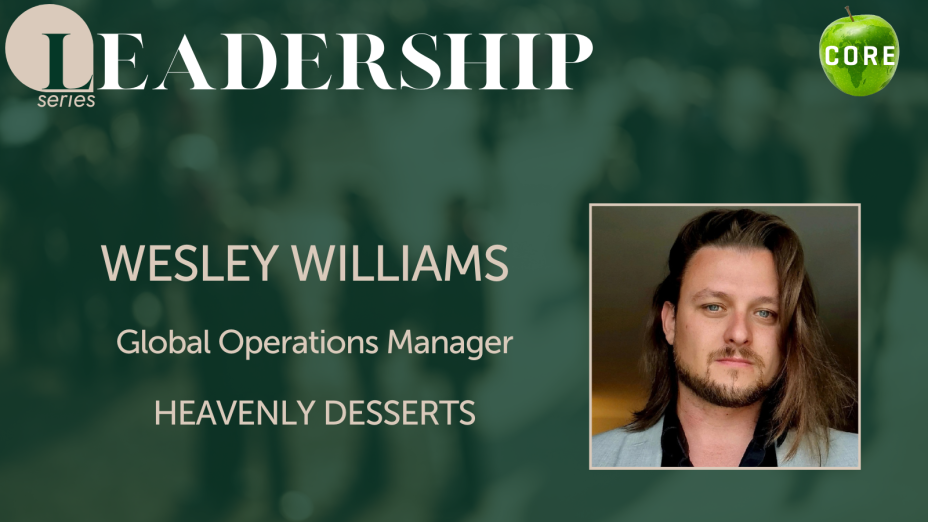
Our CORE Leadership Series documents the perspectives of influential and inspiring industry figures
We are here talking to Wesley Williams, Global Operations Manager at Heavenly Desserts.
Tell us a little about yourself and your business.
I'm a 36-year-old Welshman who has spent his whole career in hospitality and loved every minute of it. I started in the kitchens of KFC and worked my way up through the proverbial ranks into a global operations role with Heavenly Desserts. Heavenly Desserts is currently positioned as the premium experience in the desserts category, and I am very honoured to be leading the brand as we continue to drive towards our mission of being the best hospitality brand to work in, dine in and invest in.
What initially inspired you or sparked your interest to pursue this career?
Sometimes the realest answer is the right one, and in full honesty, it was my mother. She said, "Time to get a job. You're 16 now. You've got to start paying some rent."
She marched me down to KFC and said, "Here is his CV. he'll work in the back because he's an ugly mug, and he'll always be on time." It was that step into hospitality that enabled me to really understand that this is for me, because I hadn't really found my passion up until that point.
So yeah, what inspired me was forcibly my mother marching me down to KFC. That's a type of inspiration, no? ;-)
What motivates you in your work and what do you find most fulfilling about being a business leader?
It's always going to be about the people. Working very closely with a team of brilliantly experienced operators, I'm able to pass on wisdom and insight that helps them develop and succeed within their roles.
Secondarily to that is, of course, supporting partners across the globe to help build their business and solve problems. As an operator, we're natural problem solvers; something that I find great satisfaction in is not solving problems for others but helping and guiding them to solve the problems themselves.
What do you see as the biggest challenges currently facing the UK and how should/will a business like yours respond?
The hospitality scene in the UK can feel like it's on a knife edge. I don't say that just from personal experience, but from the collective feedback of peers and like-minded colleagues in similar roles.
The reality of being on a knife edge is that you've got to learn to adapt very quickly. You are constantly looking at the business model, understanding what works and what doesn't work in this environment, and being brave enough to chop away at things that no longer serve the business model or the mission.
Agility is the word that I would advise for any business in hospitality right now: remain agile.
Thinking about the (current) macro-economic and social environment (cost pressures, labour market, changing customer expectations, sustainability), what shifts do you believe will redefine “success” for our sector in the coming year or years?
The adoption of technology is going to be how our business redefines success in the sector. Hospitality is at a unique point; the reason we love it so much is because it's very human. Introducing technology is, of course, not very human—it's almost anti-human.
The businesses that find the greatest level of success over the coming years will be the ones that find the blend between introducing technology to reduce friction and speed up service, while also retaining the human side of things. In the coming years, a good blend of human and technology will be how we redefine success in hospitality.
How do you stay updated on industry trends, customer expectations and regulatory changes?
Yeah, good question. For this one, there are a few things I do:
- LinkedIn: Staying apprised of regular updates via the industry on LinkedIn is always helpful. There is lots of great insight, ideas, and wisdom floating around that is always welcomed.
- Newsletters: I constantly keep an eye out for additional information by signing up for newsletters. I find things like Propel very helpful and insightful for keeping apprised of industry news.
- AI Tools: We all have access now to what is almost an instant library through using tools like AI. While not everything can be taken at face value, setting up an agent that reports daily news and puts it in a newsletter format for me has proven to be very helpful. It shares links with me and highlights news from various sectors.
Ultimately, the utilisation of the tools we have available to serve us has been the best way for me to stay updated on industry trends.
Where do you think the most promising investments should be focusing on and/or made on?
Looking at the way hospitality is positioning itself for the future, there is a clear blending of technology and the human element.
I think the best investment brands can make right now is embracing the fact that technology is evolving rapidly. Introducing the concept of technological evolution to their teams will enable them to feel more comfortable and understand how to use these tools to best implement the guest experience.
Ultimately, the best investments are centred around learning and development, specifically regarding technological adaptation and evolution.
What do you believe will distinguish the leading service providers in the UK over the next decade (e.g. niche market, luxury, sustainability, experience-driven, hybrid models…)?
Sometimes the simplest answer is the right one, and for this particular area, I think the word is consistency.
There are a lot of emerging brands out there taking market share from the traditional "big brands"—whether you look at coffee, chicken, burgers, or pizza. Emerging brands are a real thing because people, at their very core, have a bit of a rebellious nature; they warm to those concepts very quickly.
In order to retain guests who are looking to move towards these emerging brands, consistency is absolutely crucial. You can never forgo the wisdom of McDonald's: a cheeseburger in Bromsgrove should be the same as a cheeseburger in Beijing. That is how they built their brand.
The same applies to emerging brands and the rest of the hospitality industry. Consistency will win the day.
If you could influence one thing about the future of hospitality in the UK (policy, regulation, social trend, business model…) what would it be, and why?
I think this one hit home for a lot of hospitality people. What I would want to influence here is better representation when it comes to governmental decisions.
Hospitality plays a massive part in everyone's life to some degree, some more so than others. There is also an almost hidden value to hospitality: providing spaces in which people can connect. You can't put a price on that, and the more those spaces disappear, the less connection happens in a given society.
I would like to see better representation in our government around the hospitality industry, so we have more of a voice and more of a say. I've seen some great work from Kate Nicholls at UKHospitality and a variety of other characters to embolden the voice of hospitality, but it doesn't seem we've quite kicked down the door yet.
The answer is to keep kicking the door until we get ourselves better representation in government.
What skills or mindsets do you think will be most important for the next generation of hospitality leaders in the UK?
Each generation certainly has its strengths and its opportunities. Working very closely with generations both older and younger than me, one of the key themes that often comes up as an opportunity for the younger generation is the trait of resilience.
I think we live in a very fast world now—fast information, fast food, fast fashion. It is very easy to quickly change course and move on to the next thing. When everything moves at that speed, humans can lose the ability to stay resilient and stay the course when times get tough or situations unfold in ways we didn't intend.
On the flip side, older generations (and certainly my own) can sometimes be *overly* resilient. There is a great lesson for us to learn from the younger generation about affecting change rather than just sticking with the status quo.
What is or are your biggest career achievement(s)?
The biggest achievement I could list to date would be taking a national brand to a global brand. This is quite a feat, especially given the progressive approach I've taken in my career so far.
When I joined my current brand, Heavenly Desserts, we were a national brand with 30 locations. We have since expanded that to 62 locations within the UK alone, which doesn't include our growing global presence. We began our international expansion by opening in Canada, followed by Pakistan and Germany, with several more countries lined up for entry this year and beyond.
Taking a national brand and strengthening its processes, systems, and operational procedures to the point where we are ready to take on global projects—and the unique challenges they bring—is my most significant career achievement to date.
What’s the most important leadership lesson you’ve learned?
I was fortunate to learn this lesson early on, um, from a very skilled people manager who was my director at the time. And he, he simply said, "Work with people, not through people." And that's a lesson that will stick with me forever more, and I will continue to pass that wisdom down to others. Along my journey as well.
Have you achieved everything you wanted in your career so far?
Our short answer is no; there is plenty more room to go further. The brands we want to work with are very aspirational about their global ambitions.
For example, I genuinely believe Heavenly Desserts can become the leader of the dessert industry globally. With tens of thousands of locations across the globe, I can see that being very achievable given how the brand is currently positioned. There are brilliant people working there, and there is plenty of road left to travel when it comes to growing that brand.
Additionally, we have a mission at Heavenly Desserts to be the best hospitality brand to work in, dine in, and invest in. While that mission is a "North Star" and there is no real metric to evidence that we have reached it, we have room to grow in those regards as well. We keep chipping away at that mission every single day with the decisions we make.
So, absolutely not. There is plenty left to achieve, and I am looking forward to getting stuck in.
How do you prioritise tasks when everything feels like a priority?
Simply using a tool that I had to pick up in my formative years—because I was a nightmare, constantly forgetting things and doing things in the wrong order—I learned that lesson by using an Eisenhower Matrix.
It has served me very well ever since. Understanding what is important versus what is urgent, listing those things at the start of my day, and reordering them where appropriate allows me to crack on with the important stuff right at the start of the day in a way that matches the level of urgency. Using a tool like that to guide decision-making has been incredibly profound for me.
Have there been any hard decisions you had to take as a business leader?
Yes, there have been a couple in my career along the way. The first one that springs to mind is around COVID. For the brand I was working for internationally at the time (not Heavenly Desserts), I was in another country operating those restaurants. When COVID struck, based on the employment law for that country, we essentially had to close up shop and exit.
That involved some tough conversations in a foreign nation with a language I didn't speak very well, ultimately letting people go and winding down operations. It was a very hard decision to make and enact as a business leader.
More generally speaking, it is always a difficult decision to let people go. The primary reason I find for letting someone go in any operation is that a person just isn't matching the culture the business is exerting. There can be many reasons for that, but while letting people go is always a tough job, the culture of the business will always come first—and I hold myself to that as well.
What do you hope your legacy will be both for your organisation and for the hospitality industry more broadly?
Certainly, for Heavenly Desserts, it is to be that global presence when it comes to the dessert industry. There is a niche to fill there, and we are well on our way to making sure that is filled, so I am looking forward to that being a legacy that I leave behind.
More so personally, the legacy that I wish to leave behind is that of value. I don't want to be remembered for "good things" or "bad things"—they are simply things. The question I ask myself is: "Did I add value to that conversation, or did I not?"
If no value was added, I then have to take a look at why I am having those conversations, and how do I ensure that I deliver value for every conversation that I have. A legacy for me personally is about providing value to those that I engage with.
Could you briefly introduce yourself, your role and the core mission of your organisation within the UK hospitality landscape?
My name's Wes. I'm the Global Operations Manager for Heavenly Desserts, the UK's premium dessert experience brand.
The core mission of our organisation is to be the best hospitality business to work in, dine in, and invest in. Our guests, our teams, and our investors are equally of importance to us, and every decision that we make should serve at the very least one of those stakeholders in our business.
What do you see as the most significant challenges and opportunities currently shaping the service industry /sector in the UK?
Quality is always at risk and consistently gets pushed, simply because the price of everything when it comes to food and drink always goes up and very rarely comes down. As costs increase on the raw products that go into restaurants, one of two things happens:
- Prices stay the same, and quality reduces because operators are forced to buy cheaper ingredients.
- Prices go up, which impacts the wider public.
The biggest challenge, but equally the biggest opportunity, is finding a way to very swiftly manage those cost increases on raw goods and turn that into a menu that is agile, adaptable, and resilient to the fluctuations of cost of goods across the business.
Inflation has been one of the key words I've heard for the last two years. It isn't going anywhere, and I think it would be naive to say that it's not going to now become a common part of the hospitality experience in terms of leadership.
Are you expecting consumer expectations to shift this year?
In short, I think consumer expectations at the core will remain the same: good value, good service, and good products. That is what people are asking for at the core of hospitality.
Where expectations will shift is on the fringes. We have a very trend-driven society now, and various trends have cropped up over the last few years that have come out of nowhere. Some people have jumped on them quickly, while others have bided their time, which is equally a good strategy. The "battle" will occur on these fringes regarding how quickly people jump on trends or choose not to.
A trend we've seen in more recent times is a health trend—specifically, people taking appetite-reducing supplements. This is a macro trend on the fringes of hospitality that operators and restaurants alike are adapting to.
So, I would say that the core will always remain the same when it comes to consumer expectations: good value, good service, and good food. But it's on the fringes where expectations will continuously shift as the years go on.
How has your leadership philosophy evolved, especially over the past few years of rapid change?
The word to use here for me would be "simplify". I've always believed in the process of simplification and have tried to honour that across my career, but it's become even more important as the tech world—and specifically how AI is making people's jobs and ability to move with speed—becomes even quicker.
Finding ways to simplify everything amongst all of the noise has been sharpened in my leadership philosophy over the last couple of years. So, the word I'd use to evolve my leadership philosophy has been more simplification.
How do you balance the demands of commercial performance with staff wellbeing, retention and culture building?
Going back to what's important versus what's urgent: we typically find—and I think this is an agreed-upon principle in hospitality, certainly with the people I speak to—that culture comes first. That's the important stuff; it's the thing that drives everything else.
To get a culture right and humming in a business, everything feels effortless. That then translates to commercial performance through to the frontline. The team also feels better about their work and retention increases.
For this particular question, the actual answer is prioritizing what is important versus what is urgent. Culture will always come out on top for me. Culture is number one, and everything else balances itself out if you get that bit right. That's my experience.
What strategies have proven most effective for attracting and growing future talent?
Radical Candor mixed with guided autonomy. I'm sure there's a formula or an equation you could make out of that. A very powerful book I picked up in my formative years was Radical Candor by Kim Scott. Having challenged but caring conversations is incredibly important to growing talent.
When it comes to attracting talent, I always emphasize that there is a culture of autonomy. We want people to come in who have proven they can do the role in the past and be given the freedom to operate and make the decisions that impact their areas and their expertise.
I say "guided autonomy" because everybody needs a guide. In a new or existing brand, there will always be a need for someone to guide others along the right path, especially when they encounter situations they have not experienced before.
What innovations — technological, experiential or operational — excite you the most right now?
Actually, what excites me the most right now is not necessarily operational, but it absolutely impacts every part of the business: learning and development. There are some brilliant platforms doing tremendous things out there that are certainly gearing more towards how the younger generation learns, which is important because that is who we predominantly employ in the hospitality industry.
There is brilliant work going on across the L&D fronts, and it is vital for me as a Global Operations Manager because learning and development is how we do everything. It starts from day one when you are introduced with a video from the CEO saying, "Hey, I'm Wes, and this is what we're all about at Heavenly Desserts," all the way through to the training and the experience on the floor.
L&D touches all base in a hospitality business, so the emerging technologies, systems, and tools finding their way through the L&D world at the moment are very intriguing to me.
Sustainability is a growing priority. How are you embedding meaningful, long-term sustainability practices into your business?
We've got a tremendously talented development team at Heavenly Desserts, who don't just consider the best product or the best plating technique to make a dish look superb. As part of their procuring process, they also hold themselves to a sustainability mindset. They review how a product will impact the business in terms of the amount and type of waste it produces.
These are important considerations to ensure that:
- We are not operationally burdening the business with excess amounts of different types of waste.
- We are adhering to the guiding principle of not being wasteful.
They are a wonderfully talented group of people who continue to knock it out the park.
Looking back, what has been the most pivotal moment in your career — a turning point that shaped how you lead today?
There was a particular conversation that springs to mind, which I’ve referenced previously. It was a conversation when my director came to my restaurant while I was a GM. We were top of the balanced scorecard—the restaurant was absolutely flying—and I was proud as punch.
The director came to me and said, "How's it going, Wes?" I said, "Yeah, all good. We're absolutely flying at the moment." He then asked me a very direct question that seemed a bit odd at the time: "Do you think people like working with you, Wes?"
I responded, "Of course. We're top of the table; we're the best in the business. Of course, people like working with me."
He said, "Just an FYI, nobody at HQ likes working with you. I'm going to leave that with you."
Looking back on those formative years, that conversation holds the biggest lesson of my career so far: work with people, not through people. In order to get to the top of the table, I was burning relationships and burning bridges left, right, and centre. That is not a sustainable way of working, so it was a great lesson and a real turning point in my career that I'll probably take with me to the grave.
What’s a lesson you learned that still influences your decisions?
To follow on from that anecdote, relationships will always outlast performance.
Who or what has had a major influence on your approach to leadership?
Luckily, a book that I read some time ago—I'm probably due a reread, if I'm honest with myself—was called The Fearless Organization by Amy Edmondson.
The book focuses on psychological safety. What I took away from it and still hold as a very important part of how I operate, is that in such a fast-moving world, psychological safety is an absolute must.
If teams don't offer ideas for fear of judgment, fear of looking silly, or fear of being shot down, you simply can't keep up with the speed of the world. It is incredibly important that psychological safety is artfully worked into every organization, because the world moves so fast, we can't afford to slow down.
Very high psychological safety is an immediate priority for any business I work with and any team I lead.
What does the industry need more of — or less of — to continue thriving?
Broadly speaking, I think the industry needs more human-to-human communication. It's very easy to get lost in emails, WhatsApp messages, or whatever form of digital communication people use and lose touch with the human on the other side of the conversation—especially with the speed at which everything moves.
Something I'm more mindful of now than ever is balancing the care aspect of how a person is feeling with the actual problem at hand, ensuring that a fair challenge is given to the problem as well.
If you could change one policy, trend or misconception about the sector, what would it be?
I love this question. We don't have conscription in the literal sense for the military in the UK, but I will say we should have some form of "hospitality conscription."
Experiencing a busy Saturday night is a once-in-a-lifetime opportunity for a lot of good reasons, and it is very humbling as well. If I were to change one policy about the hospitality industry, it would be a mandatory four-week period of service for a local restaurant.
It would be a nightmare to manage, and I would be fibbing if I said I've given much thought to the practicalities of it, but I just love the idea of people really understanding what our industry is all about. Give me shout if you wish to make this a reality Keir.
What advice would you give emerging leaders who want to shape the future of hospitality?
Trust your instinct. Never give up. It's ok to be wrong.
Author
Date Published: 12th March 2026
