
WE ❤️ HOSPITALITY - Roland Horne
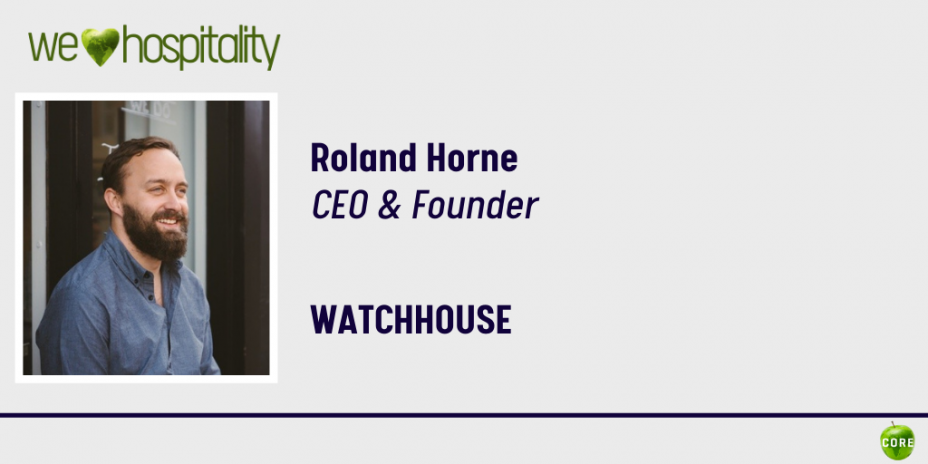
The last year has been terrible for the hospitality sector. Most businesses have seen extreme financial challenges and its reputation as an employer has been severely affected. We are now hearing from many, many of our clients about their fears for the future from staff shortages to skills gaps and top mid-senior talent moving to other sectors.
Krishnan Doyle is sharing his conversations with service industry leaders and operators on all that is good about hospitality & catering with the purpose to improve the sector's reputation as one of the largest employer worldwide but also as a great place to develop your career.
How did you get into hospitality?
My first ever job was in hospitality working at McDonald's for two years as a youngster, which I still claim to be probably the most formative part of my career in terms of understanding standards, procedures and team work ethic to date. And generally, an approach towards working and ultimately engaging with staff and with customers. Obviously, it was a lot of fun at that age, but that was my first foray into hospitality followed by a more serious one in 2014 whilst establishing WatchHouse.
I was approached by a friend who was already in F&B and looking for a partner to invest in the expansion of his business. During that period, he felt that he couldn't proceed further with the expansion and although I’d yet to actually sign the lease I decided to just go for it. I sold my other business and went full time at WatchHouse in 2016.
Do you think it's important to have studied hospitality to have success in the sector?
I don't think studying hospitality prior to entry is a important no. A benefit for sure but in may ways this business is a vocational life learnt on the tools. Given the fact that I'm a non-industry professional who now works within the sector is probably a good example of this. When I say non-professional, I mean a non-vocationally trained F&B operator, which comes with its positives and obviously its negatives. The positives are that I see things through a lens of principally a customer, and I think that level of empathy is significantly important when it comes to operating successfully in hospitality. The downside, of course, of not having that vocational exposure via graduate training program or working in a very large F&B or hospitality outfit is that you don't have the exposure to the fundamental toolkit that others do have.
I've come to learn over the years that structure and systems are vital to making this sector, and ultimately the company you're in, successful. Harping back to my days at McDonald's is probably the best example; where a multi-billion-dollar business is built on the essentially on back of teenagers and run brilliantly.
So, I don't think it's important to have studied hospitality, but I do think it's important to take the view that it is a lifelong learning exercise; a vocational training exercise, very much learning as you're doing. I think you surround yourself by people who have had more traditional exposure in the space, whether that's through non-executive director appointments or people who work from the executive to junior level teams, who have come through other businesses and bring their knowledge with them.
Which leader figure inspired you and why?
For me there was a leader of the industry, a gentleman called David Saxby, this was in the aquarium world, who was a particular mentor to me. He was a difficult individual to work with, incredibly driven and incredibly financially secure to the point he likely didn’t need to work. In his 70’s when I knew him, he really taught me the importance of not taking money for granted, and the success you have doesn't mean you can become complacent about. He taught me the fundamentals of business, looking at PNLs, cost, space, and generally looking at the appetite for growth and expansion in yourself.
I think more internationally known I would focus very much upon Elon Musk as an inspiration in that he has managed to, in some ways, change the world and is on that path to doing so. His relentless appetite towards changes is akin to someone like Isambard Kingdom Brunel in terms of what he did. But I think the downsides of those individuals is of course you end up sacrificing yourself and your family around you, and that's scary.
So, as I say, my, my inspiration or the person who really inspired me was David Saxby, who was a London business owner, and more internationally known would be Elon Musk in terms of his drive and dexterity.
What keeps you in the sector and why are you, why do you enjoy working in it?
What keeps me in the sector is not one single thing. I think if I had to pick one thing, it would probably be the energy that manifests itself in the people, which I think I find ultimately the most amazing part of the business; to see people around you living, enjoying, creating a livelihood from the business that you have helped grow is really, really cool. I would also say the ability to create new spheres is something that I find really attractive. I love creating things and having the opportunity to go around in the real world and also digital world, creating different experiences I find really amazing.
There are similarities for me psychologically I guess you could say, in terms of the creation of spaces in relation to what I did in the aquarium world as well. Where you were literally creating mini worlds within people's lives, for their enjoyment. I find the parallels between that and creating physical spaces for people to come in and exchange energy, enjoyment and love and emotion, I find that quite inspiring and therefore it keeps me interested. And as long as I'm interested, I’m there.
Tell us about the development / training that you give to your teams and management?
Coming back to the lifelong learning thing, I think the investment and development of your team is something that we're always working to do. In 2017 it became very apparent to me that in order for WatchHouse to be successful, we had to seek to build a best-in-class cultural environment within our business, one in which we are all relentlessly dedicated towards excellence. And in some ways accepted and enjoyed the fact that it can never really be achieved - all you can do is be better. I think whilst achieving a goal can be a milestone along the road, I don't think I ever want to create an environment where we feel that we have always achieved the end outcome of what we want. That carrot, as it were, should always be out of reach, therefore pushing ourselves to be better and better. To be happy, of course, but I think fundamentally to always be better.
I think taking that approach then towards the development and training of the staff, is of course, a juggling act between the financial commitments of the business and what resources we can physically put into it. But I think what I realised in 2017 was that to create a truly great business we needed to create and foster and aim to achieve along the way, a fantastic culture and one in which we put a lot of emphasis upon development and skills. This can stretch throughout, from the operations element right through to the back office, the financial side and the marketing side. We’re not, by any means, perfects at this. But what we do, is strive to be is excellent and to continually make ourselves better at it.
It involves investing heavily in induction programs and making sure that all teams are adequately supported in terms of their requirements for training and skill improvement, and also for the cultural onboarding into the business from the very outset. I saw that difference, in induction and quality of team culture, when I was in New York in 2017 looking at a couple of different operators there. Speaking to the staff and seeing the difference staff would take towards working within a business when they were invested heavily from the very off, it showed great commitment.
What advice would you give to those starting out in this sector?
The advice I would give to everybody is that you need a general, basic toolkit of what to do and what not to do. And they focus around principally making sure that you're entering the space, if it's a bricks and mortar space, making sure that you're taking somewhere which is sustainable and you've done as much market research as possible to understand whether or not there is any desire for your offering within that space (and there are some key financial assessments and KPIs that you can look at.) But above all of that which is more, I guess vocational than technical, I think the ultimate point really is to ask what difference do you want to make? And do you, as a consumer, see a huge benefit in that desire to go out and do something that you think needs to be done?
I would also canvas your close family and your friends, because they will give you honest advice. And I would seek to openly tell them that you want their honest and frank advice to ensure that they give a sanity check to what you're doing. You may think that doing a certain type of very rare food is interesting because you've read about it on Reddit or wherever it may be. But ultimately if you've got no marketplace for it, or people aren't interested or it's too expensive, then it might be great to 0.01% of the population but when it comes down to it, there isn't a market there. Equally, you might have a great product, you might have something that's very ubiquitous and you know there's a market for it. But ultimately if you're in a space where the macroeconomics of the environment or the community doesn't support your product, then you're in the wrong space.
Or indeed the rent might be too high on the space that you're talking about, or the footfall might be too low.
So, the kind of a general point here is, do what you think is genuinely needed in your area and look at it through the lens of a consumer, but sanity check that against your close friends and family and really give them the opportunity to give you open and frank advice that challenges your view.
If you could go back and tell yourself one piece of advice as you started your career, what would it be?
That's a good question. I would say do more research before you commit to an investment project. Don't make general assumptions based upon past experiences without doing the requisite deep dive into those specific areas.
We realised this when we opened up in our Fetter Lane site, where we just assumed that we would be successful from day one, because we were in our first two sites, and we didn't really deep dive into why we were successful with the first two sites. What was particular to those communities and what demand there was around Fetter Lane versus the other sites and all those things. We managed to get it right and get the questions answered but it took time and money to square this circle.
So, I think fundamentally my advice to myself would be ask yourself, realistically, is what you're doing in demand? And have you done the requisite market research before you go in and makes some difficult investments and moreover be mindful about the investment that you are making vis-a-vis the projections of what you're looking at achieving in the future. Consider your value proposition from top to bottom, and if you research and important your gut says let’s go, then go.
If you would like to take part as a leader in this thriving sector, get in touch with Krishnan (krishnan@corecruitment.com)
Author
Date Published: 12th May 2021
