What the hell happens now?
I am sure there are other ways to dress up that question.
We have been running panels for the last month now and have interviewed over 50 hospitality / leisure / retail and property executives from a variety of countries and (although very well informed and intentioned) nobody seems to really know. With 12,000 people having viewed the panels, the overriding conclusion is that people are looking for answers.
As a recruiter, I am mostly interested from an employment perspective, as to when will companies feel secure enough to hire again? Will candidates feel secure to move? How will the working environment change? Which types of job roles will be in demand when things “normalise”?
We have a great contact within global hospitality who has put some thought into recovery times. With over 20 years of experience in company modelling and having studied at leading universities in the UK and the US, we are inclined to listen. If you would like to see the full report, then please send me an email and I can send it over. I think this model is the most sensible I have seen.
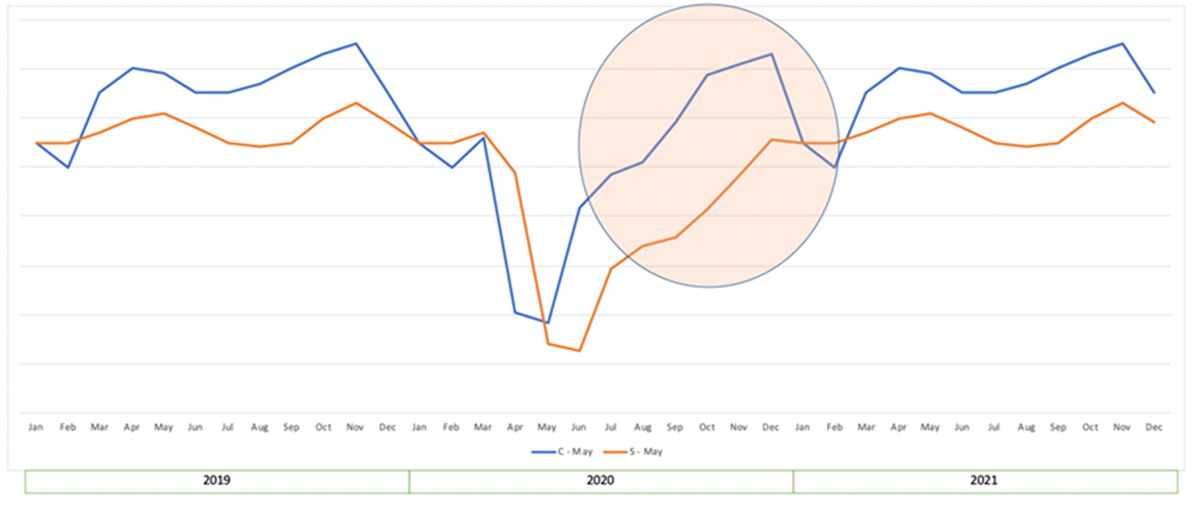
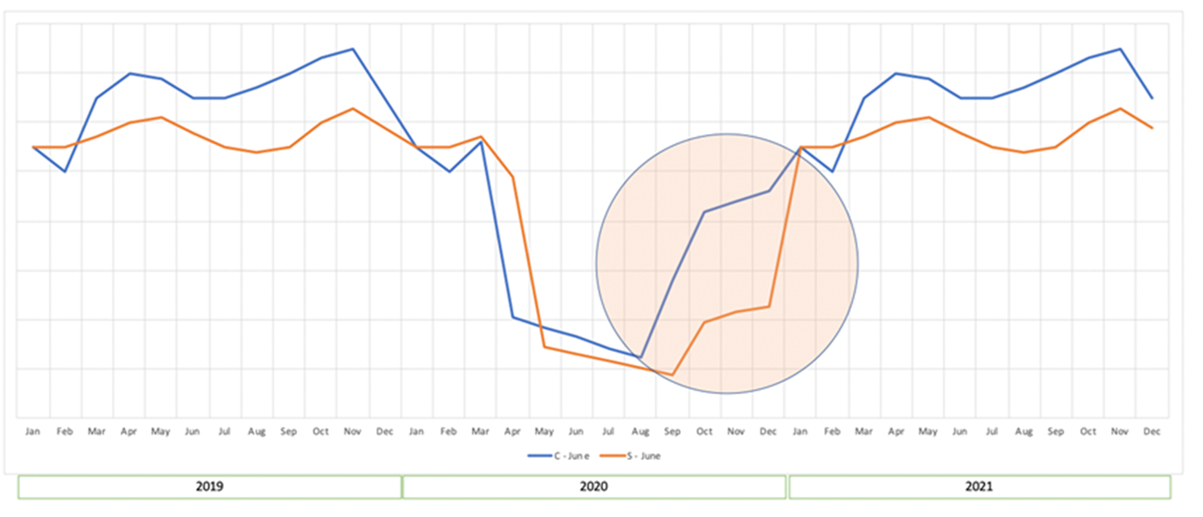
The data creates a model of the impact of the virus and simulates a potential recovery based on three scenarios; things starting to open at the end of May, June and August. The data is compiled from information available on the impact of SARS, MERS, ZIKA and the Second World War. Having validated it with McKinsey and Boston Consultancy models, research suggests it might be on the right track. The blue in is the Hospitality Industry’s Revenue, the Orange represents the support and supply industries (such as recruitment / food supply, uniforms etc.) The circles are the danger zones based on the availabilities.
May 2020
June 2020
August 2020
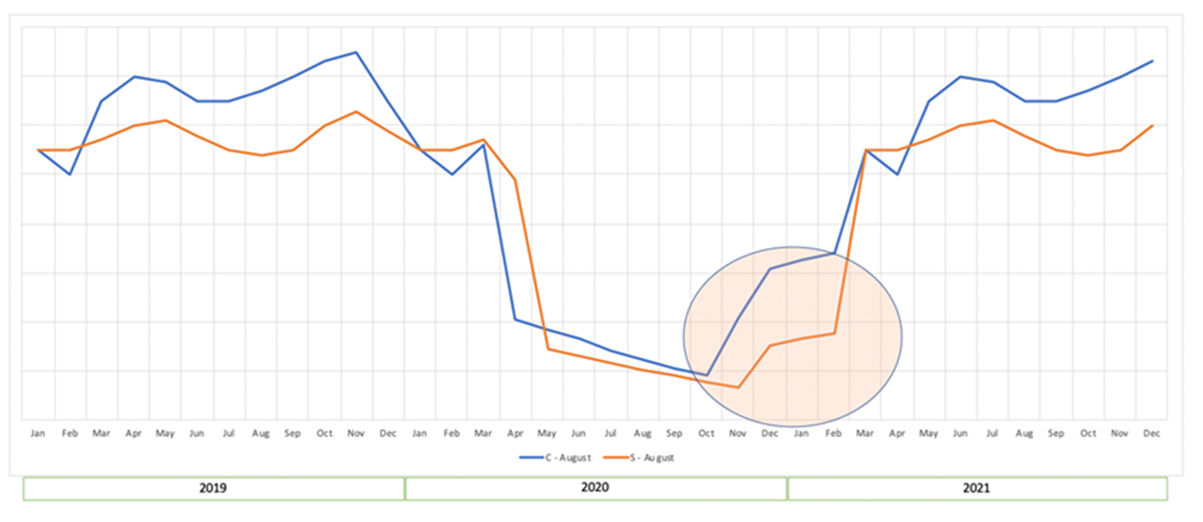
Revenue is obviously directly linked to sales and therefore employment, so you can see there is an upswing anywhere from now to October. Still not much reassurance – but the longer social distancing seems to continue for the longer more elongated the bottom of the V becomes a U and hopefully never a W (or an L which was suggested to me this week...)
The question (or challenge) that this model brings into mind, is the challenge of re-establishing our supply chain – food, product, people, for when consumer spending returns – as inevitably it will. When looking at reports from China and other countries who are in the process of lifting lock down, there seems to be an initially timid response followed by a boom in luxury / treat / impulse purchases – people have pent up emotions when it comes to lock down (and it would appear they have pent up savings too).
My opinion about what will happen
I don’t think anything will be the same after this crisis. People have learned a new way of working; we have just accelerated social trends of 30 years within a month. I of course think the pendulum will swing back – but not all the way. We must take the positives from this in terms of more social / family time, lower emissions, less commuting time and hopefully a message about exercise and health.
From a business perspective – I expect two years of realignment, false dawns and restructure. Given we have just had 2 years of this with Brexit in the UK it is not a prospect I relish, it would be excellent timing to ask the EU if we can just have the same deal as Canada – I don’t think anyone has the appetite for yet more uncertainty.
In the last week alone, there has been 85 trophy assets globally placed onto the off-market arena (15 in London alone), this is the perfect time to start looking at future assets that are becoming available. These are ones that may not been on the market within modern times. Industry contacts are working at a frenetic pace, analysing and producing feasibility case studies to get a first mover advantage, when the grass roots of recovery start at which point it will be a buyer’s market (a free for all to be honest and may be a scramble for trophy’s). This will mean up to six months to a year afterwards, people will be replaced, new concepts will start emerging and a new normal established.
Hard business focused leaders are business critical now, people who are multi skilled to notice the synergy between departments, people who have high levels of financial logic as well as supply chain and marketing knowledge etc will be the one in need. This will be the key in the short term, softer skills in experience and concept will become more important over time.
In other areas, lower management will be problematic, a lot of Europeans have left due to Brexit and more will leave because of the virus; leaving a vacuum in cheap, lower skilled management roles. Middle management will be culled and re-focused onto hard business critical roles at the start and slowly ramp up over time to none critical roles, the key to success now is hard business skills. There is then the question of how many people we “loose” in hospitality – other less “front line” sectors who will open earlier in the year will have an advantage in securing sector talent
Author
Date Published: 28th April 2020
