
IWD 2025 - an interview with: Chef Eszter Palágyi
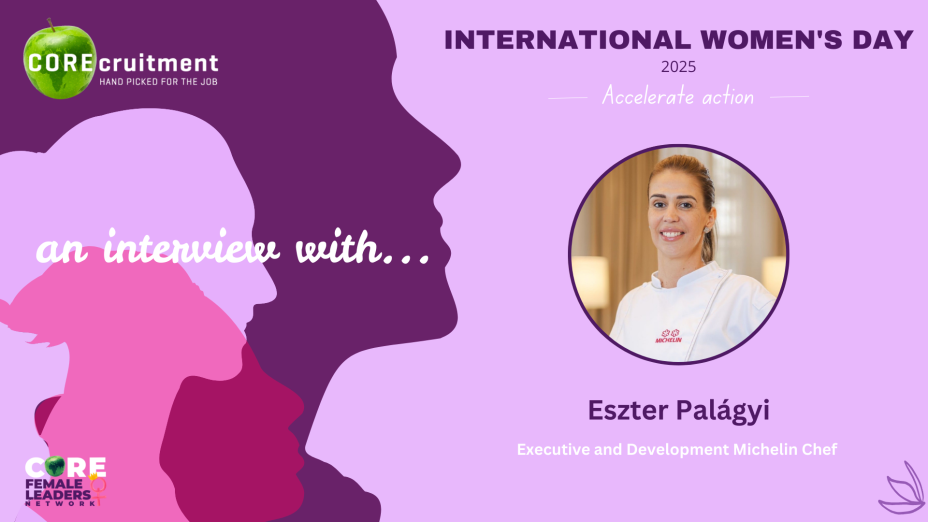
Tell us a little about your career journey leading to where you are now.
My career has been built on a foundation of passion, perseverance, and a constant drive for innovation. I started my culinary journey in Hungary, where I became the executive chef of Costes, Hungary’s first Michelin-starred restaurant. Under my leadership, Costes not only maintained its Michelin star but gained international recognition as a gastronomic destination.
Over the years, I expanded my expertise in fine dining kitchens across Europe and the UAE, playing a key role in securing Dubai’s first Michelin star. Beyond the kitchen, I have been actively involved in designing gastronomic concepts for luxury hotels, global brands, and Michelin-starred restaurants, ensuring that their fine dining experiences meet the highest standards.
What does the International Women’s Day slogan “accelerate action” mean for you?
For me, “accelerate action” is about turning ambition into concrete change. Talking about equality is not enough—we need to actively create opportunities for women in leadership and ensure they have the support, recognition, and platforms to thrive.
In the culinary world, where leadership has traditionally been male-dominated, accelerating action means:
- Mentoring and supporting young female chefs, so they don’t feel they have to fight alone.
- Challenging outdated biases and ensuring women get leadership opportunities based on talent, not gender.
- Creating environments where women don’t just participate but lead with confidence and without compromise.
- True action requires courage, persistence, and collective effort—and I’m committed to being part of that movement.
How important is it for women to lift each other up, and what does that mean to you?
It’s absolutely essential. No woman should have to fight her way to success alone. When we support each other, we create a stronger, more resilient network that benefits everyone.
- For me, lifting each other up means:
- Sharing knowledge and opportunities, instead of competing against each other.
- Building professional networks where women can find mentorship and real career advancement.
- Celebrating each other’s successes—because one woman’s victory is proof that we all can rise.
The most successful industries are built on collaboration, not isolation—and that’s just as true for women in leadership.
How important is diversity across senior leadership teams?
Diversity isn’t just important—it’s a necessity. Without it, industries stagnate. A diverse leadership team brings fresh ideas, new perspectives, and better decision-making.
In fine dining, diversity means:
- Innovative, creative menus that reflect global influences.
- A more inclusive industry where talent, not gender or background, determines success.
- Stronger business results, as teams with different perspectives make smarter, more well-rounded decisions.
A leadership team that lacks diversity is missing opportunities—for growth, innovation, and true excellence.
Senior leadership: 26%, C-suite: 19%, 1 in 4: Chief-level. These are the percentages and numbers of female leaders in our industry. What do these numbers represent to you?
These numbers tell two stories: progress and urgency.
On one hand, they show that women are breaking barriers—but on the other, they highlight that we still have a long way to go. The fact that only 1 in 4 C-suite leaders is a woman means that systemic challenges still exist. It tells me that:
- Bias still plays a role in leadership selection.
- Women often have to work harder than men to be recognized at the highest levels.
- More active efforts are needed—from mentorship to structural policy changes—to create true equality.
I see these numbers as a challenge to overcome, not a limit to accept.
As a successful leader, how do you think (business) leaders can accelerate action toward closing the gender gap and ensuring equal opportunities in the workplace?
Leaders need to move beyond words and take real, measurable action. Some key ways to accelerate change:
- Mentorship & Sponsorship: Women need strong mentors and sponsors who actively advocate for them in leadership circles.
- Equal Pay & Promotion: Leadership opportunities should be based on merit, not gender—and pay gaps should be closed.
- Flexible Work Policies: Many women juggle professional and personal responsibilities, and workplaces should adapt to ensure they don’t have to choose between career and family.
- Redefining Leadership Norms: Leadership doesn’t have one ‘masculine’ model—different styles of leadership should be valued.
Change starts with leaders who are willing to challenge the system and reshape it for the future.
Can you share your top tips for entrepreneurial/managerial/leadership success?
Of course! My top leadership principles are:
- Be bold in your vision. Don’t just follow trends—set them.
- Surround yourself with excellence. The best teams push you to be better.
- Keep evolving. Stay curious, keep learning, and always refine your craft.
- Trust your instincts but be open to feedback. Strong leaders listen.
- Stand out. Innovation comes from those who dare to be different.
Success is about passion, resilience, and always pushing the boundaries of what’s possible.
What’s the most important piece of advice you’d give to a woman thinking of starting a career at leadership level?
- Own your power. Don’t wait for permission—step up and claim your space.
- Confidence is key. You belong in leadership, just as much as anyone else.
- Find strong mentors. Learn from those who have paved the way.
- Be ready to challenge the status quo. Leadership is not just about following rules—it’s about rewriting them.
- And most importantly: never let self-doubt stop you from reaching your full potential.
Have there been any role models through your life (work or professional) who have helped shape you as a leader?
Yes, I’ve had incredible mentors—both men and women—who challenged me to think bigger, work harder, and never settle for less than excellence.
For example Ana Ros, Anne Sophie Pic, Elena Arzak.
Some were my direct mentors in fine dining, others were industry pioneers whose careers inspired me to break barriers. But beyond individuals, I draw inspiration from strong, fearless women across all industries—those who defied expectations, reinvented their fields, and proved that true excellence has no gender.
Their stories remind me that resilience, innovation, and fearlessness are the keys to lasting success.
Author
Date Published: 5th March 2025
