
Leadership interview series: Sam Anstey
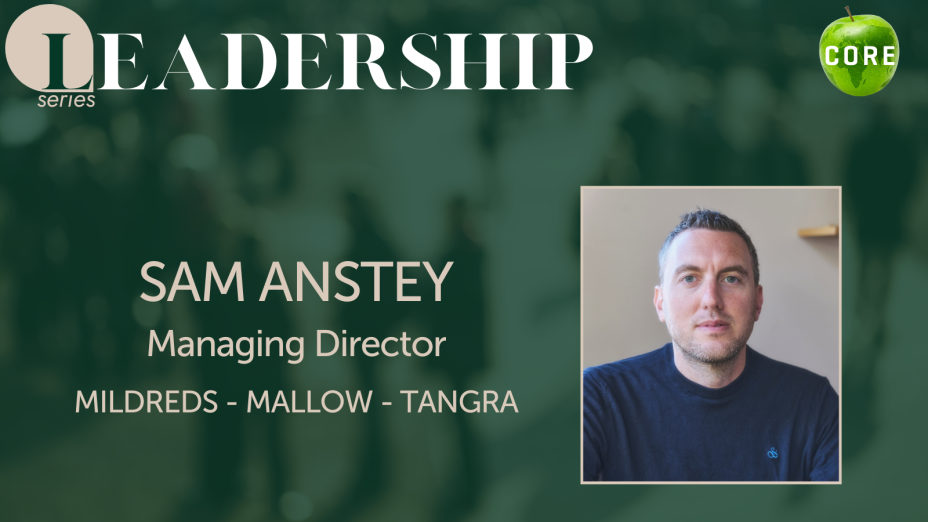
The CORE Leadership Series brings inspiring industry leadership to life through in-depth interviews.
This is the interview of Sam Anstey, Managing Director - Mildreds, Mallow and Tangra
Can you tell us more about Mildreds and your mission?
Mildreds began long before I arrived, back in 1988, as a small vegetarian café tucked away in Soho. What pulled me towards it was that it never felt preachy or self-important. It was simply great food, busy rooms and people who genuinely cared about hospitality.
For a lot of Londoners, Mildreds represents a different time in Soho and in the restaurant scene, something nostalgic, independent and full of character. That history carries real weight, and it is something we feel responsible for protecting as we grow.
Today we are still rooted in that same spirit. We see ourselves as a restaurant group first, not a label. My mission is straightforward. Create places people want to come back to, look after our teams properly, and prove that plant forward food can be indulgent, generous and full of flavour.
I have spent most of my career building restaurant brands, and what excites me about Mildreds is that we are not trying to convert anyone. We are just focused on creating brilliant hospitality that happens to be vegan. If guests walk out feeling looked after, slightly surprised by how good the food was, and already planning their next visit, then we know we are on the right track.
From a menu development and supply chain perspective do you have any unique challenges being a vegan concept?
Absolutely, but I see them as creative opportunities rather than limitations. You cannot rely on butter, cream or animal protein to carry dishes, so everything must be built properly from the ground up. That means more work in development, more tasting, more global influence and a real focus on balance and texture. We are lucky to have an incredible food development team around us. Sarah Wasserman (director of food & brand) is a real talent, and we work very closely together. She has written 3 cookbooks and understands that the vegan space demands serious creativity, which she absolutely nails. There is a constant energy in the kitchen around testing, refining and pushing dishes until they feel right.
From a supply chain perspective, we are very exposed to fresh produce pricing, which keeps me close to procurement and forecasting. My background has always been quite operational and financially focused, so I spend a lot of time making sure creativity and commercial reality sit side by side. The upside is that the food never feels predictable.
We can draw inspiration from India, the Middle East, Southeast Asia or Latin America and keep evolving.
The number of vegans is growing quickly. Are you looking to open more restaurants or move into retail or at home?
The real growth is not just vegans. It is people who want to eat better without feeling restricted. I think about Mildreds as a brand that meets people wherever they are on that journey.
Restaurants will always be the heart of what we do because I am a restaurant operator at my core. I love busy rooms, team culture and the energy of service. At the same time, our ambition is to build a multi concept vegan and vegetarian business in London, one that shows we can work across different cultures and cuisines while delivering world leading plant forward food. Concepts like Mallow and Tangra allow us to explore different identities and global influences, while still staying true to the same values around flavour, hospitality and creativity.
I do believe there is a future for retail and at home products if we do it in a way that protects the quality and the personality of the brand. Expansion only makes sense if it strengthens what people already love about us.
The South African hospitality scene is thriving. What attracted you to London?
London is one of the toughest hospitality markets in the world, and that is exactly why I stayed. It keeps you honest. There is an unmatched energy in central London that has kept me inspired for 25 years. Guests are curious, standards are high and competition is relentless. If you can build something that works here, it tends to travel well.
I have now lived in London longer than I ever lived in South Africa, but for years I always described it as a work experience that just kept going. Somehow that work experience turned into a 25-year journey. What makes London special is its diversity. It is one of the few cities where multi-cultural concepts can feel truly authentic, all existing side by side, and that has had a huge influence on how I think about restaurants and creativity.
Personally, I was drawn to that diversity from the start. Soho especially has always felt like a place where new ideas thrive. That energy shaped how I think about brands today. You must keep evolving without losing your soul.
Which previous leader has inspired you and why?
I have been fortunate to work alongside leaders who really understood people, not just numbers. Old school restaurateurs like Russel Joffe were some of the greats. The ones who influenced me most were calm under pressure, decisive when things were tough and never lost sight of culture, always with their finger on the pulse.
I also worked closely with Trish Corzine when we were franchising Giraffe into UK airports while she was CEO of TRG Concessions. She was an incredibly impressive operator and built a division of TRG that I have huge respect for. I learned something in almost every meeting we had. That period of my career exposed me to many operators I admired, people who balanced commercial discipline with real care for teams and guests.
As I have grown into more senior roles, I have realised that leadership is less about having all the answers and more about creating an environment where teams feel safe to push themselves. When you get that right, performance tends to follow naturally.
Not every day is a sunny day. What is your biggest failure and what did you learn?
I have made plenty of mistakes. Opening sites that were not quite right, holding onto people or ideas longer than I should have, believing that things might turn around without enough action.
The biggest lesson for me has been that hope is not a strategy. I use that line in many of my meetings!
People are always your biggest asset, but I have also learned that the wrong people or negative energy can impact a business far more than you realise at the time. One of the most important things I have tried to do over the years is surround myself with strong, positive individuals who challenge me and lift the standards of the whole team.
What experience has taught me is to be honest early, make decisions with kindness but also with pace, and accept that not every move will be perfect. The only real failure is not learning and not evolving.
What innovations excite you the most right now?
I am less interested in flashy technology and more excited by tools that quietly make restaurants run better. Better forecasting, smarter scheduling, tighter stock control. When systems work properly, they should always benefit the teams working in the restaurants first, not just satisfy the needs of head office. If the tools make life easier on the floor, service improves and guests feel it straight away.
We recently had an exec discussion around AI and how it could help us become more efficient, and I think there are some genuinely exciting opportunities there. AI has the potential to change how we approach data, training and guest feedback, maybe even reducing the need for some of the heavy systems and layers of support we rely on today. If it helps us understand our guests better, train teams faster and make smarter decisions in real time, then that is incredibly powerful.
The future for me is about using data to support intuition, not replace it. Hospitality will always be human at its core.
If you could give your younger self one piece of advice, what would it be?
Play the long game. Earlier in my career I probably said yes to too many things because I wanted to move quickly. Over time I have learnt that relationships, reputation and resilience matter far more than short term wins.
London has changed hugely over the past 25 years, and it has always been important to evolve with it, whether that is trends, inflation, recruitment or how guests behave. We have had our fair share of challenges and people interact with restaurants very differently now compared to pre covid. The biggest lesson has been that standing still is not an option, you must keep adapting while staying true to who you are.
I would also say that today everyone is a restaurant critic and we are never short of opinions. Listen, learn and stay open, but ultimately be true to what you believe is the right direction for your team and your business.
Focus on building great teams, protect your energy and remember that the best opportunities often come from consistency rather than chasing every new idea.
Author
Date Published: 5th February 2026
