
Leadership series: Ben Stead
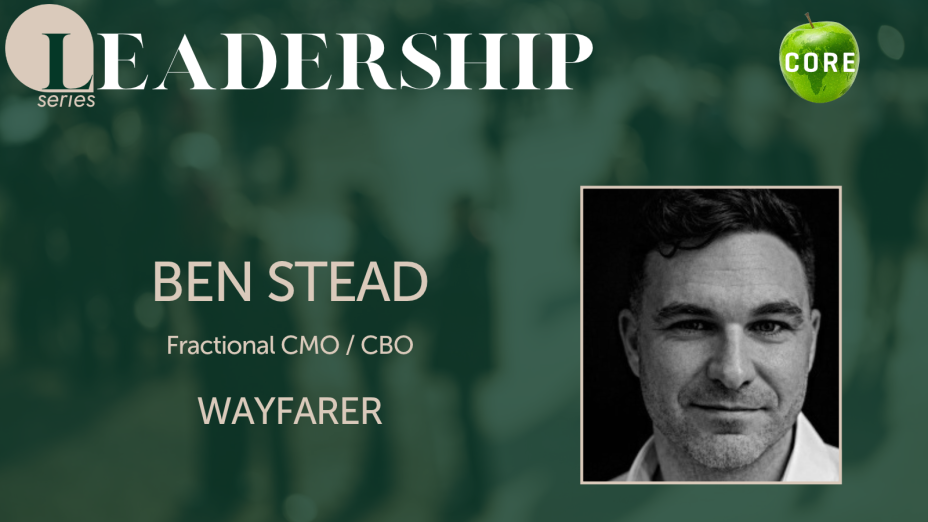
Our Leadership interview series tells the stories of inspiring leaders making an impact across the industry.
We are here talking to Ben Stead, Fractional CMO and CBO at WAYFARER, the strategic advisory practice that helps organisations close the gap between ambition and reality.
You've moved from hotel operations (Belmond, Pandaw River Expeditions) through consulting (LQA), a founder role (TAIAO Kombucha), regional and group leadership (IHG)and giga-project brand-building (NEOM)to now running your own advisory practice (WAYFARER). Which of those chapters changed how you think about brand the most, and why?
I grew up in operations, working across Anantara, Hyatt, The Sarojin and IHG before managing a hotel for Belmond in Myanmar and leading Pandaw's river cruise operations on the Mekong as regional general manager. So I knew what it took to keep a promise on a bad day. But LQA, which benchmarks luxury hotels against global standards, is the chapter that changed how I think about brand.
I worked with around 150 luxury hotels across 30 brands, comparing what the brand said would happen with what actually happened to the guest. The same pattern turned up everywhere. The brand promises warmth, and the receptionist hits every standard, uses your name, offers help with your bags, and never once looks up from the screen. It's rarely bad intent. Usually, it's a standard that's been trained as a script rather than a feeling.
That's why the emotional standards mattered most. Alongside the technical ones, LQA scored whether the person read my mood, anticipated what I needed and made it personal, and whether I left feeling neglected or like I mattered. The technical standards are the price of entry.
Get them wrong and guests notice straight away. Get them right and nobody books again because the towels were folded properly. The emotional ones are what people come back for.
They're also what makes a brand distinctive. Byron Sharp and Mark Ritson both talk about distinctive brand assets, the cues that tell you whose brand it is without reading the name, like a colour, a logo or a sound. They're mostly talking about being noticed and remembered when people are choosing. My take is that once a guest is through the door, the assets that matter most are behavioural: how the team greets you and how a problem gets put right. Do them consistently enough and people connect them with you and nobody else. Being recognisable isn't the whole job, though. You still need a reason to be chosen, which is where differentiation comes in, and the way your people behave can give you both. A competitor can copy your rooms, but they can't copy how your people make guests feel. The same goes for retail, airlines, banking and healthcare, and even B2B, where how you answer the phone or follow up after a meeting says more about your brand than the pitch ever will.
That chapter is when I stopped thinking of brand as a communications job. Marketing has four Ps, product, price, place and promotion, but most marketing teams only really get to work on promotion, because it's the easiest to track, especially online and on social. Those channels matter, but everyone's playing there and it's very hard to stand out. Brand should shape all four: what you sell, what you charge and where people experience it, not just what you say about it. And the experience is only ever as good as the people delivering it, so you need the right people, and you need to look after them. Everything I've done since, at IHG, at NEOM and now with WAYFARER, has been about closing the gap between what a brand promises and what people actually experience.
You call the gap between promise and delivery 'Promise Debt.' What's the most expensive example of promise debt you've seen a brand carry, and how did it show up to the customer?
I put it simply: brand creates the promise, operations pays the debt. Every promise is borrowed against future delivery, and someone on the front line has to pay it back every single time. If they can't, the debt doesn't disappear. It builds. It was the subject of my talk at Cannes in 2026, because I think the industry has been running it up for years. Rates have gone up and the marketing talks about seamless, personalised stays, while the teams delivering them have got leaner.
The most expensive version I see is recognition. A brand spends years and a lot of money telling guests it knows them. The app remembers your pillow and the emails use your first name. Then you arrive after a long flight and the person at the desk asks you to spell your surname. On its own that's a small miss, but you were told you'd be known, so it feels like a broken promise. Guests rarely complain. They quietly downgrade you in their heads, stop opening the app and next time book on price through a third party. The money spent building that expectation ends up making the disappointment worse, and a loyal guest becomes a price shopper. Every sector has its version, like the bank that says it's there for you and then leaves you on hold for forty minutes.
I use a simple chain: promise, proof, memory, momentum. Promise Debt is what happens when the proof never turns up. The guest still leaves with a memory. It's just the wrong one, and that's the version they tell other people.
My advice to any leadership team is to treat every promise like a loan. Before it goes out, be clear who delivers it, what it costs to deliver every single time, and how you'll know it's happened. If you can't answer those three, don't make the promise yet.
Fractional CMO/CBO work is becoming a real category rather than a stopgap. What made you decide to build a practice around embedded, time-bound leadership instead of taking another permanent seat?
It is becoming a real category, because a lot of businesses need senior experience for a specific job rather than a permanent headcount. Timing played a part for me too. My role at NEOM came to an end in March 2026, and rather than rush into the next big job I wanted to use the moment properly. So, I set up WAYFARER, and it's become one of the most useful stretches of my career.
The reason is range. In hospitality I'm advising a longevity hotel concept and a project turning an existing building into a compact, space-efficient hotel. Outside it, I've worked with a Series A travel-tech business on winning luxury customers and a medical AI company moving from specialist credibility to mainstream trust. I advise Peace One Day and other charities, do keynotes and I judge and chair industry awards. On paper none of it has much in common. In practice it's the same problem every time: the gap between what an organisation promises and what it can prove.
Peace One Day is a good example. Peace is about as abstract a promise as you can make, and abstract promises are hard to fund. A lot of the work has been making it tangible, a donor proposition that shows people exactly what their money does. That's the same job as a hotel brand, just with higher stakes. Working across sectors at once, and judging a lot of other people's work, you quickly learn which problems are universal and which are just one company's habits.
It isn't an anti-corporate stance. I've spent most of my career inside big organisations and I'd happily do it again for the right business. What's changed is what I'd bring. Working embedded and time-bound forces you to find the real problem fast and leave something that works without you. That's a pretty good description of what any senior leader should be doing anyway.
Leading Brand and Experience for the hotel division of an entirely new destination meant building a brand system for something that didn't fully exist yet, at a scale most brand leaders never encounter. What's the hardest part of writing a brand playbook before the physical product is finished?
There's no guest to watch. Normally you'd build a playbook from what's in front of you: how customers actually use the place, what the brand needs to stand for, and what the business needs it to deliver commercially and operationally. When the building doesn't exist yet, you can see the brand and the business case, but the customer is a guess, and the personas you inherit are usually thinner than anyone likes to admit.
So, the first job at NEOM was to unfreeze what we thought we knew about guests. We took every persona and asked what it was hiding: what frustrates this guest, what do they want but would never say, and what don't they realise yet? It's how you catch lazy assumptions, like "price-conscious guests have low expectations". We also designed the guest we'd never want, like the flashy status seeker who wants VIP labels and to be treated differently from everyone else. It sounds like a joke, but agreeing what a brand isn't tells you more than most positioning statements.
Then we made people feel it before it existed. We read short scenes aloud with music playing, the walk from a shared space back to the room, moment by moment, and asked what people felt and what they'd need before they could switch off. That's experience design at its most practical, and it's far cheaper to find a problem in a story than in a finished building.
The second hard part is that a playbook is just words until someone delivers it, so we designed the employee experience alongside the spaces, not after them. One exercise asked what an employee would never say. You'd never hear "Sorry, that's not my job." You would hear "Let's figure this out together." A line like that explains a brand better than twenty pages of standards, because to the guest, the housekeeper they pass in the corridor is still the brand.
Large-scale destination developments move fast, are highly ambitious and answer to shareholders with a long time horizon. How do you protect brand and guest-experience thinking from getting flattened by construction timelines and political pressure?
The odd thing about projects like that is that the shareholders are thinking in decades while the construction programme is thinking in weeks, and the guest experience gets squeezed in the middle. You can't make that pressure go away, so you build habits that make good ideas harder to kill.
I always look for what I call the RED thread: an idea that's Relevant to what people need, Easy to understand and use, and Distinctive enough to remember. The workshops I designed and facilitated were built to find it, and I've always believed the answers are usually already in the room. Someone knows exactly what a guest will hate or what will go wrong on day one, but they're not the most senior person there or the loudest, so it never gets said. A good facilitator makes sure the right voice is heard, not the biggest title.
So, the rules were simple. Build on an idea before anyone's allowed to shoot it down. Be guests, not tourists, which means taking ownership, challenging properly, and noting the watch-outs without letting them limit the thinking. Anything off-topic gets parked, not killed. Timelines and budgets are real but let them into the room too early and you end up with something quick and cheap that doesn't work for guests, employees or owners. That isn't business-ready.
We also needed a shared way of judging ideas, so I adapted a 1-to-10 creativity scale the advertising world has used for years. At the bottom was anything reckless or culturally careless, which matters when you're a guest in someone else's culture. A 5 was safe and expected, brand wallpaper, and the target was 7 and above. Fresh flowers and pre-set lighting before a guest arrives is a 5, so the job was working out what makes it a 7. Once a room agrees on the bar, the debate stops being about rank and starts being about whether the idea is any good, which takes a surprising amount of the politics out.
The last habit is agreeing the feeling and the people early. The build runs on its own clock, and you can have every design signed off and still find nobody can say how a space should feel or who'll bring it to life. Then you end up with beautiful rooms and no idea what they're for. That's true of any big capital project, from a hotel to a hospital.
What did designing hospitality for places that didn't exist yet teach you about the future shape of destination and hospitality brands more broadly?
Two things. The first is that the hotel as a single building, sealed off from the place around it, is on borrowed time.
Some of the most interesting work I did was on a concept where the rooms were spread through neighbourhoods rather than kept in one building, with shared spaces used by guests and locals alike. People increasingly want to live in a place for a few days, not look at it through a lobby window. That changes the brand job completely. You're no longer designing a property; you're designing how someone belongs somewhere and the locals have as much say as the guests. Nobody wants their culture served up as a performance, or to feel less important than the visitors in their own neighbourhood. If the shared spaces don't work for the people who live there, they don't work at all.
The second is that experience design is becoming a core business driver. As more of life moves onto screens and AI makes content and convenience close to free, the things you can only get by turning up somewhere become more valuable. People will go out of their way, and pay, for a physical experience that feels real, and judge it on how it made them feel. That goes well beyond hotels. The shops that are thriving are the ones worth visiting, and the same will be true of offices, airlines, venues and whole destinations.
Doing that at scale means keeping the feeling consistent while letting the format change from place to place. We had a principle for the shared spaces that I still like be less, but loved. Do fewer things, do them properly, and people remember how they felt rather than a list of what was on offer.
Projects on that scale always change shape along the way, but the thinking behind them travels well beyond any one place.
Across Four Seasons, Aman, Mandarin Oriental, Six Senses and the other names you’ve worked with, is there a single shift in what 'luxury' means to guests today that you think most operators are still underestimating?
Yes. Luxury is shifting from something you show off to something you feel. I've worked with most of the names in that question, and the best of them already get this: luxury is never a transaction, it's about intent. At the top end, guests have been impressed plenty. Marble and a long list of amenities stopped being the point a while ago. What they want now is to feel understood, which is much harder to deliver.
What operators underestimate is what that shift demands, starting with how quickly scale turns into sameness. You get the same spa menu and the same scripted welcome in Bangkok and in Mayfair, and at those rates, generic feels like poor value. The places people rave about feel like they could only exist where they are.
Personalisation is where most get it wrong. I've seen one of the big groups print guests' names on shampoo bottles and embroider them into flannels. It sounds thoughtful in a meeting. In practice the bottles went in the bin once they were empty, and the flannels didn't last much longer because the quality wasn't there. That isn't personalisation, it's performative.
Real personalisation is someone noticing something and acting on it without making a show of it. One of the best examples I've had was at a luxury hotel on Koh Samui in Thailand. I was talking in the car to my partner about Hat Yai fried chicken, a southern Thai speciality, and the driver overheard. The next morning, it was waiting for me at breakfast. I never asked and nobody made a fuss, and that's the kind of thing people remember for years. It can be as small as remembering where someone likes to sit and keeping it free. None of it costs much. It needs people who pay attention and are allowed to act, which is harder to scale than a script, and exactly why it's worth so much. The same goes for any business. Putting someone's first name on an email isn't knowing them.
Give me quiet, properly delivered luxury that belongs to its place over marble and logos any day.
You've led teams on a large-scale destination development, inside a global hotel group, and now in your own practice. How has your leadership style had to change across those very different environments?
My leadership was formed outdoors, early in my career. I qualified as an outdoor leader, responsible for people in places that don't forgive mistakes, and getting there took a lot of determination. I went on to study Outdoor Adventure, Leadership and Management at university, a demanding academic degree where we were also expected to lead in industry, after lectures and in our own time. That work didn't pay the rent, so I was leading teams in food and drink as well. By the time I graduated I'd been leading real teams, in two very different worlds, for years.
The outdoors teaches you principles you don't forget. You're responsible for people's safety, so trust comes first, because nobody stretches for someone they don't trust. You make decisions with incomplete information in changing conditions, and you own them. And you review everything afterwards, because an experience only becomes learning when you reflect on it.
That's where my discovery-based approach comes from. I push people because I want the best out of them, give them the autonomy to make their own decisions and learn from them, and coach them as they need it. What I never do is throw anyone in at the deep end. Think of the Comfort Zone Model. People learn most when they're stretched just past what feels comfortable, but push too far and it tips into panic, where nobody learns anything. I also don't treat everyone the same. A team is like a hand. The fingers look much the same, but each one does a different job and needs treating differently. Get that right for every finger and the hand works.
I've spent the last twenty years honing that approach with multinational, multicultural teams across Southeast Asia, the Middle East and Europe. Different cultures need different things from a leader, which is exactly why the hand matters. The core hasn't changed, but where I apply it has. At IHG, most of the people I needed across a global matrix of brands, regions and owners didn't report to me, so trust did more than the org chart ever could. At NEOM, the team was building something nobody had done before. The job was keeping them in that stretch zone while the ground moved, and growing them, including a succession plan for a senior role. Now I do it with clients' teams through WAYFARER.
The part I'm proudest of is the people. I've coached and grown dozens of people who are in far better positions now because someone pushed them, and I still give my own time to mentoring. I've been the one asking for help, so now it's my turn to give back. Who knows where they'll be in five, ten or fifteen years. I might be asking one of them for a job.
What I hold onto through all of it is consistency, clarity and a bit of courage.
If you could change one thing about how the hospitality and destination industry treats brand and customer experience, what would it be?
I'd stop treating brand and delivery as two different jobs with a handover in between. For me, the real value is in that messy handover between strategy and delivery, and it's where most of the damage happens too.
What still baffles me is how good the industry is at the front end, the brand books and the journey maps, and how little of that effort follows the promise onto the floor. Journey maps are useful when they change decisions, but generally useless when they become a neat way of documenting what everyone already knew and still avoids. The brand team signs off the promise, operations inherit it, and the front line finds out what it means when a guest asks. A new signature welcome launches with a video and a lot of excitement, and six months later plenty of hotels have never heard of it, because it never made it into training.
So, I'd judge the work less on how good the strategy looks in the boardroom and more on what actually gets fixed, and whether the business is more capable of delivering its promise than before. If brand and experience leaders were measured that way, a lot of very expensive decks would never get made, and a lot of guests would have a better stay.
I'd also put the people who deliver the promise in the room when it's written, because engaged people are where the returns come from. Harvard's Service-Profit Chain made the link back in 1994: look after your people, they look after your customers, and your customers look after your numbers. A classic eleven-year study of more than 200 companies found that those whose cultures valued employees and customers as much as shareholders grew net income by 756%. The rest managed 1%, which is a loss once you allow for inflation. Gallup's 2024 research puts the profit gap between the most and least engaged teams at 23%.
Experience design is the discipline that joins all of this up, and it's going to be one of the biggest drivers of value in any business, because good experiences, delivered by people who care, compound over time. Get that right and you stop running up Promise Debt, the gap between what a brand promises and what it actually delivers. Get it wrong and every new campaign just borrows a bit more against a front line that's already overdrawn.
What do you want WAYFARER, and your body of work more broadly, to be known for in ten years?
Making brands prove what they promise.
I'd like physical proof to be taken as seriously as positioning is today, meaning the things a customer can see, touch and feel that tell them the promise is true. Guests don't judge a meal in isolation. They judge it through the glass, the chair, the lighting, the music, the service and all the small physical cues operators dismiss as "not the product". The strongest proof of all is emotional, though. Whether someone read the moment, noticed what you needed and actually cared is what people remember longest, and no amount of design makes up for it when it's missing. If in ten years hotel groups review their brands by walking the building and listening to what guests remember, rather than reading the strategy deck, I'll be happy. And if Promise Debt, the gap between what a brand promises and what it actually delivers, becomes a phrase leadership teams use to check their own business, even better.
I'd also like to have changed how people think about friction. The industry is obsessed with removing it, and plenty of it should go, but the goal isn't to remove friction, it's to remove anxiety. Some friction is the best part of the experience. Waiting for a table everyone wants builds anticipation, and people will pay for it. A host who walks you to your room rather than pointing you at the lift creates a connection. Small gestures of goodwill like that look like inefficiency on a spreadsheet, so they're often the first thing to be cut. My test is simple. If the friction creates meaning, memory or margin, keep it. If it just creates hassle, take it out. That's where technology earns its keep: let it handle the hassle, so your people have time for the moments that matter. As so much else goes digital and frictionless, positive friction will only become more valuable.
On a personal level, my purpose has always been to create positive memories. I've run an exercise with teams where they imagine a guest who has forgotten the hotel's name but remembers exactly how the stay felt and then ask what that feeling was. That question is the job, really. The customer doesn't take the journey map home. They take the memory of how you made them feel, and that memory is what brings them back.
WAYFARER is about orientation, which is probably the outdoors in me coming out. In unknown terrain a fixed map is less use than knowing how to find your bearings, and that's where most of the businesses I work with are. I want WAYFARER to be known for helping good businesses find their way through ambiguity without losing what made them worth choosing in the first place.
If people look back and say we helped a few good brands keep their promises, that'll do me.
Author
Date Published: 7th October 2026
