
Leadership series: Didier Agueh
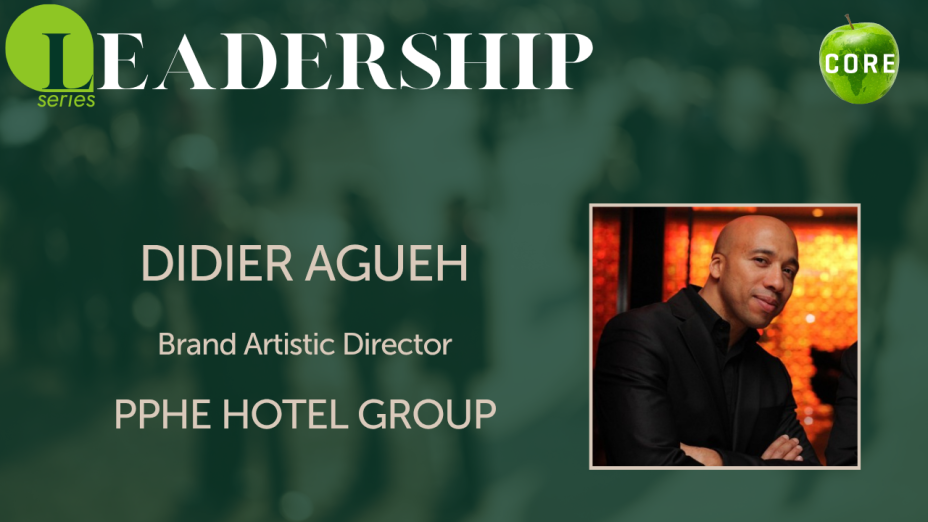
Our CORE Leadership Series documents the perspectives of influential and inspiring industry figures.
We are here interviewing Didier Agueh, Brand Artistic Director and Executive Host at PPHE Hotel Group.
Could you briefly introduce yourself, your role, and the core mission of your organisation within the hospitality landscape?
My name is Didier Agueh, and I am Brand Artistic Director at PPHE Hotel Group, working across our hospitality brands with a strong focus on art’otel, our lifestyle brand where art, culture, design, hospitality and guest experience come together.
My role sits at the intersection of brand, culture, entertainment, partnerships and experience. In practical terms, this means curating artistic and cultural programmes, developing entertainment concepts, building creative collaborations, supporting venue positioning, and helping our hotels become more than places where people simply stay.
For me, the mission is to create hotels with a real pulse. Hospitality today is not only about rooms, restaurants or service standards. Those things are essential, of course, but guests and local communities increasingly want places that feel alive, relevant and emotionally engaging. My work is about helping our spaces become destinations where people can discover art, listen to music, meet interesting communities, attend talks, enjoy cultural moments and feel connected to something bigger than a transaction.
What initially inspired you or sparked your interest in pursuing this career?
My interest started very naturally through music, nightlife and travel. I was lucky to be exposed quite early to international hospitality, entertainment and cultural scenes, particularly through cities and places where music and lifestyle were central to the experience.
One of the biggest turning points for me was discovering Ibiza when I was 18. It was not only about clubs or parties. It was the first time I truly understood the emotional power of atmosphere. The right music, the right crowd, the right space and the right energy could bring people from completely different backgrounds together and create memories that stayed with them for years.
That shaped the way I see hospitality. A hotel, a bar or a restaurant can be beautifully designed and perfectly operated, but what people often remember most is how a place made them feel. That emotional layer became my passion. Over time, I became increasingly interested in how entertainment, art, music, storytelling and cultural programming could elevate hospitality brands and create deeper connections with guests and local communities.
What motivates you in your work and what do you find most fulfilling about being a business leader?
What motivates me most is turning ideas into moments that people genuinely remember.
I love seeing a concept evolve from a conversation or a piece of inspiration into something real: a rooftop filled with music, a gallery hosting a powerful cultural discussion, a hotel lounge transformed by a live performance, or an emerging artist being given a platform in front of a new audience.
What I find most fulfilling is when creativity creates value on multiple levels. It should create emotion for guests, visibility for the brand, opportunities for artists and partners, pride for the teams, and ultimately commercial impact for the business.
I also enjoy connecting people. A big part of my work is about building bridges between hospitality and the creative world — musicians, artists, cultural communities, brands, media partners and local audiences. When those connections feel authentic, they can completely change the energy of a venue or a hotel.
Thinking about the macro-economic and social environment, what shifts do you believe will redefine “success” for our sector in the coming year or years?
The hospitality sector is facing very real pressures: rising costs, labour challenges, changing customer expectations and an increasingly competitive landscape. Because of that, I believe success will no longer be defined only by traditional metrics such as occupancy, spend or footfall, even though those remain extremely important.
The next definition of success will be more layered. Hotels and hospitality brands will need to ask themselves: Are we culturally relevant? Do local communities want to engage with us? Are we creating experiences that people talk about and share? Are we giving guests a reason to come back beyond convenience or price? Are our teams proud to be part of the story?
Guests are becoming more selective. They want authenticity, value, quality and a sense of meaning. They can feel very quickly when something is generic. So the brands that succeed will be the ones that know who they are, what they stand for, and how to create experiences that feel distinctive.
For me, the future of success in hospitality will be about combining operational excellence with emotional intelligence. You need the fundamentals to be strong, but you also need soul, identity and cultural relevance.
What do you believe will distinguish the leading service providers over the next decade?
The leading hospitality brands over the next decade will be those that move beyond being service providers and become experience platforms.
Beautiful design, good food, efficient service and comfortable rooms are expected now. They are the starting point, not the full story. What will distinguish the best brands is their ability to create a strong point of view and build a world around it.
That world might include art, music, wellness, fashion, food, technology, sustainability, local culture or community. But it has to feel coherent and authentic. People want to feel that a brand has taste, personality and purpose.
I also think the most successful brands will be those that understand the importance of local relevance. A hotel cannot only speak to travellers. It also has to mean something to the city it belongs to. When local people choose to come to your bar, restaurant, rooftop, gallery or cultural event, that is when a hotel starts to become truly alive.
The future belongs to hospitality brands that can create belonging — not in a forced way, but through genuine experiences, great curation and meaningful connections.
What innovations, technological, experiential, or operational, excite you the most right now?
I am very interested in the way technology can help hospitality become more personal, more creative and more connected — as long as it remains human.
AI is obviously one of the most exciting areas. I see it as a powerful tool for efficiency, creative development, personalisation and insight. It can help teams work smarter, understand guest behaviour better and develop ideas faster. But I do not believe AI replaces taste, emotional intelligence or human instinct. In hospitality, those things remain essential.
I am also interested in Web3, digital membership models and community-driven platforms, especially when they are made accessible to people who may not be familiar with the technology. Used well, these tools can create new forms of loyalty, access and engagement around art, culture and hospitality.
Experientially, I am excited by immersive storytelling, AR, sound design, sensory branding and cultural programming that extends beyond the traditional hotel stay. The question I always ask is: how can innovation make the guest experience richer, not more complicated?
Technology should not be used just because it is fashionable. It should help create better memories, stronger relationships and more meaningful experiences.
What skills or mindsets do you think will be most important for the next generation of hospitality leaders?
The next generation of hospitality leaders will need to be adaptable, emotionally intelligent and culturally curious.
Hospitality is changing quickly. Leaders can no longer rely only on traditional formulas. They need to understand business, of course, but also people, creativity, technology, community, sustainability and brand identity.
Curiosity will be one of the most important qualities. The best leaders will be those who keep learning, keep observing and stay open to what is happening outside their immediate industry. Inspiration can come from music, fashion, art, technology, nightlife, wellness, sport or social movements. Hospitality does not exist in isolation.
I also think future leaders will need courage. Not reckless courage, but the courage to try new ideas, challenge old habits and create experiences that feel fresh. At the same time, they will need humility, because leadership today is less about having all the answers and more about bringing the right people together.
The leaders who succeed will be those who can combine commercial discipline with imagination.
What’s the most important leadership lesson you’ve learned?
One of the most important lessons I have learned is that a good idea is only powerful if people can understand it, believe in it and help bring it to life.
In creative roles, it is easy to be passionate about an idea because you can already see the final vision in your mind. But leadership requires translation. You need to explain the idea in a way that makes sense to different people: operations, marketing, finance, general managers, artists, partners and senior leadership.
I have learned that vision needs patience. You have to listen, adapt, build trust and bring people with you. Sometimes the idea is right, but the timing, language or execution needs to be adjusted.
Another important lesson is that creativity and structure are not enemies. The best creative work often happens when there is a clear strategy, a strong framework and good communication behind it.
What do you hope your legacy will be both for your organization and for the hospitality industry more broadly?
I hope my legacy will be to show that culture is not an accessory in hospitality. It is not just decoration, background music or something “nice to have”. When it is done properly, culture can become a serious driver of identity, loyalty, revenue, community engagement and brand differentiation.
For my organization, I would love to contribute to a future where our hotels are recognised not only for their design, service and locations, but also for the cultural energy they bring to their cities. I want our spaces to be places where guests and locals can discover artists, hear great music, attend meaningful events, meet interesting people and feel inspired.
More broadly, I hope to encourage the industry to take cultural programming more seriously. Hospitality has an incredible ability to bring people together. If we use that power with imagination and responsibility, hotels can become modern cultural hubs — places of connection, creativity and discovery.
That is the kind of hospitality I believe in.
How do you see culture, entertainment and community shaping the future of hospitality?
I believe culture, entertainment and community will become some of the strongest differentiators in hospitality.
For many years, entertainment was often treated as something secondary — a DJ in the corner, background music, or an occasional activation. But when curated properly, entertainment becomes part of the identity of a place. It influences who comes through the door, how long they stay, how they feel, what they share and whether they return.
Culture gives a brand depth. Entertainment gives it energy. Community gives it meaning.
The future of hospitality will not only be about selling rooms or tables. It will be about creating ecosystems where people feel connected to a lifestyle, a set of values, a creative scene or a shared experience.
This is especially important for lifestyle hotels. A great hotel should not feel disconnected from the city around it. It should reflect and contribute to the local cultural landscape. That could be through live music, exhibitions, talks, artist collaborations, wellness sessions, creative partnerships or community-led events.
The opportunity is huge. Hotels have beautiful spaces, international audiences, local visibility and operational expertise. If we combine that with authentic cultural curation, we can create places that feel much more relevant, memorable and human.
I believe the future of hospitality belongs to brands that understand that people are not only looking for service. They are looking for emotion, identity, connection and stories worth remembering.
Author
Date Published: 21st May 2026
