
Leadership series: Fabio Bensaja
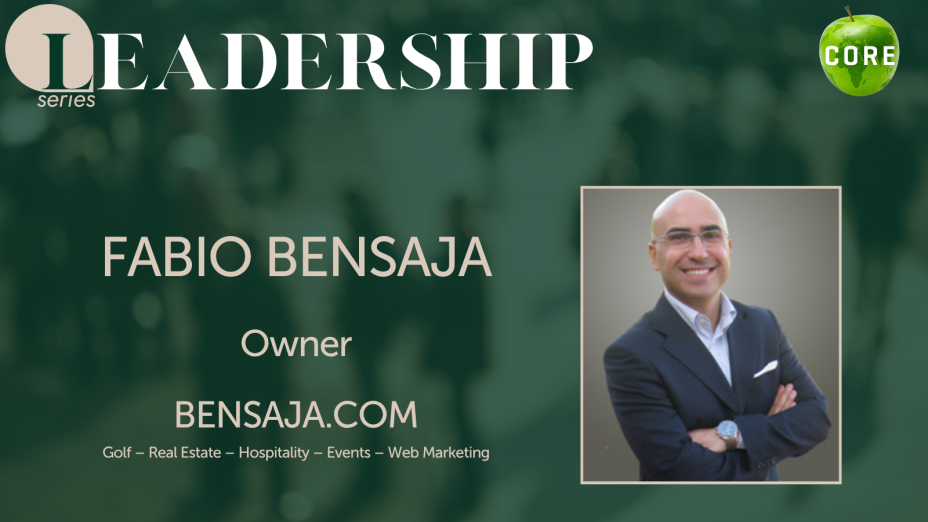
Through our CORE Leadership Series, we highlight outstanding industry leaders through in-depth interviews.
In this interview, we speak to Fabio Bensaja, Owner of BENSAJA.com: Golf – Real Estate – Hospitality – Events – Web Marketing
Tell us a little about yourself and your business.
I was born in 1972 in Reggio Calabria, in the heart of the Mediterranean, between Scilla and Charybdis. Growing up at a crossroads of cultures—Greek, Byzantine, Arab, and Spanish—forged in me that "warrior" and tenacious character typical of my land. I chose to graduate in Political Science with an international focus in the 1990s, just as a united Europe was taking its decisive steps; I wanted to understand the global mechanisms that were changing our lives. Since then, my engine has always been one: the curiosity to not just look, but to observe in order to understand.
My career is a constant evolution driven by this attitude. I started with IT training, transforming a teenage passion into a solid technical skill. Later, I decided to challenge myself in the world of golf—not merely as an enthusiast, but by studying at the FIG National School of Golf to become a Director. This path allowed me to serve as General Manager in some of Italy's most prestigious Golf Resorts, eventually leading to strategic consultancy. During those years, I had the intuition to apply Revenue Management principles—then in their infancy—to the golf sector, creating innovative management models.
My entrepreneurial journey didn't stop there. My drive for problem-solving led me to range from automotive patents to initiatives in the food industry and digital services for social welfare. I have encountered successes and, naturally, mistakes. But as Leonardo da Vinci said: "It is not he who begins, but he who perseveres." I firmly believe that failure is simply a necessary stage for those who choose to act.
After years away, the call of my roots and the desire for a new balance brought me back to Calabria. What was meant to be a "contemplative" return transformed into a new professional challenge. I began by exploring non-hotel hospitality, discovering a world of fascinating human and managerial dynamics, very different from traditional “hôtellerie”.
This research projected me into Real Estate. Observing the gaps in the local market, I decided to apply my managerial experience by opening my own real estate agency. In just one year, we grew from a single office to a central Hub with several agencies and operational points across the metropolitan area, expanding throughout Calabria thanks to a synergy with the "Casaspetti" network.
Today, my business is the synthesis of my various paths: in real estate, I also specialize in the sale of luxury hotel and tourist facilities. I believe that only those who have managed these structures from the inside can be truly authoritative and competent intermediaries. The future? I don't know what the next challenge will be, but I know that as long as there is a frontier capable of making me curious, I will be there, ready to open that door.
What motivates you in your work and what do you find most fulfilling about being a business leader?
Honestly, I have never viewed the role of a leader in terms of personal "gratification." More than the prestige of the position, what deeply motivates me is the sense of responsibility toward my team. For me, being a leader means being the catalyst for collective enthusiasm: my main task is to maintain high morale and ensure that every team member not only sees the goal but fully shares the vision.
I consider gratification almost superfluous compared to the concreteness of the result. When a goal is set, achieving it is—or should be—the norm, not the exception. For this reason, I experience every success not as a finishing line, but as the starting point for the next challenge. In a sense, I embrace the philosophy of the "infinite": once a goal is reached, the bar is immediately moved forward.
However, there is an aspect that precedes every action: intellectual honesty. I never accept a challenge unless I am convinced of its feasibility or the value it can generate. This does not mean avoiding risk but approaching it with such preparation that victory becomes the only acceptable outcome. If circumstances change, I change the strategy, but I never deviate from the objective. It is this constant drive toward excellence, combined with the ability to adapt without losing course, that gives meaning to my business ventures.
How do you stay updated on industry trends, customer expectations, and regulatory changes?
I believe my humanistic background is my true compass. Rather than relying exclusively on industry reports, I prefer to use the tools of observation to "read" people and intercept the vibrations of a society in perpetual change. For me, staying updated doesn't just happen behind a desk, but through what I would define as a kind of "urban anthropology."
I enjoy observing purchasing behaviors in shops, studying how young people interact, listening to new musical trends, and analyzing the languages of social media and cinema. I constantly try to read between the lines to identify "weak signals" before they become mass trends. Often, my best business intuitions have been born precisely from this ability to process anthropological data and transform it into an entrepreneurial vision.
Regarding the regulatory landscape, we find ourselves in an era of great complexity and, at times, contradiction. I see a system that often overlaps, creating uncertainty. I face this challenge with a critical and rigorous approach: I believe our generation has the duty to untangle these complexities to build more solid foundations for those who come after us. In a fluid regulatory context, the key is not just compliance, but the ability to be resilient and ready to recalibrate business strategy quickly, protecting the value we create for our clients and the territory.
Where do you think the most promising investments should be focused on and/or made on?
We live in the age of Artificial Intelligence, a time when efficiency and speed are becoming commodities. In this scenario, I believe the most promising investment lies in what technology can never replicate: authentic human warmth. I am referring to that ability to transmit trust and value through a handshake, personalized attention, or a shared emotion.
While global capital shifts massively toward the cybernetic sector and mass process automation, I see an extraordinary opportunity in going against the grain. In sectors such as high-end tourism, luxury Real Estate, excellence in food and wine, fashion, and starred hôtellerie, "luxury" is no longer just the product, but the quality of the relationship. If digitalization serves to manage the mass market, the niche market will increasingly demand analog and sensory experiences.
Betting on "human capital" and relational skills may appear to be an unconventional choice today, but I am convinced it will become the primary factor of competitive differentiation. Especially in a country like Italy, where the culture of hospitality and the aesthetics of living are intrinsic assets, investing in Luxury Experience Management means occupying the only segment that will gain value over time: the one where the human being remains at the center of the process.
Have you achieved everything you wanted in your career so far?
If I said yes, it would mean that my curiosity has run dry, and for me, that would be the true failure. I have reached significant milestones: managing prestigious resorts, innovating with revenue management, and building a real estate Hub in my homeland. However, I consider every achieved goal not as an end point, but as a new base from which to look further ahead. As I often say, as long as I have the strength to be curious, there will always be a new door to open.
What do you see as the most significant challenges and opportunities currently shaping the service industry/sector?
The main challenge is hyper-digitalization, which risks sterilizing the relationship with the client. The opportunity, conversely, lies in the "paradox of abundance": in a world full of automated and cold services, excellence in human service becomes an absolute luxury. Those who can combine algorithmic efficiency with empathy and the ability to "read" the unspoken needs of people will dominate the market in the years to come.
How do you balance the demands of commercial performance with staff well-being, retention, and culture building?
I do not believe lasting performance can exist without a culture of well-being. As a leader, my responsibility is to maintain high morale and share the vision: if the team doesn't "feel" the goal as their own, performance will be nothing more than an ephemeral numerical data point. The strength and commitment of collaborators are obtained by making them participants in the intellectual challenge and respecting their human balance. A happy consultant transmits that confidence which is the foundation of every successful sale.
What strategies have proven most effective for attracting and growing future talent?
Intellectual honesty and direct involvement. Young talents today are not just looking for a salary, but for a project that stimulates them to use their brains for what they were created for: understanding and solving. My strategy is to give them autonomy and continuous training, even in areas seemingly distant from their core business. I attract talent by showing them that here they don't just "execute," but they learn to "observe" and build their own professional future.
What innovations, technological, experiential, or operational, excite you the most right now?
I am excited by anything that frees up time for the relationship. In real estate, for example, the integration of AI systems and home automation that simplify operational management is fundamental. But the innovation that fascinates me the most is "experiential": the ability to use data to personalize hospitality or real estate searches so deeply that the client feels like the sole protagonist. The future is an invisible technology at the service of a real emotion.
Looking back, what has been the most pivotal moment in your career, a turning point that shaped how you lead today?
The most critical and formative moment was deciding to leave a consolidated position in sports management to start from scratch in my home city. There, I understood that true leadership does not come from the rank on your jacket, but from the ability to persevere when certainties fail. That transition taught me that a leader must first and foremost be an example of courage and strategic adaptability: changing course without ever losing sight of the horizon.
What advice would you give emerging leaders who want to shape the future of the service industry?
Study things that seemingly have nothing to do with your work. Nourish your curiosity with political science, sociology, art, or pure technology. A leader in the service industry does not sell a product; they sell a solution to a human need. To understand human beings, you must look beyond the boundaries of your office. Do not limit yourselves to look; observe, delve deep, and have the courage to be "analog" in a world rushing toward pure digital.
Author
Date Published: 5th August 2026
