
Leadership series: Joshua Becerra
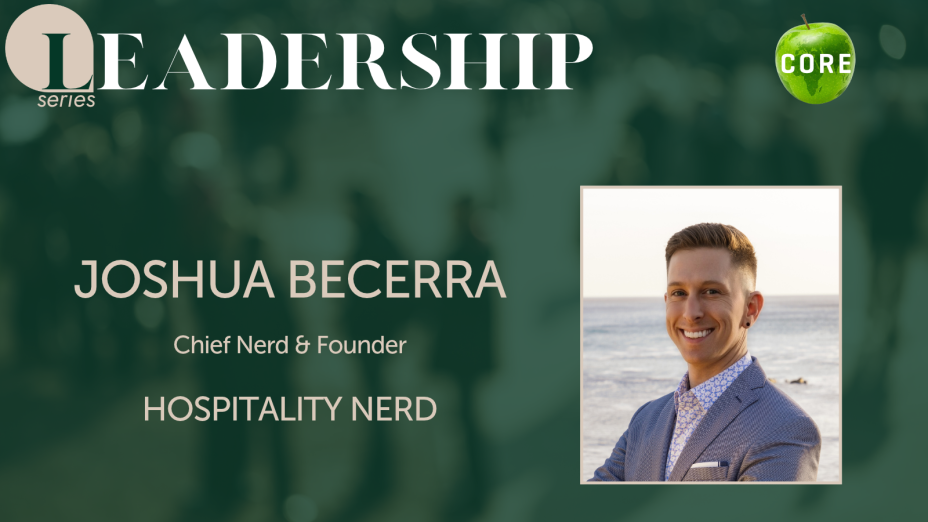
Meet the industry’s most inspiring leaders in our Leadership series of in-depth conversations.
In this episode, we are speaking with Joshua Becerra, Chief Nerd & Founder, Hospitality Nerd.
Tell us a little about yourself and your business.
I’m Joshua Becerra, Chief Nerd and founder of Hospitality Nerd. I’ve spent 20 years in hospitality. I started as an operator, worked my way into marketing leadership, and most recently served as a chief marketing officer. Along the way I’ve had a hand in marketing more than 100 restaurants across 20+ brands.
Hospitality Nerd is marketing for operators. Whether you have one restaurant or 100, I meet you where you are, from operator-level basics to advanced strategy. I work with what you’ve already got and make it stronger or build it from scratch if it isn’t there yet.
That happens three ways. As a fractional CMO, I plug in as a brand’s marketing leader without the full-time executive price tag. Our Restaurant Marketing Audit scores a business across ten areas and shows exactly where it’s winning and where money is leaking. And the Nerd Shop offers playbooks and guides for operators who’d rather do it themselves.
And yes, the name is honest. I nerd out over cover counts, check averages and a well-timed happy hour. Somebody has to.
What initially inspired you or sparked your interest in pursuing this career?
Every career has an origin story. Mine starts with my mom.
She had me young, and life didn’t hand her much, so she fought for every opportunity she could get for me and my sisters. She was also our first boss. All three of us got our start in hospitality because of her.
Long before I ever had “marketing” in my title, I was learning by watching her: how to take care of people, how to work harder than anyone in the room, and how to make a guest feel like they matter. My drive, my work ethic, and my love of restaurants, marketing and operations all came from her.
Working alongside her, I also became the kid asking why. Why was Tuesday dead and Friday on a waitlist? Why did some guests come back every week while others came once and disappeared? Those questions pulled me toward marketing, and I’ve never stopped asking them.
Today, as I build Hospitality Nerd, she’s still my biggest cheerleader, just as she has been every step of the way. I’m in the industry I love because of her.
What do you see as the biggest challenges currently facing the landscape, and how should a business like yours respond?
The obvious ones are real: food costs, labor costs, rent, and guests who are thinking twice about every dollar they spend dining out. Margins were thin before. Now they’re razor thin.
But the challenge I see most often is quieter. When money gets tight, marketing is usually the first thing cut, or it turns into a panic button: run a discount, boost a post, hope for the best. Both are expensive. One starves the business of new guests. The other trains your existing guests to wait for a deal.
The other big shift is how scattered the guest journey has become. A single reservation might touch Google, Instagram, a review site, a booking app and a phone call before anyone walks through the door.
Most operators can’t see that path, so they’re guessing where to spend.
My response is simple: fix the leaks before you buy more traffic. Look at the data you already have, find where guests are slipping through the cracks, and plug those holes first. It’s almost always cheaper to keep a guest than to find a new one.
That’s exactly what our Restaurant Marketing Audit is built for. It’s not glamorous, but neither is a walk-in cooler, and you’d never run a restaurant without one.
Where do you think the most promising investments should be focused?
On knowing where your guests come from, and making sure you never miss them.
I’ll give you a real example. I asked a restaurant client a simple question: where do your covers come from? Walk-ins, online reservations, phone calls. They weren’t sure. So, we dug into their reservation system and found that, over the course of a year, phone calls were steadily shrinking as a source of covers.
The assumption was that guests just don’t call anymore. Wrong. Guests were calling. Nobody was picking up. Calls came in before opening, after close, and during the rush when the host was juggling a full stand.
Using a conservative average, they were missing 20 to 30 calls a day, per location. With a $40 check average, even if every call was a party of one, that’s at least $800 a day. Close to $300,000 a year, per location, ringing out to voicemail.
We put an AI phone solution in place, so every call gets answered. Phone reservations came back up, and so did private event inquiries and takeout orders.
That’s where I’d invest: guest data, loyalty and the unglamorous plumbing that captures demand you’ve already earned. Follow the guest, then follow the math.
What do you believe will distinguish the leading service providers over the next decade?
The winners will be high-tech in the back of house and high-touch in the front.
Guests don’t want a robot pouring their wine. They want to be recognized. They want the server to remember they like the corner booth and that it’s their anniversary. The irony is that the best way to deliver that personal touch at scale is good data and smart systems working quietly behind the scenes.
I also think clarity will beat breadth. The restaurants that last are famous for something: one dish, one drink, one ritual people drive across town for. Trying to be everything to everyone is how you end up being nothing to anyone.
And the leaders will know their numbers cold. Not just sales, but where covers come from, what a regular is worth over a year, and which marketing dollars actually come back. Whether you’re luxury, niche or a neighborhood favorite, that discipline is what turns a great concept into a lasting business.
So, if I had to name the model: experience-driven, data-informed and unmistakably human. Hospitality with a calculator in its back pocket.
What skills or mindsets do you think will be most important for the next generation of hospitality leaders?
Be bilingual. Operators who can think like marketers, and marketers who can think like operators.
For too long those two worlds have talked past each other. Marketing pitches a beautiful campaign that the kitchen can’t execute on a Friday. Operations dismisses marketing as “the people who post on Instagram.”
The next generation of leaders will close that gap. They’ll understand that a promotion is only as good as the server explaining it, and that a great service culture is the best marketing there is.
Second, comfort with numbers. You don’t need to be an analyst, but you should be able to look at a report and ask, “So what? What do we do Monday?” Curiosity about the why behind a slow Tuesday is worth more than any software.
Third, practical AI literacy. Not fear, not blind faith. Know what it’s good at, know what it gets wrong, and use it to give your team time back for the human parts of the job.
And finally, humility. Test small, learn fast, and be willing to say “that didn’t work.” Ego is expensive in this business.
What is or are your biggest career achievement(s)?
The scale of it still surprises me. Over 20 years I’ve had a hand in marketing more than 100 restaurants across 20+ brands, from neighborhood spots to national concepts. Every one of them taught me something, and most of them taught me something the hard way.
But honestly, the achievement I’m proudest of is the newest one: starting Hospitality Nerd. After years of building marketing for other people’s brands, I’ve built something of my own, with my name on the line and every decision mine to own. In a short time, we’ve launched consulting services, the Restaurant Marketing Audit, the Nerd Shop, and a book in the works called Rules of the Nerd.
The quieter achievement, and the one that matters most to me, is the people. Watching team members, I’ve worked with grow into leaders running their own departments and businesses beats any campaign result.
What’s the most important leadership lesson you’ve learned?
Your team is your first audience.
Early in my career I’d build what I thought was a brilliant campaign, launch it, and watch it fall flat. The creative was fine. The offer was fine. The problem was that the people on the floor didn’t understand it, didn’t believe in it, or found out about it from a guest. If your servers can’t explain a promotion in one sentence, your guests will never hear about it.
So now I market inside before I market outside. Brief the managers, walk the team through it, taste the special, answer the questions, and get their feedback before anything goes public. It sounds obvious, but it changes everything. The team becomes your best channel instead of your biggest blind spot.
The second lesson came from starting my own business: when everything feels overwhelming, shrink the menu. Kitchens get better when they cut the dishes that don’t sell. Leaders do too. Fewer priorities, done really well, beat a long list done halfway.
How do you prioritize tasks when everything feels like a priority?
I run it like an expo line on a Saturday night. Not every ticket is equal, and somebody has to call the order.
My filter is one question: does this put a guest in a seat, bring a guest back, or protect the guests we already have? If it does one of those things this week, it moves to the front. If it doesn’t, it waits, no matter how loud it is.
Every Monday I pick my top three. Not ten. Three. Everything else is either delegated, scheduled, or politely ignored. Some of the most valuable work I’ve done came from saying no to something shiny so I could finish something boring that actually mattered.
I also separate urgent from important. A guest complaint on a review site is urgent, so it gets handled today. Fixing the reason those complaints keep happening is important, and that one gets protected time on the calendar, so it doesn’t keep getting bumped.
And I’m honest when the plate is too full. In a kitchen, the worst thing you can do is accept every ticket and send everything out late. Same goes for leaders.
What innovations, technological, experiential or operational, excite you the most right now?
AI, but probably not the way most people mean it.
I’m not excited about AI writing every post or replacing the host stand with a chatbot. I’m excited about AI doing the jobs nobody has time for, so people can do the jobs only people can do. Answering the phone at 11pm. Drafting a first response to a review. Spotting that Thursday covers dipped three weeks in a row before anyone notices. That’s AI buying back time for hospitality, not replacing it.
The phone example in my own work proves it. An AI answering system didn’t make that restaurant less personal. It meant guests who called actually reached them, and the host could focus on the guests standing in front of her.
The catch is that AI is only as good as the person steering it. I see a lot of operators either afraid of it or trusting it blindly. Neither works. That’s why I wrote an ebook, Nerd Out Over AI, with a simple framework we call P.L.A.T.E. to help operators write better prompts and get useful results instead of generic ones.
Used well, it’s the best sous chef a small marketing team has ever had. Just don’t let it run the pass.
What does the industry need more of (or less of) to continue thriving?
More measuring, less guessing. Too many great restaurants make big decisions on gut feel alone. Gut feel built this industry, and I’d never throw it out, but it works best when it’s checked against real numbers.
Know where your covers come from. Know what a regular is worth. Know which marketing dollars come back.
Less discounting, more reasons to come back. A coupon gets someone in the door once. A great experience, a server who remembers your name, and a reason to celebrate with you bring them back for years. Discounts attract people who love discounts. Hospitality attracts people who love you.
More sharing between operators. Independent owners often feel like they’re figuring it all out alone. The groups and associations where operators swap what’s working, what failed and who to call are some of the most valuable resources we have, and more people should use them.
And less treating marketing as an expense to cut when times get hard. It’s the engine that fills the dining room. Turning it off in a slow season is like turning off the hood vents because the kitchen is quiet. It feels like savings until something catches fire.
What is your long-term vision for your organization, and what legacy would you like to leave within the industry?
My vision is for Hospitality Nerd to be the place operators turn to when they want marketing that actually works, whatever their size or budget. Part agency, part fractional CMO, and part toolbox of resources that didn’t exist before, built specifically for restaurants and bars.
Over the next few years that means growing our client base, expanding the Nerd Shop, and publishing Rules of the Nerd, a practical, no-fluff guide to hospitality marketing that an owner can keep on the office shelf and actually use.
As for legacy, I’d love to help change how the industry thinks about marketing. Not as a cost, not as a mystery, and not as something only big brands can afford, but as part of hospitality itself. The welcome starts long before a guest walks in, and it continues long after they leave.
If, 20 years from now, there are independent restaurants still thriving because they finally knew where their guests came from and how to bring them back, that’s a legacy I’d be proud of. Bonus points if a few of them call themselves nerds.
Author
Date Published: 11th November 2026
