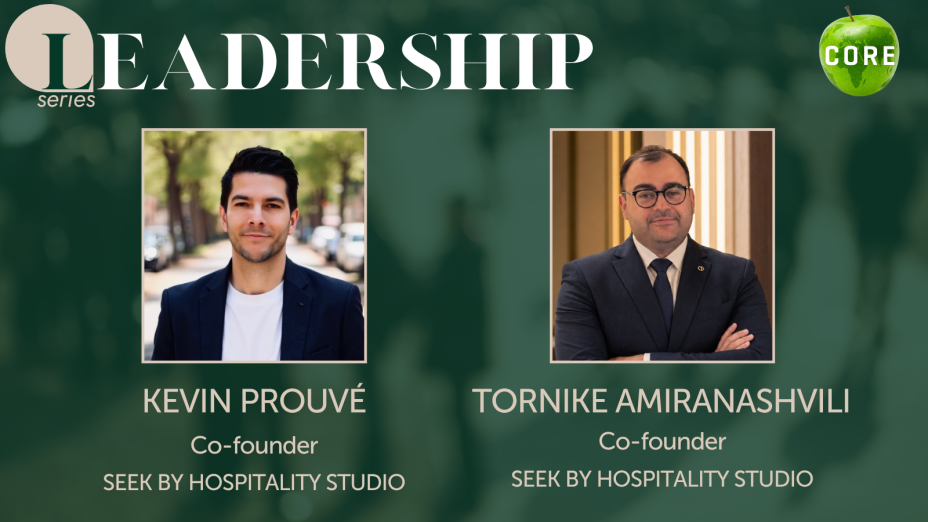
Leadership series : Kevin Prouve & Tornike Amiranashvili
Our Leadership Series features in-depth interviews with exceptional and inspiring industry leaders.
We are here talking to Kevin Prouvé and Tornike Amiranashvili, the Co-founders of Seek by Hospitality Studio, a free, mobile-first learning application designed specifically for food, beverage, and hospitality professionals.,offering bite-sized, micro-learning lessons tailored for the cracks in a busy workday, such as a quick five-minute break or a commute
Could you briefly introduce yourself, your role, and the core mission of your organisation within the hospitality landscape?
KP: My name is Kevin Prouvé. I'm originally from Burgundy, where I started young in a three Michelin star kitchen. Over more than a decade in fine dining I worked nearly every position, and I learned from a lot of great mentors along the way. Today I'm Regional Director for the Delta One Lounges, after opening the very first one at JFK, where the goal was to bring real hospitality into the airport. My core mission hasn't changed, it's the guest, and it's developing and mentoring the team that takes care of them while thinking of other ways of achieving it.
TA: My name is Tornike Amirnashvili—though my team knows me as Tor. My journey into hospitality started before I can even remember. My father was a winemaker, and my grandfather owned a restaurant, so I grew up in the restaurant world. I immigrated to the United States and studied finance at Baruch College, bartending across New York City along the way. On paper, I was headed toward a career in finance. But the more time I spent behind the bar, the more I realized I wasn't comfortable with a desk job. I wanted to be running a bar—creating something, building an experience, and making people happy. That's what made me truly happy. So, I leaned in. I spent years behind and around the bar, working my way up to Beverage Director and learning the craft from the ground up—from inventory and cost control to wine programs, staff training, and the small details that separate a good night from an unforgettable one. Today, I'm responsible for the bar and beverage program at the Delta One Lounge. Every day, I put my full effort where it matters most: training, mentoring, and operational excellence.
What do you see as the biggest challenges currently facing the landscape where you are and how should/will a business like yours respond?
KP: A few things. The first is that we see brands building beautiful luxury experiences but missing the hospitality, the people, which is the heart of it. The industry is also still training people the way it did thirty years ago. The generation of workers has changed, society has changed, but our approach hasn't. We want to flip the table and challenge how things are done.
TA: For me, the two biggest challenges come down to consistency and motivation. The first is consistency at scale. Delivering the same quality, the same care, the same experience every single time—across a large operation—is genuinely hard. It takes systems, training, and constant attention to detail to make excellence repeatable rather than occasional. The second is motivation, especially with the new generation. The hardest part isn't talent—it's getting people onto the right track and helping them see what's possible. Once they're there, once it clicks, they go on to do great things. So, our job is to meet them where they are, make training something they actually want to engage with, and give them a reason to invest in this craft. That's the vision behind everything I build—not to reinvent hospitality, but to make it easier for the next generation to fall in love with it the way I did.
What do you believe will distinguish the leading service providers over the next decade (e.g. niche market, luxury, sustainability, experience-driven, hybrid models…)?
KP: Everything seems to be moving toward ultra-luxury. Look at aviation, removing economy seats to add more premium cabins. People are chasing experience, and because we've all seen everything, nothing surprises us anymore, so brands, restaurants and hotels keep betting on the next "wow." Part of me believes the real differentiator is the opposite, going back to the core of hospitality. A great, simple restaurant, comforting food, the perfect pairing, and genuine service. If I open my own place one day, I want to bring back the French bistrot of the 80s. No chichi, as we say. Just a great moment. To me that's the real experience, not something curated for social media.
TA: For me, it comes down to consistency, approachability, and fun for everyday people. Somewhere along the way, reliable, quality service for the average guest got eroded on a scale. We've poured all our attention into the luxury end while the everyday experience slipped. The providers who can deliver the same dependable quality—and make it approachable and genuinely fun—day in and day out, for ordinary people, will win an enormous and underserved market. It's not about being the most expensive or the most exclusive. It's about rediscovering the fundamentals of hospitality, people serving people, making them feel welcoming and exciting rather than intimidating, and building the systems and training to deliver that reliably, every single time. That's what will distinguish the real leaders over the next decade in my opinion.
What skills or mindsets do you think will be most important for the next generation of hospitality leaders?
KP: The same way we're taught to read a table, the next generation needs to read their people, to really understand what each one needs. I try to see the potential in every team member and develop it as best I can, and to keep learning alongside them. That means adjusting your leadership style to each person while holding everyone to the same mission and the same vision.
TA: Adaptability is huge. The industry, the workforce, guest expectations—they're all constantly shifting, and the next generation has to be able to move with them, fast. That means staying open to new ideas instead of holding onto how things have always been done. And second is sharp focus—the discipline to work on one high-quality task at a time. It's easy to get pulled in a hundred directions, but the real progress comes when you lock in on what matters most and see it through.
Looking back, what has been the most pivotal moment in your career, a turning point that shaped how you lead today?
KP: Every place I've worked has challenged me and shaped who I am, and I expect that to keep happening for the next twenty years. The last two years opening Delta One with Restaurant Associates have been challenging in the best way, and I still learn something every day. As Tor likes to say, it's like a restaurant on steroids, you never know what's going to happen on a given day, who you'll meet, what problem you'll face. I never imagined I'd be working in an airport, and yet it's where I've learned the most. It taught me to keep thinking outside the box and to always challenge myself.
TA: Looking back, the most pivotal moment was taking on the Delta One Lounge—an operation at least twenty-five times the size of anything I'd run before. The scale forced me to grow fast and rethink how I lead. But the real turning point came when I leaned into AI and started building Seek. That's when it clicked: with the right vision, anything is possible—as long as you stay adaptable and focused. That's how I lead today, I don't get intimidated by scale or problems I haven't solved before—and I try to give my team that same confidence.
Walk us through what Seek is: what does it do, and who is it for?Seek is a hospitality training app, built for the floor, not the classroom. It takes everything we'd normally pass on through years of mentorship, service, wine, spirits, food and allergens, leadership, the culture of hospitality, and turns it into something you can actually learn day by day, in a few minutes, on your phone. It's built around seven pillars and four levels, from Foundations all the way to Mastery, so it meets someone on their very first shift and still has something for a seasoned maître d'. And it's not just memorizing facts, it moves you from recall, to applying it, to making real judgment calls in front of a guest. Who is it for? Anyone in hospitality, the person who walked in with zero experience, and the operator who wants to lift a whole team at once.
You both come from the operational side of hospitality. What was the moment that made you think: this problem needs a product, not just better operations? Pretty quickly after opening Delta One, honestly. Suddenly you're not training a team of thirty, you're training more than three hundred, seven days a week, with people on site around the clock. We realized the classic tools, preaching at pre-shift, written steps of service, beverage and menu descriptions, weren't going to be enough on their own. We still do all of that, but we had to think differently, especially because at least 95% of our team had never worked in a restaurant or in hospitality before.
Hospitality is fundamentally human, but this generation needed something built for the way they actually learn. So we started a daily newsletter covering different topics, a bit like Seek's pillars today. The change was dramatic. Suddenly the work wasn't just a paycheck, for a lot of them a door opened, and it was beautiful to watch. We ran it for about six months with incredible results, lower turnover, stronger sales, a team that was sharper on the floor. That's when we knew this needed to be a product, not just a program.
Tor, your background spans Hilton and the Delta One Lounge at Restaurant Associates as Beverage Director. Kevin, yours is Regional Director of Operations for Delta One Lounge too after more than a decade in fine dining? How did the two of you end up building something together?
TA: Building on what Kevin said—that shared language is exactly what made the rest align. For us, hospitality runs deeper than standards and procedures; it's about knowledge, fun, and flow, and it touches everyone, from chefs to managers to staff. Once we finished opening the Delta One Lounge, the real question became how to stay efficient with 300 people and keep everyone aligned. The synergy was there from the start. Over 6 months, we kept throwing ideas at each other until we landed on a final project.
KP: We come from different countries, but we're both from the old world, and we speak the same language, the language of hospitality. So it was natural. We'd already been building and training together at Delta One, and at some point it just made sense to turn what we were doing into something bigger.
If you could change one thing about how hospitality businesses use technology or how tech companies approach hospitality, what would it be?
The one thing I'd change, too often technology in hospitality is built to replace people or to squeeze efficiency, and it ends up feeling cold. And tech companies often build for hospitality without ever having stood on a floor. I'd flip that. Technology should make the human side stronger, give people confidence, knowledge and pride, not take the human out of it. That's the whole idea behind Seek, tech in service of hospitality, not the other way around.
What does success look like for Seek in three years and how will you know you've built something that matters to the industry?
Success in three years isn't really about download numbers for me. It's when a young team member who started with zero experience tells us Seek helped them fall in love with this craft and build a career. It's when an operator tells us their team is more confident, stays longer, and takes better care of the guest. If we've changed how this industry trains its people, even a little, and given the next generation a reason to stay, then we've built something that matters.
Co-founding is its own kind of leadership test. How did you divide responsibilities, and how do you handle it when you disagree?
KP: We divide it naturally along our strengths. Disagreement is part of this business, what matters is how you handle it. We share the same vision but bring different things to the table, so we'll each argue for our ideas, and yes, we disagree sometimes. But our motto is simple, let's try it. If it doesn't work, we adjust. That keeps us moving instead of getting stuck on who's right.
TA: Agreed with Kevin. We divide tasks based on our strengths, and so far we've been truthful with each other about that naturally—we both just quietly do our jobs, while touching base to check in on each other's progress. As for disagreements, we usually handle them by thoughtfully arguing it out with facts, giving each other time and space, and not rushing to any conclusion. Eventually we reach consensus naturally.
Author
Date Published: 26th June 2026
