
Leadership series: Luciana Nijdam
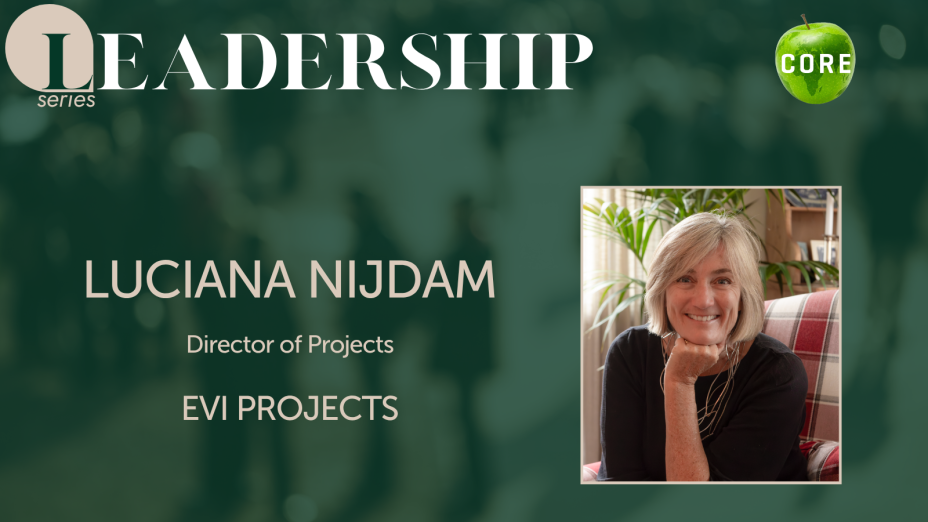
Through our CORE Leadership Series, we highlight outstanding industry leaders through in-depth interviews.
We are here speaking with Luciana Nijdam, Director of Projects - EVI Projects
Tell us a little about yourself and your business
I have worked in boutique luxury hospitality across over a dozen nations for over thirty years, transitioning to private estate management, in particular private islands, about 15 years ago. As the private sphere exploded exponentially, moving into consultancy was a natural progression.
What motivates you in your work and what do you find most fulfilling about being a business leader?
For me, it is the astonishing learning opportunities cross-cultural experiences bring to the table. Seeing one idea work in one continent, then adapting it with sensitivity to another, can be thrilling. It keeps concepts fresh, strategies nimble, and allows for innovation beyond what one might initially expect.
What skills or mindsets do you think will be most important for the next generation of leaders?
I have long been a proponent of compassionate leadership, both as a concept and as an operating philosophy. With technology moving quickly, client expectations constantly evolving, and borders in the business world increasingly blurred, I believe future leaders will need more than the right mindset: they will need a deeper, more nuanced understanding of their human capital.
Thinking about the (current) macro-economic and social environment (cost pressures, labour market, changing customer expectations, sustainability) what shifts do you believe will redefine “success” for our sector in the coming year or years?
In my field, which often has a non-commercial angle (unless the island or estate is available for buy-out rentals), I see wealth working much more from the top down in terms of community involvement, through philanthropy or investments that go beyond private land banking. These can have a significant impact on the macroeconomic dynamics of isolated island nations, particularly in terms of employment, economic growth and development, and the creation of a more upwardly mobile society.
Have there been any hard decisions you had to take as a business leader?
Absolutely! When I started my career, women in leadership positions were practically nonexistent in some of the regions where I worked. Add to that hard or unpopular decisions, and there were many moments of great discomfort. However, I am sure many would agree that the hardest decision to make, no matter where in the world, is always about downsizing – it never gets easier.
What do you believe will distinguish the leading service providers over the next decade (e.g. niche market, luxury, sustainability, experience-driven hybrid models…)?
For my clients, all of the above. The private sphere is inherently niche and closely tied to ultra-luxury, and luxury can no longer be separated from sustainability, particularly on an island where resources are finite and ecosystems fragile. Balancing these demands is challenging in jurisdictions that may not yet be attuned to any of them.
I believe the real distinction will lie in minimising the headaches for ownership, regardless of the hospitality segment. The leading providers will absorb the complexity on the owner’s behalf, managing operations, compliance and sustainability seamlessly in the background while protecting the asset and the owner’s peace of mind.
How do you manage the demands of commercial performance with staU well-being, retention, and culture building?
Being on the floor, being part of the team. I believe hospitality - in fact leadership - whether private, commercial, boutique, luxury, or budget, is about mucking in. Sure, improving commercial performance sometimes means crunching numbers, but often the numbers follow if the client is happy, and if the client is happy, the team tends to happy. Maintaining that long term, certainly at this stage of my career, is about knowledge sharing to ensure my experience does not stay with me, but gets passed on, so that the team grows, stays, and keeps the guest experience consistently strong.
Sustainability is a growing priority. How are you embedding meaningful, long-term sustainability practices into your business?
Believe me, in remote areas, sustainability is very hard to achieve. Take trash - small islands cannot recycle and often have no choice but to burn their waste. The also have to rely on generator power, which consumes excessive amounts of diesel. This is not a matter of a lack of environmental awareness; rather, development has either not yet reached their shores, or innovation has simply not come up with solutions to very real problems.
However, at grass-roots level, there are many small initiatives that did not exist as little as a decade ago – beach clean-ups, solar hot water heaters, and reusable first policies are becoming much more commonplace.
What’s a lesson you learned that shaped how you lead today?
Arriving “fresh off the boat” in places where I did not speak the language, or understand the culture, bringing expertise that might have little relevance, is a very humbling experience. It has taught me to observe, observe, observe, and reserve judgement until I am well entrenched in a place. The best ideas are usually already in place it is a matter of tapping into them and allowing them to flourish in a local context for a global audience.
Who or what has had a major influence on your approach to leadership?
Sally Ball, Director of Sales and Marketing at The Dorchester London in the early 1990s. I was just starting my career, and, apart from her fabulous suits, she was a force to be reckoned with: always a teacher, a mentor, and an inspiration. I think of her often, and fondly.
Author
Date Published: 10th November 2026
