
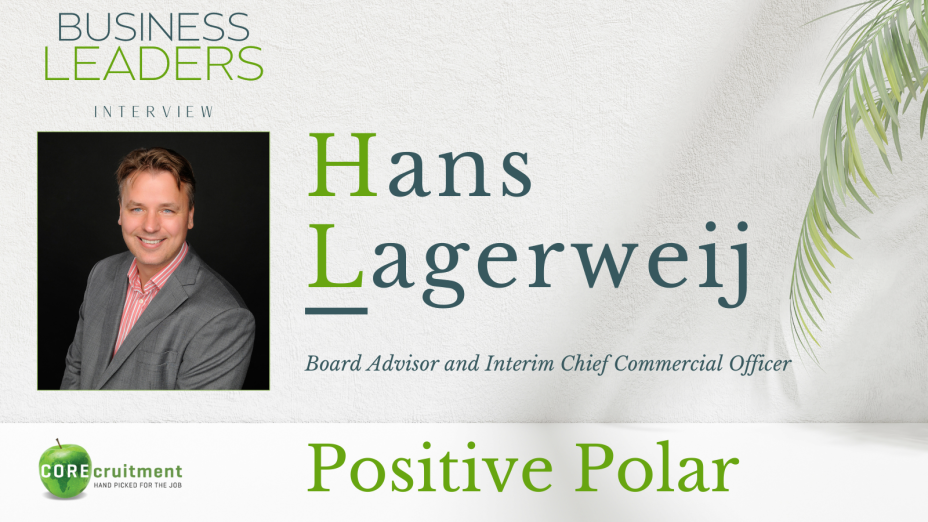
Business Leaders interview: Hans Lagerweij
Tell us a little about yourself and your business.
Driven by a commitment to ocean health, I now leverage my experience managing expedition cruises at Quark Expeditions, Victory Cruise Lines, and Albatros Expeditions to advise Positive Polar (positivepolar.com), a new startup offering expedition cruises and a scientific platform to conduct research focused on ocean restoration. Ultimately, they aim for climate restoration through this research. Beyond ocean conservation, I actively support innovative companies. I'm a board advisor at Lepdr ([Leprd Home Cleaning (getleprd.com), a service platform to reclaim your time by outsourcing tasks, and XpBrand.AI, an AI-powered customer insights platform. Additionally, I serve as a trustee at the Safer Tourism Foundation.
How did you develop your leadership skills and how would you define your leadership style?
My leadership journey began in the fast-paced world of FMCG at Kimberly-Clark, where I gained exposure to diverse markets and business functions. This foundation was instrumental in developing my strategic thinking and problem-solving abilities. Subsequent roles at TUI Travel and Quark Expeditions exposed me to the complexities of the travel industry. Leading Sawadee Reizen through the economic crisis and turning around the loss-making Quark Expeditions honed my crisis management, financial acumen, and ability to inspire and motivate teams. My leadership style is a blend of strategic vision and operational focus, characterized by empowering teams to drive innovation while providing clear direction and support. The recent challenges posed by COVID-19 at Albatros Travel further refined my ability to adapt to rapid change, build resilience, and foster collaboration in a remote work environment.
Innovating is crucial in our very diverse industry. How do you stay ahead of trends and incorporate them into your global strategy?
Innovation is the cornerstone of our success in this dynamic industry. To stay ahead of trends, I employ a multi-faceted approach. First, I cultivate a culture of innovation by encouraging open dialogue, experimentation, and learning from failures. Secondly leveraging a diverse team is crucial. By combining internal expertise with external insights from industry experts, conferences, and publications, we identify emerging trends early on. For instance, recognizing the potential of AI, I invested in developing a deep understanding of the technology and its applications. Now I have a very clear view on how this could optimise our operations and customer service, and I was even able to write an article about it. See Setting Sail with AI: How Artificial Intelligence Will Revolutionize the Cruise Industry - Guidepoint
How do you approach identifying areas for improvement within a company's operations?
When joining a new organization, I adopt a structured approach to identifying areas for improvement. I begin by immersing myself in the business, engaging with teams across the organization, and conducting a thorough analysis of key performance indicators (KPIs). By combining data-driven insights with qualitative feedback from customers and employees, I can quickly pinpoint opportunities to drive growth and efficiency. This often involves assessing factors such as revenue generation, occupancy rates, cost structure, customer satisfaction, and operational processes. Once I have a clear understanding of the business landscape, I prioritize the top three areas for improvement based on their potential impact and feasibility. By collaborating with the senior leadership team, we develop a focused action plan to address these key challenges and drive sustainable results.
What is or are your biggest career achievement(s)?
My most significant career achievement was turning around Quark Expeditions. I joined as a young executive and successfully transformed a multi-million-dollar loss-making company into a highly profitable enterprise. By implementing a combination of cost reduction measures, revenue enhancement strategies, and product innovation, I increased revenue and improved customer satisfaction scores double-digit. Additionally, I expanded our global distribution network to over 50 countries in the world. This experience was instrumental in developing my leadership and strategic thinking skills.
Do you have examples where your leadership made a difference? If so, what were they?
I've been fortunate to lead teams through various challenges and transformations. One standout example is my role at TUI/Sawadee Reizen during the economic crisis. By implementing a customer-centric strategy focused on value proposition and cost optimization, we achieved double digit growth and doubled our profitability. This success was driven by a collaborative effort with the team, who embraced the challenge and contributed innovative solutions.
What’s the most important leadership lesson you’ve learned?
The most impactful leadership lesson I've learned is the importance of empathetic listening, as embodied in Covey's 'First try to understand, then to be understood.' I've found that genuinely seeking to understand the perspectives of my team members is crucial for building trust and driving change. In addition, it is a great skill when negotiating with external partners.
How important is personal development to your success, and how do you approach it?
Personal development is absolutely critical to my success. It's the foundation for continuous improvement and adaptability in today's rapidly evolving business landscape. I actively seek out opportunities to expand my knowledge and skill set through a combination of new assignments and responsibilities, reading, attending industry conferences, and seeking mentorship.
What was the hardest decision you have taken as a leader?
Undoubtedly, the most challenging decision of my career was navigating the workforce reductions necessitated by the COVID-19 pandemic. Saying goodbye to valued team members, many through impersonal virtual platforms, was incredibly difficult on both a personal and professional level. I approached this crisis by prioritizing open and honest communication, providing as much support as possible to affected employees, and focusing on retaining key talent. While the decision was painful, it was essential for the long-term viability of the company. By emphasizing retraining and upskilling for remaining employees, we were able to build a more resilient and agile organization
What steps do you take to measure your own performance?
I measure my performance through a combination of self-evaluation, key performance indicators, and feedback. Aligning with the company's strategic objectives, I set clear, measurable goals for myself, such as increasing revenue by X% or improving customer satisfaction by Y points. I conduct regular self-assessments, focusing on areas like strategic thinking, leadership development, and operational efficiency. Additionally, I actively seek feedback from my team, peers, and superiors to identify areas for improvement. By consistently analyzing my performance and making necessary adjustments, I ensure that my contributions are aligned with the organization's overall success.
What does success mean for you as a business leader?
Success as a business leader means creating a thriving organization that delivers exceptional value to our stakeholders. This encompasses financial performance, happy customers, sustainable growth, and a positive impact on our community. Equally important is fostering a high-performing culture where employees are inspired, engaged, and empowered to reach their full potential. And we should never forget to have fun as a team!
Author
Date Published: 6th August 2024
