
Leadership series: Paul Downie
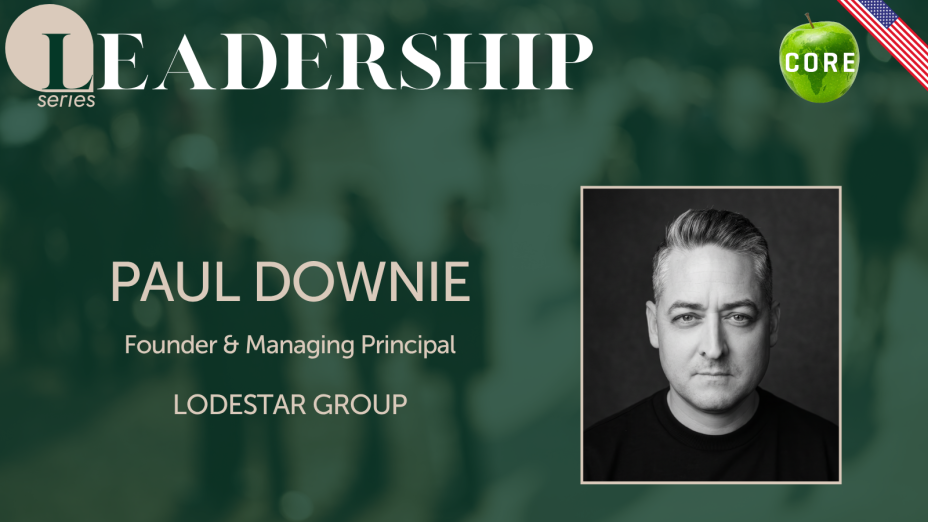
Our Leadership Series offer a deeper look at industry leadership through long-form interviews.
We are here talking to Paul Downie, Founder & Managing Principal, Lodestar Group
Lodestar Group is principal-led hospitality consultancy based in New York that provides hands-on operational leadership and advisory for high-end restaurants, hotel groups, private equity, and family offices. They focus on executing new launches, reversing operational decline, optimizing ongoing standards, and acting as owner's representatives to protect hospitality investments.
You've spent nearly three decades inside the operations of some of the world's most demanding kitchens and dining rooms: Eleven Madison Park, Dinner by Heston Blumenthal, the Tin Building, and eighteen years at Starr Restaurants. What made you decide, after all of that, to go out on your own and launch Lodestar?
The honest answer is that the observation I'd been making for years became impossible to ignore.
You can run a great restaurant. You can build a great team. But if the operating architecture underneath it, the management structure, the communication pathways, the standards systems, the P&L accountability, isn't there, the restaurant is only as good as the person holding all of it together. Remove that person and the standard degrades, often faster than anyone expects.
I'd seen this pattern across every environment I'd worked in, from the most decorated restaurants in the world to multi-concept groups deploying hundreds of millions in capital. The food was extraordinary. The intent was genuine. The operating infrastructure frequently wasn't there. And the gap between what was promised and what was delivered widened over time, quietly, until something broke.
Lodestar exists to close that gap. I knew what the problem was, I had thirty years of diagnostic tools to identify it, and I had enough experience at enough levels, frontline, operational, executive, to actually fix it. The calculation was simple: there was a serious problem in the market, a genuine capability gap, and I was in a position to do something about it.
Lodestar's positioning is 'operational leadership, not advisory from the sidelines.' That's a pointed distinction. What does it mean in practice, and where does it come from?
It comes from watching the conventional consultancy model fail repeatedly.
The standard approach delivers the deck and exits. A set of recommendations, a bound report, and a handshake. The client absorbs it (or doesn't), and the consultant isn't there when the plan meets reality, which is where all plans either hold or collapse.
What I mean by operational leadership is that we stay present through execution. The diagnosis and the prescription are the easier parts. The hard work is understanding why the right thing isn't happening, what is occurring inside the people responsible for the change, where the resistance is, what hasn't been said in the room, and working through that layer rather than around it. That requires presence, relationship, and the trust that comes from having been the person accountable for the floor, not just the person who analyzed it.
In practice it means we are embedded in an operation, not observing it from outside. We are in the building, in the service, in the conversation. That proximity is not incidental to the outcome. It is the outcome.
Lodestar states that most hospitality projects don't fail, they drift. Where does drift typically begin, and what are the early signs that most operators miss?
Drift begins with a conversation that didn't happen.
Not a crisis, not a collapse. A moment of discomfort that was avoided. A correction that should have been made in real time and wasn't. A corner cut once with no consequence and then cut again. The threshold of acceptable shifts so gradually that no one can point to the exact moment it moved.
The early signs are always visible in front-of-house behavior before anything shows up on a P&L. The welcome starts to feel transactional. The team goes through the motions competently but generates no warmth or genuine hospitality. Tables are managed rather than looked after. The service that made the place successful, the aliveness of it, the genuine care — gets replaced by efficiency. Technically correct but not actually good.
Operators miss this because they're measuring the right things (revenue, covers, reviews) but the leading indicators are behavioral, not financial. By the time the score changes, drift has been in motion for months. The diagnostic I use is simple: I watch a team and ask whether they are performing hospitality or actually practicing it. The answer is usually clear in the first twenty minutes.
When you walk into a turnaround situation, a place where standards have softened and the gap between promise and delivery is widening, what are the first things you look at?
Not the financials. Not the menu. The management layer.
The presenting problem in a turnaround is almost never the real problem. The service is inconsistent because the training is inconsistent. The training is inconsistent because no one has been accountable for it in six months. No one has been accountable because the management structure doesn't distribute ownership clearly. The management structure doesn't work because it was never designed, it accreted over time as the business grew, and no one built the company underneath the restaurants.
The first diagnostic is structural: who owns what, and does the person who owns it know they own it? I want to understand the communication architecture; how does information flow from the floor to leadership and back? Where does it stop? And I want to observe a service without introducing myself, because twenty minutes at a door, a bar, or a host stand will tell me more about the health of an operation than a month of P&L review.
The fix is almost never what the owner thinks it is. But the real problem is almost always findable quickly, if you know what you're looking for, and you look in the right places.
You've said that great leadership is what sustains an operation, not great food alone. What does great leadership look like day-to-day in a restaurant environment, the things that don't show up on a P&L?
It looks like managers who give feedback in the moment rather than saving it for a review. It looks like a shift that starts on time because the leader is already there when the team arrives. It looks like a pre-service briefing that is fifteen minutes of genuine information, what's on tonight, who the VIPs are, what went wrong yesterday and what we're doing about it, rather than a performance of leadership that everyone has to sit through.
Day-to-day great leadership in a restaurant is mostly invisible when it's working. Problems get solved before they reach the floor. Staff who are struggling get a conversation before they become a complaint. Standards stay consistent not because they're enforced dramatically but because they're held quietly, consistently, every service.
What it doesn't look like: a manager who is reactive, who manages by exception rather than by design, who addresses a problem only when it reaches the guest. That manager is always behind the operation. The great ones are always slightly ahead of it; anticipating,
calibrating, making small adjustments before small things become large ones. That vigilance is the job. It doesn't show on the P&L because when it's done well, nothing that requires a P&L conversation happens.
Hospitality has a well-documented talent problem: recruitment, retention, burnout, career progression. From where you sit, across multiple operators and ownership structures, what are the most effective things you've seen work?
The most effective thing is also the simplest and least practiced: build a management culture that doesn't drive good people out.
The industry has a retention crisis, not an attraction crisis. Good people enter hospitality constantly. They leave because the management culture is unsustainable, the hours, the communication standards, the tolerance of behavior at leadership level that would not be accepted elsewhere, the absence of any visible pathway to something more. Most operators treat this as an industry-wide problem they're powerless to change. It is a house-by-house problem.
The specific intervention that works most reliably is the development conversation. Not the annual performance review, which arrives too late and in too formal a format to be useful. The regular, structured conversation in which a manager asks a team member where they want to go and what they need to get there and then follows through. The research on why people leave hospitality is very consistent: it's not the pay; it's not the hours. It's the feeling that no one in this building sees them or cares what happens to them. That is fixable, and it is entirely a management decision.
You sit at an interesting vantage point, working with operators, owners, and investors across different ownership models and market conditions. What's your honest read on the state of high-end hospitality in 2025 and 2026?
Stratified. And the stratification is widening.
At the very top, the operations that have built a genuine brand, a consistent guest experience, and an operating infrastructure that holds under real conditions, it's strong. The market for genuine excellence is robust. Guests who have experienced it know what it is and they return to it.
Below that top tier, the picture is more honest. A significant number of operations positioned as premium have not kept pace with what guests expect premium to mean in 2026. The physical plant has aged. The service standard has drifted. The concept that felt fresh in 2019 hasn't been meaningfully evolved. Those businesses are facing a choice between reinvention and gradual irrelevance, and most are making that choice slowly and reluctantly rather than decisively.
The underlying dynamic: there is a widening gap between operators who have built the internal infrastructure to deliver consistently and those running on the personal energy of their founders. That gap will become commercially significant in the next three to five years as competition increases and guest expectations continue to rise. The market will not be forgiving of the difference.
What do the next generation of hospitality leaders need to understand that most of them currently don't?
That the job is to build a system, not to be the system.
The most talented people coming up are extraordinary at the work, technically precise, guest-focused, resilient under pressure. They are the reason the operation works. And that is a problem, because what happens to the standard when they leave, or are promoted, or are simply not in the room one night?
The next generation needs to understand that leadership in hospitality is not about being the best operator in the building. It is about building an operation that runs at the highest possible standard with the team that's actually present, trained, supported, and held accountable by systems that exist independently of any single individual.
The other thing they don't understand (and the industry is partly responsible for this), is that the difficult conversation is not the opposite of care. It is the highest expression of it. The manager who avoids saying the hard thing because they don't want to upset someone is not being kind. They are being negligent. The team member who never hears accurate feedback about where they're falling short is being failed by their manager, not protected by them. Getting comfortable with precision and honesty, not harshness, precision, is what separates the people who will lead great organizations from the ones who will manage acceptable ones.
What do you want Lodestar to stand for, five or ten years from now?
The standard by which operating excellence in hospitality is measured.
Not one of the better consultancies in the market, the reference point. The organization that the industry looks to when it wants to understand what great operations actually look like, how they're built, and how they're sustained under real conditions.
The path there is straightforward, if not simple: build the IP, prove the methodology, deliver outcomes that can't be argued with. Every engagement is a case study. Every operator we work with should be able to say, five years later, that what we built together is still holding. That is the standard we're working to.
The larger ambition, and I'm serious about it, is to rebuild the relationship between hospitality operators and the people who work for them. The industry has one of the most significant talent attrition problems of any sector, and the primary cause is not the work, which most people in hospitality genuinely love, but the management cultures that surround it. If Lodestar's methodology eventually becomes the template for how well-run hospitality organizations build their management cultures, that is an outcome worth building toward. Not just commercially. Actually.
Author
Date Published: 1st September 2026
