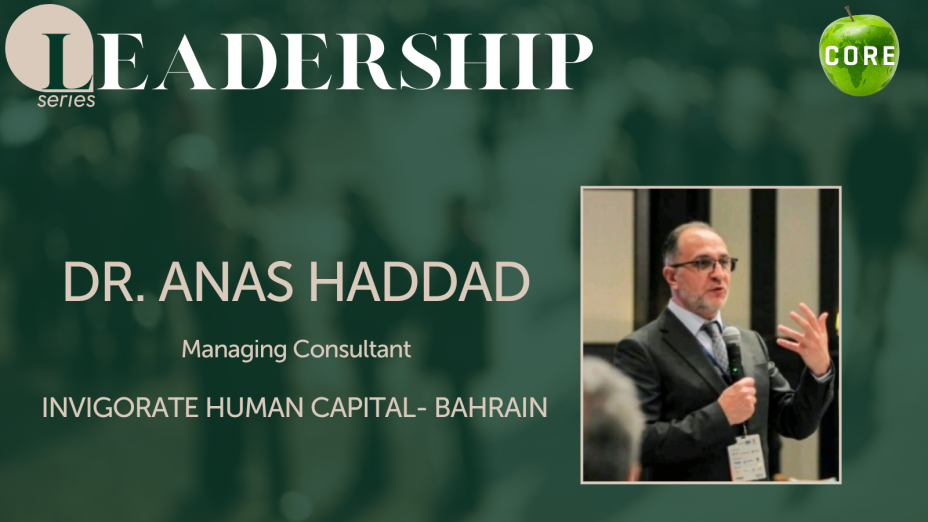
Leadership series: Dr. Anas Haddad
Our Leadership Series give a voice to exceptional leaders shaping the industry today.
In this interview, we speak to Dr. Anas Haddad, Managing Consultant at Invigorate Human Capital- Bahrain
Tell us a little about yourself, Invigorate Human Capital, and what led you to launch it back in 2018.
I’m a Human Capital and People Strategy professional who’s worked across HR strategy, human capital consulting, learning & development, talent and performance transformation, and employee relations. What sets my background apart is that I’ve spent the majority of my career designing HR frameworks and ensuring they were adopted and delivered—across hospitality, retail, logistics, aviation, and training/consulting.
Invigorate Human Capital (IHC) was launched in 2018 in Bahrain because I wanted to bring a more outcomes-driven model to HR consulting. From my work at M.H. Alshaya, DHL Aviation, and Americana, I saw a recurring gap: most consulting firms come with their own model for business, and they try to impose it on the client organization rather than put the effort into understanding the client’s business needs and challenges, and then customize models and solutions that would help the organization meet its goals and deal with the challenges.
At IHC, I focus on bespoke human capital solutions that improve performance and reduce costs through pragmatic HR architecture—things like performance management systems, reward and recognition, job architecture, organizational redesign, and competency frameworks. A clear example is the business optimization program I delivered for a leading food manufacturing organization in Bahrain and KSA, where costs reduced by ~20% annually. That’s the kind of impact that drives our approach—trust our delivery, innovation in design, and excellence in execution.
What first sparked your interest in HR as a career, back in your Kuwait Food Company (Americana) days?
My interest in HR started because I saw HR as an operational lever, not just an administrative function.
In Americana’s environment—especially across restaurant operations —I was close to the business realities: labour cost impacts, daily service standards, workforce capability, and productivity. In my role as HR & Training Manager, I managed annual HR and training plans, manpower plans, and individual development plans, and I tracked labour cost impacts and employee productivity alongside training execution. I also calculated ROI for training outcomes and reported results to corporate headquarters.
That experience made HR feel tangible and measurable. I enjoyed being able to connect workforce planning and capability building directly to performance outcomes—customer service quality, operational standards, and cost control. From that point, I began to build my career around transformation and changes that stick.
After 19 years inside large corporates (Americana, DHL Aviation, M.H. Alshaya), what motivates you now as the founder of your own consultancy?
What motivates me now is freedom and responsibility: freedom to tailor solutions, and responsibility to deliver outcomes without the corporate barriers that sometimes exist in large systems.
In corporates, I led complex HR transformation and multi-market programs—nationalization and transformation initiatives at Alshaya across multiple markets, end-to-end onboarding for opening operations, including ~1,800 employees for “Avenue Mall” in Bahrain, and employee relations across markets. At DHL Aviation, I led talent and learning programs and supported large-scale competency model development for 200+ roles, and I managed Investor in People accreditation across the MENA area.
But in a consultancy, I can go further into the details that really determine success—how managers adopt the system, how HR governance is made practical, and how we design frameworks that work in the local context.
As a managing consultant at IHC, I’m directly involved in policy and procedure redesign, performance management system design, organization re-engineering, reward and recognition system development, and job analysis and role profiling. I’m motivated by seeing the full line from design → implementation → adoption → results.
What do you see as the biggest challenges currently facing the HR consulting and human capital space in Bahrain and the wider region, and how should a business like Invigorate respond?
The biggest challenges are:
a) Over-reliance on deliverables, under-delivery on adoption.
Many HR consultancies can produce frameworks and decks. Fewer ensure managers and teams actually use the system consistently. In my experience—across MENA transformation programs and post-merger integration work—adoption comes from governance, clarity, and practical implementation support.
b) Budget scrutiny and ROI expectations.
Clients want measurable impact under cost pressure. My work includes linking performance and incentives to organizational metrics (including KPI-based analytics) and delivering business optimization with ~20% annual cost reduction—so we naturally work outcome-led: reduced cost to serve, improved performance cycles, reduced disruption, stronger retention.
c) Misalignment between regional workforce realities and “imported” HR models.
Workforce needs change quickly—skills availability, compliance coordination, and multi-national organizational structures require localized design. IHC responds by building bespoke solutions that match the organization’s actual operating environment.
d) Gap in HR capability at the leadership and execution level.
When HR strategy is not supported by leadership capability, systems fail. That’s why IHC combines HR design with leadership coaching and training delivery—executive coaching for senior business leaders and structured leadership/management programs.
So how Invigorate should respond is clear: stay boutique and knowledge-intensive, deliver implementation—not just recommendations, and always anchor work in Trust, Innovation, Meeting/Exceeding Expectations, and Excellence.
Thinking about today’s economic and social environment (cost pressures, labour market shifts, changing employee expectations), what do you believe will redefine “success” for HR consultancies over the coming years?
I believe success for HR consultancies will be redefined around evidence , adoption , and workforce resilience , not simply HR expertise.
Evidence: Clients will increasingly ask, “What do we improve—measurably?”
ROI-based training evaluation, KPI-based analytics tied to incentives, and retention initiatives that increased staff retention.
Adoption: Success will be judged by whether managers use tools consistently—performance management cycles, reward mechanisms, governance routines, and employee relation processes. In my work, I’ve overseen performance cycle governance and employee relations across markets, and led post-merger HR integration to ensure adoption of consistent policies and practices.
Resilience and capability: Employee expectations are shifting; labour markets are changing. HR consultancies will need to deliver workforce capability that adapts—leadership development pipelines, succession planning, learning that closes capability gaps, and organizational design that reduces complexity rather than adding it.
So, over time, the standout consultancies will be the ones who can prove outcomes, drive utilization of HR systems, and build resilient talent ecosystems. That aligns strongly with Invigorate’s model: bespoke Human Capital solutions delivered with high-quality execution at a reasonable cost.
How do you personally stay on top of HR trends, labour law changes, and best practice—especially alongside your role teaching SHRM at Origin Training Centre?
I stay on top of HR trends through a mix of teaching pull and delivery pull .
Because I teach SHRM content, I’m continuously reviewing current HR thinking—capability mapping, talent strategy, employee relations, performance management principles, and practical application frameworks. Teaching also forces clarity: if I can’t explain it simply and tie it to business outcomes, I know it won’t land with clients. In addition, I always join professional specialized conferences, follow up on new publications, especially from well-renowned colleges and universities, and participate in HR-related seminars.
On top of that, my consulting work keeps me current in what matters locally—workforce planning realities, adoption challenges, and how labour and compliance expectations show up in day-to-day HR operations. And because I’ve worked across sectors with different employee dynamics—hospitality/retail, aviation logistics, training/consulting—I’m always cross-referencing trends against what’s actually working for organizations on the ground.
What skills or mindsets will matter most for the next generation of HR leaders?
Three mindsets:
1) Business Accumen mindset
HR leaders must be able to speak the language of cost, productivity, risk, and delivery timelines in order to be true business partners and take their seat on the executive table.
2) Execution/adoption mindset
Framework design is necessary, but adoption is where success lives. Next-gen HR leaders must build implementation and execution thinking into their work from day one.
3) Data + human insight mindset
Not “analytics for analytics”—but using evidence carefully to improve decisions while staying grounded in employee and culture realities.
What’s the most important leadership lesson you’ve picked up across retail, aviation, food & beverage, and now consulting?
The lesson is: leadership is only real when it changes behaviors at the front line.
In retail and food operations, you feel immediately whether leadership is theoretical or practical—customer experience and service standards don’t improve by intention; they improve through the way managers lead day-to-day, how people are coached, and how routines run.
In aviation, structure and consistency matter—competency, learning, recruitment quality, and performance governance all impact reliability.
Now in consulting, the same lesson means: if clients can’t operationalise the solution, it doesn’t matter how smart it looks on paper. Adoption is the final test of leadership and strategy.
Have you achieved everything you set out to in your career so far?
I’d say I’ve achieved a lot—and also grown my ambition.
I set out to build deep capability in HR strategy, people transformation, performance systems, and leadership development. I’ve done that across multiple sectors, and I’ve delivered measurable outcomes—cost optimisation (20% annually), retention improvements (87%), role/job architecture, competency models (200+ roles), and large-scale onboarding (1,800 employees).
Starting Invigorate was also a key personal milestone—proving I could move from corporate HR leadership into consultancy with the same level of delivery discipline.
But I don’t see it as “finished.” The next phase is scaling impact in Bahrain and the region—beyond projects into long-term institutional change in how organisations manage performance and people capability.
Have there been any particularly hard decisions—especially leaving corporate life to start your own firm?
Yes—there were two hard decisions.
First: leaving the security of corporate scale to embrace the uncertainty of consultancy. You trade predictable structure for responsibility for every outcome—delivery, client relationship, and financial sustainability.
Second: deciding what kind of consultancy I would build. I could have chased a wider portfolio, but instead I chose to stay focused on high-quality, bespoke human capital solutions with measurable outcomes and strong implementation support. That focus takes courage, because it limits shortcuts.
But those decisions were based on what I’d learned in corporates: the real value is in execution, adoption, and measurable impact. Invigorate was created to do that consistently.
What do you hope your legacy will be, both for Invigorate and for the HR profession in Bahrain and the region?
For Invigorate, I want our legacy to be simple: reliable transformation delivered with trust and real outcomes. Clients should associate “Invigorate” with implementation quality, measurable performance improvements, and HR solutions that leaders can actually run.
For the profession in Bahrain and the region, I hope my legacy is pushing HR to be: more outcome-led, more execution-driven, more locally practical, and more credible with stakeholders.
If I’ve helped raise the standard—through consulting and through SHRM teaching and capability building—then that’s a professional legacy worth having.
How has your leadership philosophy evolved moving from large regional HR functions into running your own business?
In large organisations, leadership is often about alignment and governance across complexity —many stakeholders, many layers, and formal processes. In consultancy, leadership is about ownership and clarity. I’m accountable for the solution and the outcome. I must communicate the scope, expectations, and delivery approach with precision. I have to build trust quickly because consultancy is relationship-driven.
So the philosophy evolved from “leading HR systems across a corporation” to “leading change in partnership with clients”—with even stronger emphasis on adoption, transparency, and delivery excellence.
- Sustainability is a growing priority. How do you help clients embed meaningful, long-term practices into their people strategy?
For me, sustainability in people strategy means building capability and resilience —not running one-off initiatives.
I help clients embed long-term practices by focusing on systems that remain useful over time:
- Talent and succession pipelines so capability is sustainable
- Leadership and management capability programs that keep improving performance
- Performance management governance that reinforces accountability continuously
- Job architecture and competency frameworks so talent decisions are consistent and scalable
- Learning strategies tied to ROI and business needs , so development is not detached from outcomes
- Employee relations discipline so organisations reduce disruption and preserve trust
- This aligns with your experience delivering leadership programs, competency models, performance management cycle governance, and ROI-based training evaluation.
What’s your long-term vision for Invigorate Human Capital, and what legacy would you like to leave in the profession?
My long-term vision is to grow Invigorate into a recognised boutique knowledge partner for Human Capital Excellence in Bahrain and across the region—where organisations come when they need HR transformation that is bespoke, practical, and measurable. I want our legacy to be:
- Trusted outcomes (not just frameworks)
- Strong implementation standards —delivery that leads to adoption
- Better HR credibility across the region through measurable performance impact
- Capability building through training, coaching, and education (including SHRM teaching and leadership programs)
- Ultimately, I want Invigorate to be known as a firm that helps organisations build long-term people capability—so they perform better, develop their workforce sustainably, and manage cost responsibly.
Author
Date Published: 28th August 2026
