
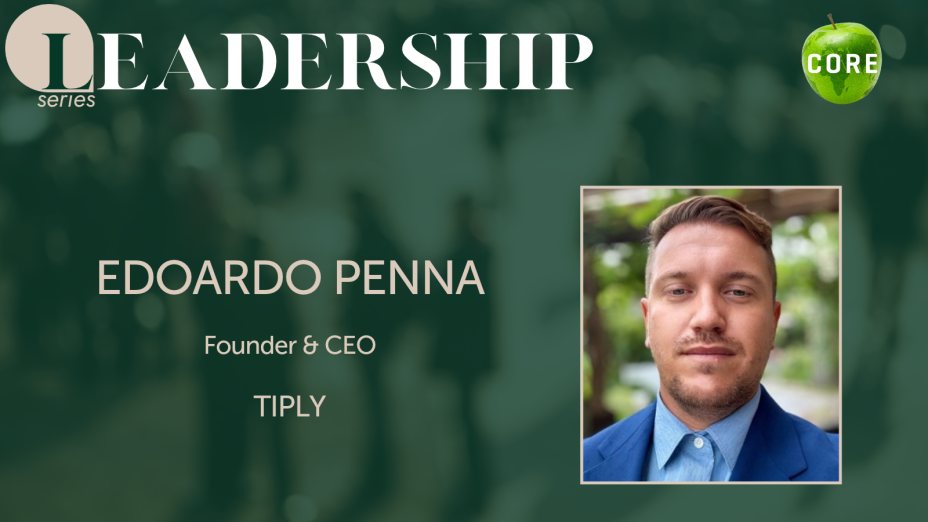
Leadership series: Edoardo Penna
Through Leadership interview series, we reveal what drives exceptional industry leaders.
Here, we are talking to luxury hospitality & operations advisor Edoardo Penna, Founder & CEO of Tiply.
Tell us a little about yourself and your business.
My professional journey began in the world of hospitality, where I developed a strong appreciation for the relationship between people, service and operational excellence. Over the years, I have gained international experience in luxury hospitality, including working at Six Senses Ibiza, where I experienced first-hand the standards, attention to detail and service philosophy required to deliver exceptional guest experiences.
My background is rooted in hotel operations, Front Office leadership, team coordination and guest experience. Working directly with guests and operational teams has given me a practical understanding of what happens behind the scenes of a successful hospitality business — and of the challenges that can prevent a property from consistently delivering on its promise.
Over time, this operational perspective evolved into a broader interest in business performance, organisational effectiveness and innovation. I began exploring how hospitality businesses can improve the way they operate, how teams collaborate and how technology can solve real problems without compromising the human side of service.
This led me to develop Tiply, a project focused on digital tipping and the wider opportunities to improve the hospitality experience through technology. I am also developing hospitality advisory activities focused on operational performance, service quality, team effectiveness and the alignment between a property’s positioning and its day-to-day execution.
For me, these are connected areas of work. Whether I am examining an operational challenge, advising on a hospitality concept or developing Tiply, the objective is the same: to identify real needs, build practical solutions and create value for businesses, employees and guests.
What initially inspired you to pursue this career?
What attracted me to hospitality was its combination of human interaction, operational complexity and the opportunity to create experiences that people genuinely remember.
In luxury hospitality, the guest may see a seamless experience, but achieving that result requires coordination, preparation, teamwork and hundreds of decisions that are often invisible to the person staying at the property.
I became increasingly interested in what makes that experience possible. Why do some operations consistently deliver exceptional service while others struggle, even when they have impressive facilities, recognised brands and talented people?
That question shaped the way I approached my career. I wanted to understand not only how to serve a guest well, but also how to build the operational conditions that make excellent service repeatable.
Eventually, I realised that many of the challenges I encountered were not isolated incidents. They reflected broader questions around processes, leadership, communication, incentives and technology.
That was the turning point: moving from simply working within hospitality operations to thinking about how those operations could be improved and how solutions could be developed to address the industry’s recurring challenges.
What motivates you in your work, and what do you find most fulfilling about being a business leader?
I am motivated by the opportunity to turn an idea into something that creates tangible value.
In hospitality, identifying a problem is only the beginning. The real challenge is understanding its root cause, bringing the right people together and implementing a solution that works in the reality of a busy operation.
Through my advisory work, I focus on helping hospitality businesses examine their operational structures, identify inefficiencies, improve coordination and strengthen the relationship between service quality and business performance. The objective is to move beyond recommendations that look good in a presentation and towards changes that can be implemented and assessed in practice.
As a founder, I have also learned that building a business is a continuous process of testing assumptions, listening to feedback and adapting. Tiply remains in active development because I do not believe innovation should stop at the first version of a product. Every new insight can reveal an opportunity to improve the solution, the user experience or the business model.
What I find most fulfilling is seeing an idea evolve into something useful. Leadership, in my view, is not about having all the answers. It is about taking responsibility for finding better ones, making decisions under uncertainty and maintaining the discipline to keep improving.
What are the biggest challenges and opportunities currently facing luxury hospitality?
One of the industry’s biggest challenges is the gap between the promise of luxury and the operational reality required to deliver it consistently.
Luxury brands invest heavily in design, positioning, marketing and facilities. Yet the guest’s perception of quality is ultimately shaped by the experience delivered by people, processes and systems. If those elements are not aligned, even an extraordinary property can struggle to fulfil its potential.
At the same time, operators face cost pressures, increasingly demanding guests, recruitment and retention challenges, and the need to adopt new technologies without losing the personal touch that defines exceptional hospitality.
I see a significant opportunity in treating operational excellence as a strategic advantage rather than simply a back-office responsibility. Better coordination between departments, clearer accountability, stronger team structures and more effective use of data can improve both the guest experience and commercial performance.
Technology is another opportunity, provided it addresses a genuine need. Digital solutions should remove friction, support employees and make processes more effective — not introduce complexity simply because a technology is available.
The businesses that stand out will be those that combine a distinctive hospitality concept with an operating model capable of delivering on that concept every day.
What shifts will redefine success for the hospitality sector in the coming years?
I believe success will increasingly be measured by the ability to balance three dimensions: guest experience, employee experience and sustainable business performance.
Historically, businesses have often evaluated these dimensions separately. Guest satisfaction belongs to one conversation, labour costs to another, and financial performance to a third. In reality, they are deeply interconnected.
A poorly structured operation can create pressure on employees, inconsistencies in service and unnecessary costs. Conversely, a well-designed operating model can support teams, improve service consistency and protect profitability.
Another important shift will be the move from technology as a novelty to technology as a practical business tool. Hospitality companies will need to be more selective about what they implement, evaluating solutions according to adoption, operational impact and measurable value.
I also expect greater attention to the entire guest journey, rather than individual departmental performance. Guests do not experience a hotel as a collection of departments. They experience one brand, one property and one continuous relationship.
Ultimately, success will belong to businesses that can deliver a distinctive experience consistently, develop their people and translate operational excellence into long-term commercial value.
Where do you believe the most promising investments should be focused?
I see three particularly important areas: people and leadership, operational infrastructure, and technology that solves clearly defined problems.
First, investment in people should go beyond recruitment and initial training. Hospitality businesses need to develop effective leaders, establish clear responsibilities and create environments where employees have the tools and authority to deliver the expected standards.
Second, operational infrastructure deserves more attention. This includes processes, communication between departments, performance measurement and the systems that support daily decision-making. These elements may be less visible than a renovation or a new restaurant concept, but they have a direct influence on how effectively a property performs.
Third, I believe there is substantial potential in focused technology. The most valuable solutions are not necessarily the most complex; they are the ones that solve persistent problems, integrate into existing workflows and generate clear value for their users.
Tiply reflects this philosophy. Its starting point is a practical issue within hospitality: making digital tipping more accessible and convenient while helping employees receive recognition for their service. The wider development process involves continually examining how technology can address real needs within the industry.
For investors and operators, the key question should not simply be whether a solution is innovative. It should be whether it solves a meaningful problem, whether people will use it and whether its value can be demonstrated.
What innovations excite you most right now?
I am particularly interested in the intersection between technology, operational intelligence and the human experience.
Artificial intelligence and automation have considerable potential to reduce repetitive work, improve access to information and support decision-making. However, in hospitality, the purpose should not be to automate the human relationship out of the experience. It should be to give employees more time and capacity to focus on the guest.
I am also interested in solutions that address overlooked parts of the guest journey and employee experience. Some of the industry’s most persistent challenges are not necessarily the most visible ones, which creates opportunities for focused products and new business models.
Tiply is part of that exploration. The project began with digital tipping, using technologies such as QR codes and NFC to make the process more accessible. Its development continues as I assess feedback, refine the product and explore how it can fit into the practical realities of hospitality operations.
I see product development as a continuous cycle rather than a fixed destination: identify a problem, build a solution, test it, learn from users and improve.
The innovations that interest me most are those that combine simplicity for the user with meaningful value for the business. Technology should make hospitality work better, not merely make it look more technologically advanced.
What is the most important leadership lesson you have learned?
One of the most important lessons I have learned is that accountability must be matched by clarity, resources and the authority to act.
In hotel operations, teams are expected to deliver consistent service while managing changing priorities, unexpected situations and demanding guest expectations. It is difficult to achieve strong results when responsibilities are unclear, communication breaks down or people are held accountable for decisions they cannot influence.
I believe effective leadership begins with understanding the reality of the operation. Leaders need to listen to the people closest to the work, establish clear expectations and create an environment where problems can be raised before they become larger failures.
Another lesson is that leadership requires adaptability. A process that works in one property, market or team may not work in another. Experience provides a foundation, but it should never replace observation, curiosity and the willingness to reconsider assumptions.
As I have moved towards entrepreneurship and advisory work, these lessons have become even more relevant. Building something new requires conviction, but it also requires the humility to recognise what is not working and the discipline to improve it.
For me, strong leadership is not about controlling every detail. It is about creating the conditions in which people can make good decisions, take ownership and deliver better outcomes together.
What is your biggest career achievement so far?
I see my career as an evolving journey rather than a single achievement.
My experience in international luxury hospitality, including Six Senses Ibiza, has given me a foundation in the operational realities of high-end service. Working with teams and guests has helped me understand the standards, coordination and attention to detail that exceptional hospitality requires.
A particularly meaningful step has been using that practical experience as the foundation for broader advisory and entrepreneurial work. I am increasingly focused on the questions that sit behind operational performance: how a business is structured, how teams work together, how service standards are maintained and how commercial objectives can be translated into everyday decisions.
Developing Tiply is another important milestone. Taking an idea from concept towards a working digital product requires a different mindset from managing an established operation. It involves product decisions, business-model development, testing, technology, user feedback and the willingness to keep refining the proposition.
I am also developing advisory work for hospitality businesses and stakeholders, with a focus on operational improvement, service quality and guest experience. My approach is grounded in practical hospitality knowledge and the objective of turning analysis into implementable solutions.
I would not describe the journey as complete. In many ways, I believe the most important part is still being built. For me, progress means continually expanding what I can contribute to the industry and developing ideas into solutions that create lasting value.
What is your long-term vision, and what advice would you give emerging hospitality leaders?
My long-term vision is to develop Tiply into a valuable technology proposition for the hospitality sector while continuing to build an advisory practice that helps businesses improve operational performance and guest experience.
I want to contribute to an industry where innovation is grounded in operational reality, where employees are recognised as essential to the guest experience, and where commercial success is supported by strong leadership and effective systems.
Tiply will continue to evolve. I see product development as an ongoing commitment to understanding the industry, testing assumptions and improving the solution as new needs and opportunities emerge. The objective is not to stand still once a product is launched, but to keep asking how it can become more useful, relevant and effective.
Alongside this, my advisory work allows me to approach hospitality from a broader perspective: understanding the relationship between the physical asset, the operating model, the team and the experience delivered to the guest.
For emerging leaders, my advice is to learn the business from the ground up. Understand what happens on the front line before trying to redesign the operation from a distance. Listen to employees, understand the economics behind decisions and develop the ability to connect details with the wider commercial picture.
I would also encourage them not to treat technology and human service as opposing forces. The strongest leaders will understand how to combine both intelligently.
Finally, stay curious and be prepared to challenge established practices respectfully. Hospitality has a rich history, but tradition should be a source of strength, not a reason to resist improvement.
The future belongs to leaders who understand the reality of today’s operations while having the courage to build better models for tomorrow. That is the principle I want to carry forward in my work with Tiply, in my advisory activities and in my contribution to the wider hospitality industry.
Author
Date Published: 29th October 2026
