
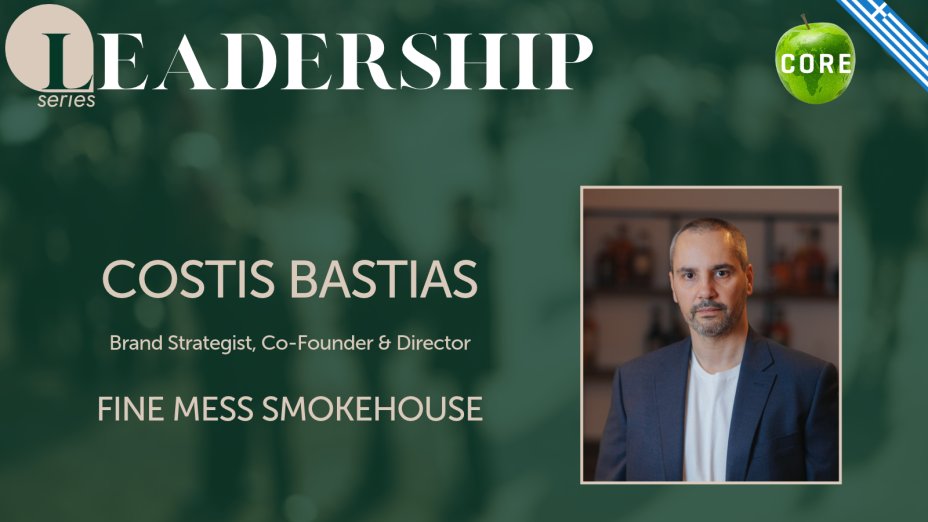
Leadership series: Costis Bastias
Our Leadership series tell the stories of inspiring leaders making an impact across the industry.
In this interview, we speak to Costis Bastias, Brand Strategist, Co-Founder & Director, Fine Mess Smokehouse
Tell us a little about yourself and your business.
I come from an unusual background - a brand strategy consultant turned entrepreneur. I entered hospitality driven by the desire to craft customer experiences where I felt it mattered the most; that is, in places where the Experience is what the customer is looking for, not merely a dress-up for a product or a service. Fifteen years into this journey, I feel that, when done right, hospitality becomes about catering not to customers but to patrons; when done exceptionally well, it becomes about welcoming guests, in very much the same way one would welcome them at their own home.
Fine Mess Smokehouse is a unique concept, a low & slow barbecue fine dining proposition. Fine Mess strips barbecue cuisine down to its values - what we consider to be the bare essentials and the culture’s very soul: bold flavours, creativity, community around the table, and a belief that pretence and appearances are unnecessary distractions. Founded on these premises, Fine Mess set out to create the Gastronomy of Smoke and bring low & slow barbecue to the modern culinary scene.
What motivates you in your work and what do you find most fulfilling about being a business leader?
Working in hospitality can be exhausting and draining, if you let it; the endless work and unsociable hours are only the most visible part of this reality. In essence, you are required to perform in real time, all the time, in the presence of your guests: you are working, yet they are there to enjoy themselves. The strain can be immense.
The greatest motivation is turning customers into guests, becoming part of their story and letting them become part of yours. Any conversation, any interaction that deviates from, or goes above and beyond the transactional nature of being a service provider, is what makes for the forging of real human relationships, and ultimately what makes this line of work so unique and worthwhile.
Arriving at this point of view is something that took years of work and contemplation. As a leader, I consider sharing this insight with my team a key component of my role; this is the perspective that allows them to operate as hosts welcoming guests, instead of employees servicing customers. Instilling this world view to my colleagues is without a doubt the most fulfilling part of what I do.
What do you see as the biggest challenges currently facing the landscape where you are and how should/will a business like yours respond?
Operating in the Athens market presents two major challenges.
The first one, on which I feel most other operators would agree on, is the extremely unsupportive Government. The State views the hospitality and F&B industry as well-established and requiring no protection; at the same time, due to the nature of our industry, the State also views it as the go-to source for fund-raising through various taxation and contribution mechanisms. Hostile, outdated fiscal and economic policies that make erroneous assumptions about the current hospitality business model force operators - unwillingly - to break the law to survive, or to offer sub-par services. The response here could only be a maximisation of efficiency. As counter-intuitive as it sounds in an environment where generosity is paramount, this must be carefully measured and applied, and businesses must be run on the principles of minimising wastage and unnecessary expenses, making the most out of every resource, and achieving full asset and capacity utilisation. In short, businesses cannot afford the luxury of underperforming.
The second is somewhat more threatening in my eyes, and it is related to the reduced consumer spending power. High inflation has reduced the value of household incomes far more than statistics indicate. This kind of financial pressure drives consumers into a general state of dissatisfaction - what one could describe as a state of misery - where no experience ever matches their expectations, regardless of price point. This could best be addressed by a combination of setting clear promises, building generosity as standard into the cost base, and establishing actual relationships with customers. After all, the age-old adage “we are all in this together” most definitely holds true today.
Thinking about the (current) macro-economic and social environment (cost pressures, labour market, changing customer expectations, sustainability), what shifts do you believe will redefine “success” for our sector in the coming year or years?
It is hard to bring to mind a time when economic pressure, limited labour supply and customer expectations in our sector were not viewed as major hardships; still, it is clear that the level of hardship is currently at what many would consider an unprecedented high. Business survival today is, for many, a success and a bragging right in itself.
It is my view that these pressures are, to an extent, a very painful way for an over-saturated market within a shrinking economic environment to correct itself. Through this prism, I would define success for any business as being driven to introspection and self-evaluation, finding a clear raison d’être, and refining its operation to serve that very reason for existing in a profitable way that makes it worthwhile for everyone involved.
What do you believe will distinguish the leading service providers over the next decade (e.g. niche market, luxury, sustainability, experience-driven, hybrid models…)?
I believe that making appropriate use of new technologies is what will separate the leaders from the followers in our market globally, and draw the distinction between experience and service providers in hospitality. We are now living in the age of Artificial Intelligence, and the temptation to automate and rely on tech to reduce costs is becoming alarmingly great. It is up to us to remember that hospitality, put very crudely and bluntly, can never be about the numbers: efficiency, cost reduction, scale of operations and maximisation of resource utilisation need to be viewed as means to an end - not the end goal itself. Those who understand the distinction and can walk the ever thinner line balancing the two, are the ones who will ultimately manage to create memorable experiences worth sharing.
If you could influence one thing about the future of hospitality (policy, regulation, social trend, business model…) what would it be, and why?
As a matter of State policy, I would challenge the assumption that hospitality will survive any hardship and regenerate without significant consequences, and would push for the creation of support mechanisms specifically adapted to the intricacies of the industry. Fiscal policy needs to be set in a similar fashion, as it is much better to avoid creating crises than to have to manage them.
What’s the most important leadership lesson you’ve learned?
In any situation, you must stay humble and keep looking for what you may have missed or for what else you could possibly learn. In my view, leadership is not about being all-knowing, or even successful in your every attempt; rather, leadership comes from recognising that in failure as much as in success, there is always room for improvement. Staying humble, pushing yourself and your team to do your best today and become the best you can be tomorrow, is what I try to do, and what I want to inspire my colleagues to do as well.
How do you prioritise tasks when everything feels like a priority?
In hospitality management, it is easy for things to become overwhelming. My approach is to categorise tasks into three groups - those essential for the viability and continuous running of an operation, those that ensure an excellent, uncompromising experience for our guests, and those which are related to our profitability and overall return as a business - and I prioritise them in that order.
I am not usually challenged on why providing an excellent, uncompromising experience does not come first; to most, it comes naturally to see the value - and necessity - of the operation surviving in order for the experience to be delivered. What is not so intuitive to realise is why the experience must be delivered to excellent and uncompromising standards before we are concerned with profitability and return. To me, the former guarantees long-term survival through reputation and loyalty, which is far more important than short-term returns.
Within each category, I do not stress too much about the order in which issues are given priority; what is most important is taking immediate action and starting to address them one by one; time spent deciding where to commit resources would be better invested in solving the issues themselves.
What do you hope your legacy will be both for your organisation and for the hospitality industry more broadly?
The concept of Authentic Hospitality is an idea I started working on long before I decided to enter the sector as an entrepreneur, and it goes back to when I was tending bar at my university’s local pub.
Well beyond the unfortunate, clichéd, vaguely defined use of the word, I define as Authentic those hospitality operations that are designed and run in the way that best serves the underlying concept and the audience it is directed to - not in the way that would necessarily generate the highest short-term profitability.
Authentic Hospitality operations are characterised by a true sense of purpose that extends beyond their performance as a business. This very sense of purpose allows for the creation of a culture of commitment among their teams and a feeling of community and belonging among internal and external audiences, and ultimately ensures a meaningful, profitable survival for the long run.
This philosophy, with its theoretical and practical underpinnings, is the cornerstone of all my projects across hospitality, from my very first business, Kokkini Svoura, to the most recent, Fine Mess Smokehouse; it is the culture and ethos I have strived to instil in my partners, colleagues and management team over the years, and it is the legacy I hope to build and leave as my mark.
How has your leadership philosophy evolved, especially over the past few years of rapid change?
Today, more than ever, I believe in leading only those who want to be inspired, instead of attempting to persuade and convince those who are negative and do not feel the need to make an effort. As I myself grow, the scarcity of time and energy becomes clearer to me; these are valuable resources best invested in serving those who want to learn, to be inspired and to bring change, rather than in those who need convincing that this is a meaningful way to live, work and create. I focus my energy on staffing my team with people who carry the right mentality, and those people only - it may mean that we are short-staffed on occasion, but even then we can bring better results in a better way for all of us than if we were fully staffed with people who do not share in our approach.
How do you balance the demands of commercial performance with staff well-being, retention, and culture building?
In running a business, delivering value is how we all get paid - and this is an idea I try to get every member of my team behind. Delivering above-market value in our work is everyone’s pathway to receiving above-market returns. It is another way of saying “there is no such thing as a free meal”.
Of course, this calls for clarity, honesty and fairness across every role and every level, and it is a principle that must hold true for everyone - and it does. This way, we are all motivated to perform to the best of our ability within our individual roles, as well as to push each other in the right direction. Unity and fairness bring alignment and commitment.
What strategies have proven most effective for attracting and growing future talent?
The “grow from within” strategy has been the approach I have followed throughout my career. I am very happy to take on ‘green’ people with the right attitude and values, invest in their development and see them grow into roles of increasing responsibility among us. This leads to a unified, trustworthy team that shares a common vision, with highly committed people at the top, and the proper motivation to inspire and drive newcomers.
Sustainability is a growing priority. How are you embedding meaningful, long-term sustainability practices into your business?
At all levels of fine dining and within the premium experiences space, it would be honest to admit that perfect sustainability practices are not attainable. Not every ingredient can be locally sourced and ethically produced, and what we aspire to present to our guests has a high energy requirement; this is a reality we should not pretend does not exist, in order to protect the meaning and the aspiration of the Sustainability movement.
What we are very focused on doing is minimising wastage across the board, in everything that we do. This means making full use of the ingredients. as much as it means that we do not make ordering mistakes that result in dishes or poor kitchen preparations that end up in the bin. And of course, when we have a choice of a locally or sustainably produced ingredient or raw material at a cost that we can support, we make it our preference.
Looking back, what has been the most pivotal moment in your career, a turning point that shaped how you lead today?
Fine Mess Smokehouse was founded in 2019, roughly six months prior to the Covid pandemic lockdowns. As a business that was just then reaching break-even in its operations, we were caught in a perfect storm, facing a very tough financial situation, a dispute with a landlord unwilling to adapt to the times, and a very uncertain outlook. Deciding to push through and persevere took not just my own but everyone’s unwavering commitment to the success of the project, and required me to make a series of very difficult decisions that carried a significant personal toll.
Today, it is evident to me that how I lead and my ability to make decisions when under pressure have clearly been shaped by the events of that time: recognising what is important and where my focus needs to be has become clearer since.
What advice would you give emerging leaders who want to shape the future of the service industry?
On my most recent road trip this summer across the Pyrenees in Spain and France, I spent a few nights in a hotel in a small town. The hotel was fully automated: I checked in through a machine by myself and got my room key; the room was tidied up the following days; I even enjoyed a buffet breakfast, all without ever seeing a single person who worked there. Everything was in order, and the hotel’s website that managed the entire booking and stay was very well designed. And the reason why I am not sharing the name of the hotel is not discretion; it is simply because I do not remember it. Indeed, I do not recall much at all from my interaction with this property, only a few months ago, and there is no recommendations to be made to friends travelling in the region this Autumn.
This personal story has a very clear moral: Products and services can be automated and offered through technology. Memorable Experiences cannot. If you want to lead in hospitality tomorrow, your focus should be on crafting experiences that are memorable and worth sharing, and on inspiring, training and motivating the people and team who will help you bring these experiences from paper to life. This would be my single piece of advice.
Author
Date Published: 30th October 2026
