
Leadership series: Mauri Ferraiuolo
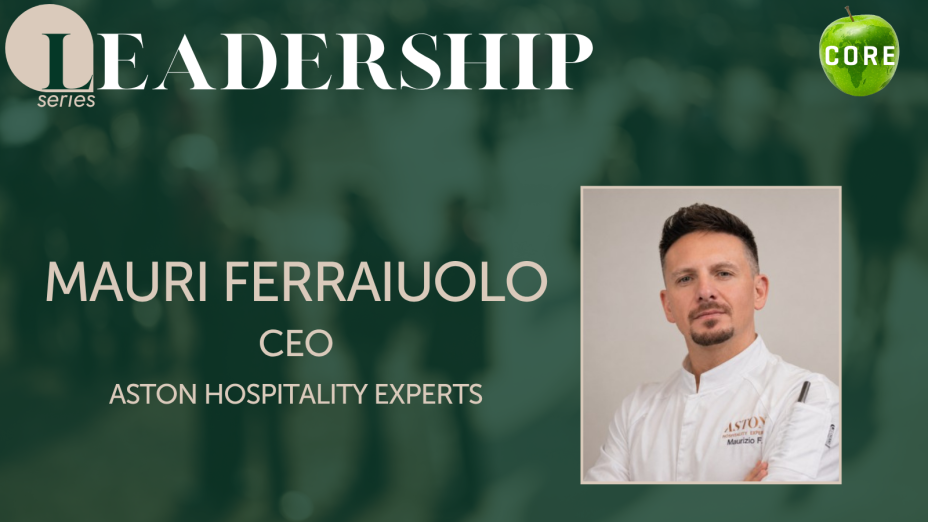
Through our Leadership Series, we share the stories, insights, and journeys of inspiring industry leaders.
We are here talking to Mauri Ferraiuolo, CEO at Aston Hospitality Experts
You've gone from personal chef to Mohamed Al Fayed to founding your own consultancy in Dubai. How would you describe Aston Hospitality Experts to someone who's never worked with you, and what gap were you trying to fill when you set it up in 2020?
Aston Hospitality Experts is essentially the team I wish I had available to me when I was running hospitality businesses. We work with restaurants, hotels, investors and F&B groups on the areas that determine whether a hospitality business succeeds: concept, food, operations, people, systems and profitability.
When I started Aston, I felt there was a gap between traditional consultants and operators. There are many people who can produce a beautiful presentation or tell you what a business should do. I wanted to build a company made up of people who had done it. We have opened restaurants, managed hotels, run kitchens, controlled millions in food spend, hired teams, dealt with bad months and fixed operations when the numbers were not working.
That practical experience is still at the centre of Aston today. We don't just advise from the outside. We get involved.
The GCC hospitality and F&B market has moved fast since you set up Aston Hospitality Experts in 2020. What's the biggest shift you've seen in the region over that period, and how are you advising clients to respond to it?
The biggest change is that being busy is no longer enough. For years, particularly in rapidly growing GCC markets, a strong location, an attractive concept and good marketing could hide a lot of operational problems. That is becoming much harder. Rent, salaries, ingredients and customer acquisition have become more expensive, while guests have become more demanding and competition is enormous.
So, I spend much more time talking to clients about what happens behind the revenue. What is the actual food cost? What is being wasted? Which dishes make money? How productive is the team? What is happening with purchasing? Where is margin disappearing? The operators who understand those numbers in real time have a significant advantage over those who simply look at sales at the end of the month.
Between cost pressures, a tight labour market, and rising guest expectations, what do you think will redefine 'success' for restaurant and hotel operators in the UAE and wider MENA region over the next few years?
I think success will increasingly be defined by profitable consistency. Hospitality sometimes becomes obsessed with openings, Instagram, awards and revenue. Those things have value, but none of them automatically create a sustainable business. A successful restaurant is one that can deliver the same experience repeatedly while protecting its margins.
That means knowing your numbers, building systems that don't depend entirely on one individual, retaining good people and understanding what the guest values. I have seen very busy restaurants (especially in the GCC) lose money and relatively simple businesses generate excellent returns. Revenue is vanity if there is nothing left at the bottom.
Where do you see the smartest investment going right now: menu and concept development, operations and training, or technology?
I don't think you can separate them anymore.
A great concept with poor operations will eventually fail. Great operations behind a weak concept won't generate enough demand. Technology without good operators simply digitises bad processes.
The smartest investment is in connecting all three.
That is one of the reasons we developed FoodSync (astonfoodsync.com). I became frustrated with businesses having recipes in one place, purchasing somewhere else, inventory in another system, financial information arriving weeks later, and the accounts department constantly arguing with the F&B team over lost invoices and variances. Technology should give operators visibility and help people make better decisions. It shouldn't create another piece of software that the team must manage.
Looking back across Harrods, Wyndham, The English Tea House, Fassco, Food Passion and now your own business, what would you point to as your biggest career achievement?
It is difficult to choose one because different periods taught me completely different things. Working at Harrods and later cooking privately for Mohamed Al Fayed gave me an extraordinary foundation. Moving through executive chef roles and eventually into F&B and senior management taught me how much bigger hospitality is than the kitchen and transitioned me from a moody chef to an outgoing professional.
But I would probably say building Aston Hospitality Experts. When you work for a major organisation, there is an infrastructure around you. When you start your own company, there isn't. You must build the reputation, find the clients, deliver the work, make payroll and take responsibility when something doesn't go according to plan. Seeing businesses that we have helped create, improve or turn around is probably the achievement I am most proud of professionally.
What's the most important leadership lesson you've carried with you from cooking for Mohamed Al Fayed through to running Food Passion as COO?
Take responsibility. In senior positions, it is very easy to find explanations for why something went wrong. The supplier failed. The chef made a mistake. The market changed. Someone didn't follow the procedure. Some of those explanations may be completely true, but as a leader the problem still belongs to you.
Kitchens taught me this very early. When service starts, nobody cares about the excuse. The guest is waiting. My leadership style has changed enormously over the years, but that principle hasn't. Give people responsibility, give them the tools to succeed and hold them accountable. But ultimately, if you are leading the business, accountability starts with you.
What operational or technological innovations excite you most right now, and are clients asking for them?
AI is obviously going to change hospitality, but I am more interested in practical applications than the hype around it. For me, the interesting question is: can technology identify a problem before the operator sees it?
If my theoretical food cost is 24% and my actual cost is moving towards 29 percent, I shouldn't discover that several weeks later when the P&L arrives. The system should be able to identify where the variance is happening, whether it comes from purchasing, portioning, waste, inventory or pricing, and bring it to the operator's attention. That thinking is behind a lot of what we developed with FoodSync (astonfoodsync.com). I believe hospitality technology will move away from simply recording information and increasingly start interpreting it for operators. That is where it becomes genuinely useful.
What's been the most pivotal moment in your career, from Harrods to founding your own consultancy, that shaped how you lead today?
Probably leaving the kitchen as my only world. For a long time, I thought like a chef. Quality came first and almost everything else came afterwards.
When I moved deeper into F&B management, I had to understand finance, HR, procurement, sales, marketing and ultimately the entire P&L and Balance Sheets.
I realised that creativity and commercial performance are not enemies. A chef can create fantastic food, but if the restaurant cannot make money selling it, eventually there will be no restaurant. That changed the way I look at hospitality, and it still influences almost every conversation I have with clients today.
What's your long-term vision for Aston Hospitality Experts, and the legacy you'd like to leave in the industry?
I want Aston to become THE hospitality company people call when they need something to work. Not simply to design another concept or write another report, but to help build businesses that are commercially strong and operationally sustainable.
The next stage is also technology. After more than two decades operating hospitality businesses, I realised that many of the same problems keep appearing because operators don't have the information they need when they need it. That led us to build our own system FoodSync.
My long-term vision is therefore bigger than consultancy. I see Aston providing the expertise and the technology behind it. If there is a legacy, I would like it to be that we helped make hospitality businesses better businesses, while never forgetting that this industry is fundamentally about people.
What advice would you give someone starting out in a kitchen today who wants to end up leading, or advising, hospitality businesses the way you do now?
Learn everything. Don't decide too early that something isn't your job. If you are a chef, understand food cost. Learn purchasing. Ask why the restaurant is busy on Tuesday but empty on Wednesday. Understand labour. Learn how the P&L works. Spend time with the front of house team. Understand why guests complain and why they come back. Don’t be a clock-watcher, if you have to spend free time learning, ask your chef and he will (should) be more than happy to show you the way.
And don't be in too much of a hurry to get the title. Hospitality rewards experience because eventually you will encounter situations that cannot be learned from a textbook or a LinkedIn post. The more problems you solve early in your career, the more valuable that experience becomes later.
What problem in hospitality are you most determined to solve next?
For me, it is the gap between what operators think is happening in their business and what is happening. I've walked into businesses doing millions in revenue where management could tell me yesterday's sales within seconds, but couldn't tell me their actual food cost, waste, purchasing variance or true profitability with the same confidence.
We have incredible amounts of data in hospitality, but much of it arrives too late or sits in different systems. I want to change that. The next generation of hospitality management should not be about producing more reports. It should be about giving an operator the right information now they can still do something about it. That is a problem I intend to spend a significant part of my next chapter solving.
Author
Date Published: 28th August 2026
