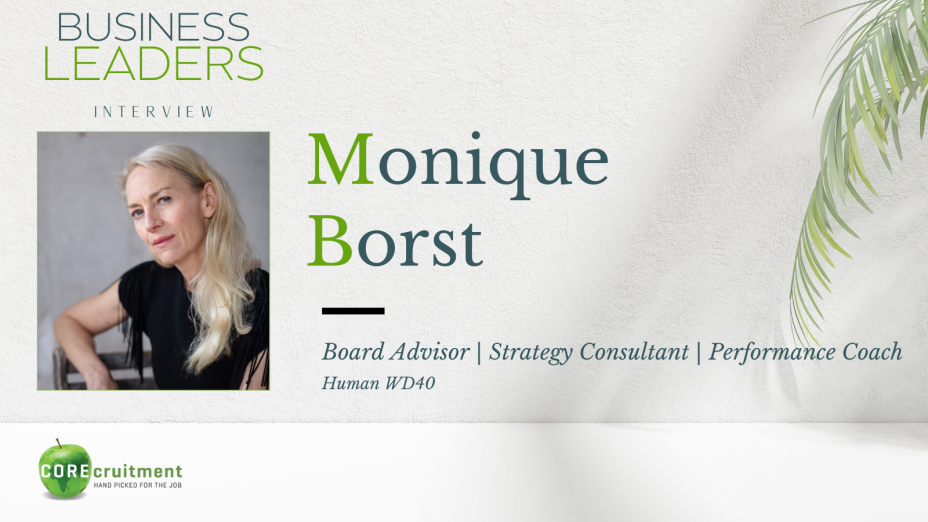
Business Leaders interview: Monique Borst
Tell us a little about yourself and your business.
An experienced advisor, I take on collaborative assignments across leadership, growth and change that require a focused dose of energy, insight and intuition.
I work with clients who think long-term, they’re realists, they want to get active in their own development and uplevelling.
With broad sector experience (including FMCG and hospitality, finance) and a strong knowledge-base, growth-oriented leaders work with me to scale and lead business their way, so they can break new ground without breaking themselves.
I guide clients holistically, but typically collaborations are arranged around these pillars:Strategy - creating a sustainable, investable proposition.Implementation - setting the business up to grow and scale, talent, marketing, business operations, fundraising.
Mindset - the double track of learning: growing your business and yourself. Uncovering and unblocking the unconscious paradigms and beliefs clients hold that are controlling their business and growth.
I have learned that 90% of the game is played above the shoulders and that businesses thrive when individuals do.
I care deeply about creating a supportive work environment. I'm one of the people who puts the passion into compassionate: I believe in thoughtfulness.
www.linkedin.com/in/moniqueborst
https://moniqueborst.substack.com
Vision or execution: which matters more to business success?
In my experience most entrepreneurs are great at creating the vision. Fewer succeed in articulating it, and even fewer can drive it to completion.
Our businesses are a mirror reflection of where we are on our own self-development journey and can only be as successful as we are aware and in control of our thoughts and emotions.
Without a true North Star, it is easy to fall prey to the urgent instead of the important.
How did you develop your leadership skills and how would you define your leadership style?
As an emotional leader, I have always given all of myself in every aspect of my work.
I think that’s partially fuelled some of my success in leadership.
But as I got older, I learned more about the importance of boundaries and how this thinking doesn’t limit potential but gives you a better perspective of where and how you should apply yourself.
The notion that growth (personal, business or economic) is never-ending and there’s no cost isn’t realistic – there have to be consequences.
There have to be boundaries.
To talk adequately about growth, we need to better describe what we value, beyond financial and strategic benchmarks.
Where do you think the most promising investments should be focusing on and/or made on?
I believe the greatest challenge of our time is to include empathy and human contact as currency. And global environmental justice, creating a sustainable future for future generations.
An interesting example of this is the start-up Friend, a $99 AI-powered, always listening necklace designed to combat loneliness. An AI wearable designed to be the wearer's friend (but mostly an AI chatbot that lives inside the pendant). It always has an opinion to share about what’s going on around it, which it communicates using text messages and push notifications on the phone it’s paired to. Friend’s necklace aims to be a digital companion, using AI to detect and respond to signs of loneliness. While the intention is noble, the execution raises ethical red flags, highlighting both the potential and pitfalls of tech solutions to human problems. Can we really rely on AI for emotional support without losing our human touch? Friendship is a relationship that is mutually reciprocal, and it's very difficult to be the friend of someone for whom we are not the friend. So, friendship is something that demands equity. To me, it exemplifies the peril and dangers of AI. Used wisely, AI can help us connect more deeply and solve complex problems. Entrepreneurs and innovators wield the power to shape our future, yet with great power comes great responsibility.
What is your biggest career achievement(s)?
Understanding the concept of presence. It’s such a powerful teaching. The ability to drop deeply into the present moment, to connect fully with my clients … for me it really does change the whole game of transformational collaborations. When I reflect on it, presence is really the secret to the success I’ve had with clients. One of the biggest misconceptions about presence is thinking you have to be Zen or optimistic in order to be present. But in reality, presence is all about tolerating emotion. Your emotions and other people’s emotions. And emotions aren’t always positive. The only way out is through!
What’s the most important leadership lesson you’ve learned?
In personal, and business, growth we have to continuously challenge what we think we know. We have to question our beliefs, examine every blind spot, and – most importantly – take responsibility for our own BS. People and organisations only thrive where ‘I don’t know’ doesn’t equal ignorance but confident humility. It seems one of the most pervasive and under-discussed issues in corporate life, at least to me.
Why is so much focus put on businesses getting bigger not better?
Society has ingrained in us very specific ideas of what success looks like. I believe size matters but only in respect of there being a match between your personal and business goals, and the type of business you’re running - or want to create - and how scalable it is or not. Staying small and building a business around your life can be the perfect goal.
Have you achieved everything you wanted in your career so far?
One under-explored issue in the ‘glass ceiling’, in my opinion and experience, is that many women simply aren’t prepared to make the same sacrifices for corporate life that men are. And I don’t think that’s a bad thing! I never wanted to have children but I enjoy seeing my friends, travelling, exercising, reading lots and working on side projects. Many men I know in top jobs have simply put all that to the side. And I wouldn’t want to swap places with them. After I came out of corporate life I pursued a portfolio career rather than a single high-profile management job, because it offered me so many more challenges, interesting opportunities to learn and widen my circle of contacts and with more personal control over my time. To me, that was a smart move. Complaining about the system, though I never felt personally disadvantaged being a woman, always seemed less compelling and effective than making it work for me. Work evolves in us and should inspire us to evolve!
How do you make big decisions? In business and in life.
I like to journal. Free writing what comes to mind without censoring myself often brings clarity. Sometimes a list helps, writing out the pros and cons. Questions I ask myself: 1) is this aligned with my values and intentions? 2) what are the short- and long-term benefits? 3) is this going to hurt or harm anyone? If so, (how) can I lessen the impact?
How do you prioritise tasks when everything feels like a priority?
Everybody wants cookie cutter productivity, morning, and exercise routines because they think the key to ‘success’ is doing what other ‘successful’ people do.
But it doesn’t matter what someone else does if it doesn’t work for you.
The trick is treating productivity like an experiment and finding the exact habits, tactics, and strategies that work for your life, your goals and your unique personality.
You need to find your rhythm and accept that it will need tweaking and adapting depending on the time of year and what’s happening in your life.
‘Important’ can fall into 2 buckets …
1. Your health, family and most important relationships. The stuff that would devastate you if you lost it.
2. The bigger picture, planning, and strategic stuff in the business that allows you to move ahead with intention (vs feeling like you're stuck on a treadmill).
People who don’t set boundaries often don’t feel they ‘deserve’ to set boundaries, and they feel that way because they’re used to always putting other people first.
Their self-esteem has been reinforced by their own inability to state what they want.
It’s a vicious cycle.
Are you making time for the important stuff? What needs to get done that will drive value? Focusing and executing on that?
How do you ensure that your DE&I initiatives are aligned with your overall business objectives?
Connect diversity to your business strategy. Don’t just recruit women, include religion, disability, age and gender preferences. Radiate genuine diversity and build a healthy organisational culture or you will lose people when they realise they’ll hit that invisible barrier.
Amid stakeholder demands and transparency pressures, leaders can no longer treat DE&I and ethics as merely a legal and reputational defense mechanism.
An insightful and practical book to help leaders navigate the challenges and risks and do the right thing in a tumultuous global landscape is Higher Ground by Alison Taylor www.alisontaylor.co
What can businesses do so that all their employees feel equally valued and respected?
Train your managers to manage people or they will rely on their instinct. We want our leaders to be real people who are able to connect with others personally.
Facilitate rather than dictate. Help people accomplish what they want to achieve.
Leaders should recognise what they don’t know … be interested in finding answers!
Whatever your age or position, you have to be open to learning and harnessing everyone’s influences and opinions; we can all learn from each other.
A business’ ideas and energy come from the team’s consumption of the current landscape, so to be culturally relevant it pays to always make sure you’re looking at what your team are looking at.
Create brave spaces.
The term brave spaces originates in social justice work in higher education settings.
A brave space is the creation of a challenging environment that encourages equal participation.
Bravery is necessary, instead of safety, because learning necessarily involves not merely risk, but the challenge of giving up a former condition / view in favour of a new way of seeing things.
You can’t create ‘safety’ for everyone. I don’t know what other people in the room are going to do. And secondly, safe for whom?
I believe all organisations can do is create spaces - judgement free zones - to be brave together.
To call people into a brave space is to summon everyone to try something together. To promise people a safe space is to make everyone a promise about everyone else. And that’s in my experience impossible to keep.
What advice would you give to your younger self?
Being heard is so close to being loved that to the average person, they’re almost indistinguishable. Tell yourself you’re great. It’s important to love yourself and not look for approval.
What do think is a missing ingredient in the world of business and work?
Elegance … you don’t hear it a lot these days. It sounds outdated. But that’s what makes it special. In business, people don't think about acting elegantly. To be elegant is to be deliberate, respond gracefully, take things lightly - to move through the world with positive purpose. It’s having a soft touch and tough resilience at the same time. In my experience, it’s an incredible secret weapon.
Independent thinking. If you’re a leader creating and shaping change in uncertain, fluid environments is not only a challenge, it’s also the invisible ink in your job description. You have to be able to think for yourself, as yourself, and be able to create the space and culture where this is true for those around you. Getting the best from people means getting their best thinking. This means knowing how to be with people, how to offer them the highest quality attention based on genuine interest in what they think, and the expectation that they can think for themselves better than anyone can think for them. Creating the conditions and a culture where everyone is free and capable to think for themselves, as themselves, helps to drive creativity and effective collaboration. Courageous thinking needs space.
Is there anything you’re actively promoting?
My newsletter Leadership Squared on Substack.
A monthly deep dive into the new era of human leadership.
I delve into my professional and lived experience to provide my perspective on topical issues that are close to my heart and provide a forum to experiment with taking skillful action.
Last month I wrote about rest, and I have written about burnout, betrayal, trust and attachment styles in leadership.
Author
Date Published: 2nd August 2024
