
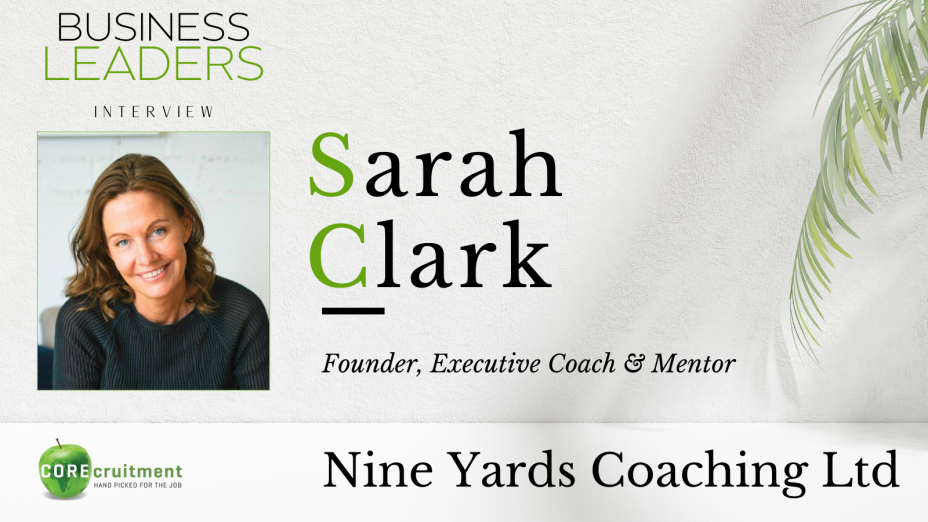
Business Leaders interview: Sarah Clark
How did you get into hospitality?
I jumped into the hospitality world by working behind a bar in a Chelsea pub at 21. Within 6 months, I was promoted to manager - it turned out I had a knack for it! I loved the energy and the people, so I kept pushing myself, ready to travel across the country to open new businesses with Bass, the company I was with at the time. That led me to Corney & Barrow Wine Bars, where I spent seven great years, eventually becoming Operations Director. Next came a stint at Pret, where I worked my way up to Head of the City. After that, I took on the challenge of running 100 pubs as Retail Director at Mitchells & Butlers with Castle and Vintage. Before starting Nine Yards Coaching, I was the Managing Director for Wellfound Ltd, a startup bar business backed by Imbiba for 7 years. It's been quite a journey, and I wouldn't change a thing!
Tell us a little about yourself and your business.
I’m the founder of Nine Yards Coaching: an executive coach and mentor, working closely with leaders in hospitality and retail. My business has two main focuses: coaching and mentoring leaders 1:1 to help them become even better at what they do - leading with confidence, not control, by building self-awareness and self-regulation.
The other part is all about sparking conversations in our industry on how we can create a new reality where coaching and mentoring become the norm for leaders, not the exception.
Imagine a world where every leader, no matter their position, has access to a coach or mentor as part of their professional development. Traditionally, coaching has been seen as something only for the C-suite, but it’s really the middle managers – the future Directors and CEOs - who have the biggest impact on our businesses and people.
The cost of coaching might surprise you - it can be quite affordable. But even if it’s out of reach for some companies, there are creative solutions like contra deals between businesses or using free coaching platforms. Or perhaps why not make coaching a standard part of our leadership packages? Training programs are important, but they only go so far. Having a personal coach tailors the experience to your specific needs as a leader.
Coaching leaders at the middle management level could transform our current landscape, setting up future leaders for success. I’m determined to start this conversation with as many leaders as I can.
What steps do you take to measure your own performance?
This has been one of my biggest growth areas over the past year. Before launching Nine Yards Coaching, I measured my performance by how well the businesses I lead were doing. I didn’t realise how much of my self-worth was tied up in daily sales reports, P&L statements, ROI, or even softer metrics like team member turnover.
I was so wrapped up in my work that my work became my identity. Now, I measure my performance on my self-reputation - whether I did what I said I would do each day. By growing my self-awareness - seeing from a sort of helicopter view how my pesky mind might try to trip me up - I can stay out of my own way.
It’s about striving to be just 1% better every day. Of course, there are days when I slip and self-sabotage - who doesn’t? - but knowing that helps me measure my performance against who I was the day before and also to enjoy the person I am becoming
What’s the most important leadership lesson you’ve learned?
To be yourself. In my early days of leadership, I spent far too long trying to mimic others. As an introvert, I found myself constantly comparing myself to the louder, more outspoken people on the leadership teams I worked with. It left me out of alignment with my values and my greatest strengths. When we’re trying to be who we think others want us to be - or who we think we should be - it’s exhausting, and people can sense that lack of authenticity from a mile away too. There’s a certain peace and freedom that comes with being completely true to yourself, and that’s when you become an unstoppable leader. I work with a lot of leaders on this very concept in my coaching programs.
How do you prioritize tasks when everything feels like a priority?
I’ve learned that I work best in the evenings and first thing in the morning, so I make sure to plan my most important tasks during those peak productivity times. I set clear boundaries to protect my energy and time, and I stick to them pretty strictly.
I’m not a fan of multitasking - I believe it doesn’t make us more productive. Instead, I focus on one task at a time, which helps me work better and faster. It avoids the mental clutter of switching between tasks, reduces stress, improves memory, boosts creativity, and makes it easier to get into a flow where I’m fully absorbed in what I’m doing.
What do you consider to be the key component(s) of effective business operational development?
It starts with people - empowering your team and investing in their continuous learning keeps everyone engaged and motivated. Having a clear vision and goals that align with your operations is crucial; it gives everyone a shared direction and purpose. But we also need to stay agile and adaptable in our fast-paced environment – and be prepared to deviate from the plan with necessary.
Open and transparent communication across all departments is key to ensuring the business works together effectively. And, of course, none of this works without a strong work ethic and a hefty sprinkle of determination, pushing through challenges with resilience and hard work.
How did you develop your leadership skills, and how would you define your leadership style?
I developed my leadership skills by watching others - learning from the remarkable leaders I worked with over the years. I’m grateful for all that they did, and sometimes for what they didn’t do, which helped me shape my own style.
I often had to figure things out on my own, which led to a lot of mistakes, but those mistakes were invaluable learning experiences. My leadership style has evolved into one that’s focused on authenticity, empathy, empowerment and straight talking - giving people the space to grow and learn, just as I did.
Author
Date Published: 8th August 2024
