
Leadership interview series: Jeremie Lannoy
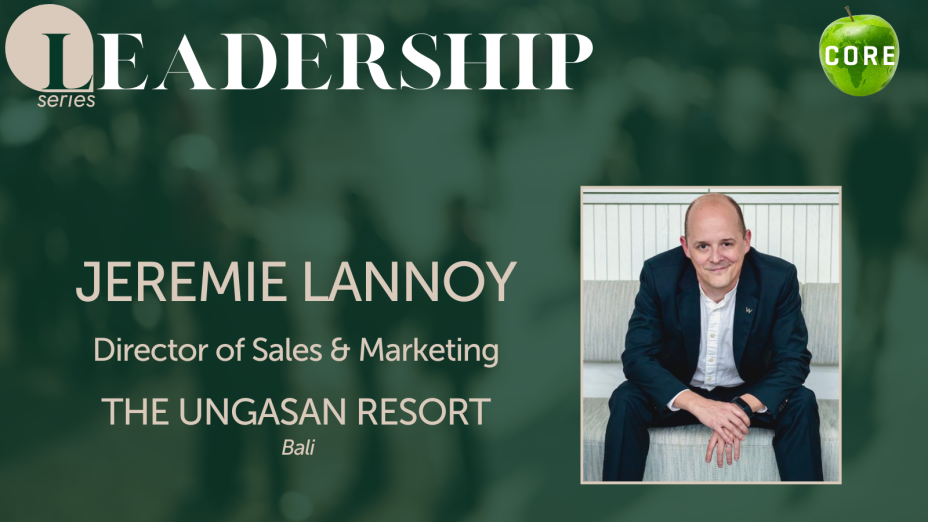
The CORE Leadership Series brings inspiring industry leadership to life through in-depth interviews.
We are talking to Jeremie Lannoy, Director of Sales & Marketing at The Ungasan Resort, Bali.
Tell us a little about yourself and your business.
Originally from Belgium, I started my career in bars in my hometown of Liège. I have worked for 13 years in advertising agency, starting as a web developer, evolving towards project management then commercial lead. In 2013, I got the chance to Join Starwood hotels as a Regional Senior Manager for Digital Marketing and have been working in luxury hospitality ever since
I am now leading the commercial strategy at a boutique luxury resort in Bali called The Ungasan, located as southernmost point of Bali. The resort includes 7 clifftop 5-bedroom villas of 2500 square meter each, and the famous Sundays beach club.
What initially inspired you or sparked your interest in pursuing this career?
I’ve always had a taste for hospitality, after all I started my career in F&B, and I had an uncle who had been working in hospitality all over North America, as Exec Chef and GM, so it was always there in the background. My time in advertising spiked my interest for the luxury industry, and I’ve always loved seeing the magic behind the scenes, what’s hidden being the “staff only” door. So, if you combine all that working in sales and Marketing in luxury hospitality, it was the best combination possible for me. It gives me that look behind the curtain, I’ve worked with some of the best luxury brands in the world, the commercial part speaks to my analytical side, and then I love being on the floor, the contact with the guests and the team. It’s a job that really provides a good balance of all the things I love.
What do you believe will distinguish the leading service providers over the next decade (e.g. niche market, luxury, sustainability, experience-driven, hybrid models…)?
Authenticity. That’s the key word for me.
In a world of standardized brands and experiences across the luxury industry, you need to provide your guests with an authentic experience, genuine care and connection. Too many brands and properties fall in the “follow the script” trap. There’s a script provided by a team in a corporate office somewhere in a different part of the world, sometimes by people with very little experience in operation and talents from the US, Europe and Asia are all asked to follow the same. The result is a standardised, clinical, interaction that won’t resonate with most of the guests.
The experience you provide must resonate with the place, and that begins with the team, allowing them to be authentic, to genuinely care for the guest, be proud of who they are and where they are, which then unlocks that authentic experience everyone is chasing.
What skills or mindsets do you think will be most important for the next generation of hospitality leaders?
More than ever, we need empathy. We’ve been taught for years to demonstrate it with our guests, especially when something goes wrong, it’s in all the recovery framework in all hospitality groups. But then again it feels a bit forced.We need to start with our teams, with our talents, we desperately need empathy in our business. Not because it will move the bottom line in the long run, but because it’s the right thing to do, especially with a new generation of talent who are more than ever asking the “why” behind decisions. We can’t fall back to the “that’s the way it is”, we need to understand why they’re asking the question and provide the answer.Teams are also increasingly multicultural, and as a leader you need to be able to understand that not everyone reacts the same way to the same cues. There is a cultural bias behind every interaction and what will work with someone form one part of the world might not work somewhere else.
What’s the most important leadership lesson you’ve learned?
The importance of talking and listening to the team of being accessible to the broader team in the hotel. I worked with a seasoned General Manager, he had been all over, and dealt with big hotels from big brands, and every day he met one member of the team, not the managers or leadership team, all employees. Every day in his calendar there was a 20-minute meeting to listen to what one team member had to say. Some had nothing to say, some had plenty, he was having a chat with all of them, and it made such a difference for everyone.
What values or behaviors do you consider essential for leadership teams today?
Empathy. You have to be able to stop for a minute and put yourself in the shoes of your team member. What’s happening in their work, in their life, why don’t they get what you’re trying to explain? What’s happening in their life that can influencer their behaviour at work? Culturally, how do they react to strong or soft leadership, or to different communication styles? I’ve done a fantastic training during my short time at Hilton: it was all about learning our team-members preferred style of communication and it was amazing. One needed a verbal brief, concise and instantaneous and all was ok, the other preferred a structured email with instructions … just adapting to that was improving efficiency so much.
It’s about understanding the context behind the person you’re working with, adjusting leadership to your team, and listening to hear what they have to say, to understand, not just waiting to answer.
How do you balance the demands of commercial performance with staff well-being, retention, and culture building?
Commercial teams have their own schedules, their activities that are different from the rest of the team. If most of the time they have a 9 to 5, they will have to go to events, organize some, have dinners and other social obligations.
You need to be a bit flexible with them and allow late arrivals or early departures based on circumstances. But also “kick them out” when there is no need to stay long hours. I tend to be in early, but I make a point of leaving at 6PM, so nobody feels like they have to stay because I’m here.
As a leader you’re also their first line of defence, you need to make sure that what can sometimes be seen as easy and fun by other departments, is work and obligations for them and you need to make sure everyone understands that; you need to work with other departments so they all understand deadlines and process essential to efficient marketing.
But then also you need to remind them that if the front of the house requires flawless execution in front of guests, they need to be flawless as well in the heart of the house. Attention to detail is still everything that matters in luxury whatever your job is.
And then of course lead from the front line when it comes to performance and KPI: accompany the team, guide, push when necessary, and reassure when sometimes we miss the mark, failure is part of the job.It’s a constant balancing exercise which relies a lot of the trust in the team and the trust you inspire in them. You need to trust them to do the job, and they need to feel they have that trust.
Open communication is essential
And then it’s the small things: the celebrations of the big milestones, the small things for no reason … just being nice to each other.
Who or what has had a major influence on your approach to leadership?
There have been a few, in different ways. Thomas Van Opstal who I worked with in Oman has been a big influence on how to lead with empathy, on how to be kind with your team. He’s such a universally loved character by anyone who’s worked with him, it’s amazing.
Then when it comes to understanding luxury and the importance of the attention to details, Gregory de Clerck who I worked with for a short time in Jordan. Gregory brings so much knowledge and experience about how to run a luxury hotel, the way I develop strategies now is a direct result of how much he pushed me. I had to rethink the whole way I was approaching marketing strategies when I was working with him, create a new framework I still use now.
If you could change one policy, trend, or misconception about the sector, what would it be?
The way price parity is handled with OTAs.
I don’t see OTAs as the enemy at all. They are a very important part of the ecosystem, and they bring strong business to hotels. But the reality on price parity is that it almost never works both ways.
Hotels get penalized very quickly if they undercut OTA rates, while the opposite is rarely true. There is always a reason: member-only offers, taxes displayed differently, promotions funded by commission, or rates being resold by third parties that no one can really identify or control.
In the end, it creates confusion for the guest. OTAs have done an incredible job convincing everyone they always have the best price, even when it’s not the case, and hotels end up paying the price in terms of trust and credibility.
If parity was enforced fairly and transparently on both sides, it would be healthier for everyone. Hotels could protect their direct channels without playing games, guests would better understand what they are booking, and the relationship between brands, distributors and customers would be much clearer.
What advice would you give emerging leaders who want to shape the future of hospitality?
Don’t forget that hospitality is a people’s business.
It’s a business based on interactions between people: the people who stay, eat and drink in the hotels, and those who make it possible. Nothing in this industry is possible without people.
So be kind, be fair, and demonstrate empathy with your guests and with your teams. Build relationship more than transactions, nobody can run a hotel alone, and a returning guest is the best proof you’re doing things right.
No matter the brand, the logo or the destination, if you do things right in a hotel, people will come because of the way the team made them feel, they will come back because of you.
Author
Date Published: 12th January 2026
