
Leadership series: Hans-Martin Braecker
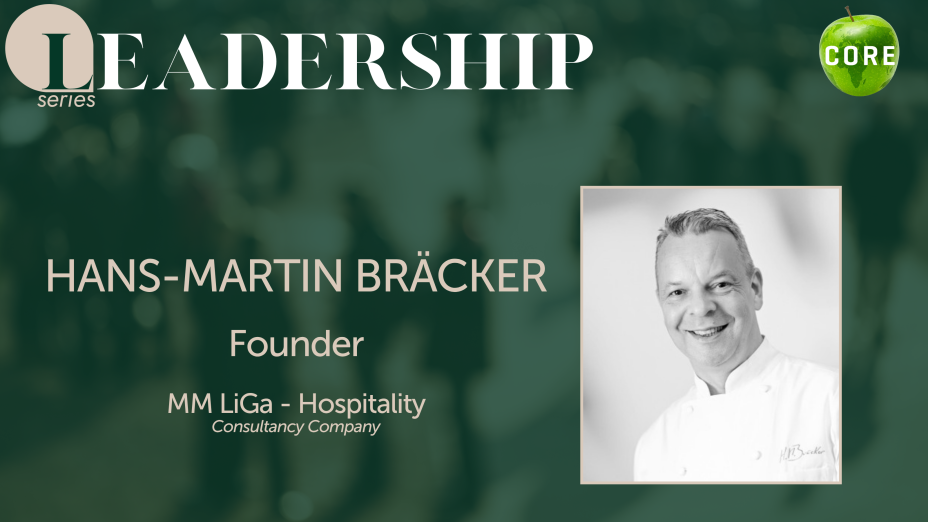
You’ve cooked and led kitchens on four continents: Germany, Greece, China, the Philippines, India, the UAE, Kuwait, Singapore and, most recently, the Caribbean. What made you decide, after Sandals, that the next chapter was building your own consultancy rather than taking another corporate executive chef role?
After more than 30 years in international hospitality, I reached a point where I wanted to use the experience I had accumulated in a different way.
I have had the privilege of working for some very strong international organisations and leading operations of considerable scale. At Sandals, for example, I was responsible for culinary operations across eight resorts in five Caribbean islands. That experience gave me a very broad perspective—not only on food and kitchens, but also on people, procurement, cost management, systems, guest expectations and the commercial realities behind F&B.
I realised that I could create more value by bringing that experience directly to different operators and helping them solve specific problems. Consultancy gives me the opportunity to remain close to the operation while also looking at the bigger picture.
MM LiGa is therefore not a step away from hospitality. It is actually a way of staying very close to it.
Tell us about MM LiGa. Who do you work with, and what’s the gap in the market you set it up to fill?
MM LiGa is a hospitality consultancy focused primarily on food and beverage, culinary operations and concept development.
I work with hotels, restaurants, hospitality groups and individual operators who need experienced, practical support—whether that is developing a concept or menu, improving kitchen operations, reviewing costs, establishing SOPs, training teams, supporting openings or simply looking at an operation with a fresh pair of eyes.
The gap I see is between traditional management consulting, which can sometimes remain very theoretical, and purely operational chefs who may not have the broader commercial perspective.
My background allows me to understand both sides. I can stand in a kitchen, talk to a chef about mise en place and execution, and then sit with management and discuss food cost, purchasing, labour, profitability and the overall business model.
When a hotel group or resort brings you in as a consultant, what’s usually the real problem behind the problem they called you about?
Very often, the problem they initially describe is not the real problem.
A hotel may say, “Our food cost is too high,” but when you investigate, you may discover that the real issue is purchasing, portion control, menu engineering, waste, forecasting or inconsistent operating procedures.
Another property might say, “We have a staffing problem.” Sometimes the real issue is leadership, training, scheduling or an operation that simply isn’t organized efficiently.
My first job is therefore not to immediately provide solutions. It is to understand what is happening. You must listen, observe and analyze before you start changing things.
You trained in Michelin-starred kitchens in Germany before moving into big international hotel brands. What did that classical grounding give you that a hospitality-management degree wouldn’t have?
A management degree can teach you how to analyze a business. Classical culinary training teaches you something fundamentally different: discipline, standards, precision and respect for the product.
Working in demanding kitchens taught me that quality is not an abstract concept. It is the result of hundreds of small decisions made correctly every day.
That foundation has stayed with me throughout my international career. Even when I was managing thousands of meals and multiple properties, I never lost sight of the fundamentals: product quality, consistency, cleanliness, organization, timing and respect for the guest.
Later, my MBA and management experience gave me another perspective. I think the combination of both is particularly valuable.
From Beijing to Dubai, Manila to the Caribbean, each posting comes with a different produce, palate and workforce. What’s your process in the first 90 days of a new market for learning what actually works there, versus what worked at your last hotel?
The first rule is simple: don’t arrive believing you already know everything.
I spend the first period listening and observing. I look at the local market, suppliers, products, pricing, guest demographics, culinary preferences and the capabilities of the existing team.
I also spend time in the markets and with suppliers. You need to understand what is genuinely available locally rather than designing a concept around products that are expensive or unreliable to source.
Then I looked at the operation itself, menus, recipes, purchasing, storage, production, waste, staffing and guest feedback.
Only after understanding those fundamentals do, I start implementing changes. International experience gives you a toolbox, but you cannot simply take the solution from one country and impose it on another.
You went from a single-property Executive Chef role to a Regional Senior Executive Chef position covering multiple Sandals resorts across the Eastern Caribbean. What changes in how you lead when you’re responsible for several kitchens and teams at once rather than one?
You must stop thinking like the chef who personally solves every problem. With one kitchen, you can be very hands-on. With multiple properties, that becomes impossible and counterproductive. Your responsibility becomes building strong leaders who can run their own operations.
You need clear standards, systems, communication and accountability. You have to establish what must be consistent across the organization while still allowing individual properties and chefs enough flexibility to respond to their guests and local environment.
The biggest change is moving from managing tasks to managing people, systems and performance.
Looking back at Kempinski Beijing, Sheraton Dubai, Shangri-La New Delhi and Sandals Caribbean; which posting changed your thinking as a leader the most, and why?
I would probably say Sandals because of the scale and complexity.
Managing culinary operations across eight resorts, five islands, dozens of restaurant concepts and a very large international workforce force you to think differently.
You cannot simply rely on your own culinary ability. You must create systems that work without you physically being present. You also must understand the commercial side at a much deeper level, procurement, volume, logistics, cost control, productivity and guest expectations.
It reinforced something I had already learned throughout my career: leadership is not about being the person with all the answers. It is about creating an environment in which other people can perform at their best.
How has your leadership style changed between leading a single Michelin kitchen as a young chef and leading multi-property teams of largely international, multilingual staff later in your career?
Quite dramatically. When I was younger, I believed that high standards were maintained primarily through discipline and personal example. I still believe strongly in standards, but I have learned that people respond to different forms of leadership. Today, I focus much more on communication, coaching, accountability and developing people.
When you have teams from many different cultures and backgrounds, you cannot assume that everyone interprets communication in the same way. You have to be clear, respectful and consistent.
The standards haven’t become lower. My understanding of how to achieve those standards has become much broader.
A professional kitchen has always had a reputation for hard-driving, hierarchical leadership. Where do you personally draw the line between the discipline a kitchen needs and the culture you actually want to build?
There is absolutely a place for discipline in a professional kitchen. Guests don’t care that the kitchen was understaffed or that someone had a difficult day. They expect the same standard every time.
But discipline does not require disrespect.
I expect punctuality, cleanliness, organization, preparation, accountability and professional behavior. In return, I believe leaders have a responsibility to treat people with respect and give them the tools and training necessary to succeed.
Fear may produce compliance for a short period. It does not build great teams over the long term.
What’s the hardest people’s decision you’ve had to make as an executive chef, and what did it teach you?
The hardest decisions are always the ones involving people who have potential but are not performing at the level the operation requires.
You have to distinguish between someone who needs training, someone who is in the wrong position and someone who simply isn’t willing to meet the required standard.
I have learned to give people a genuine opportunity to improve, but also to be clear about expectations and consequences.
Leadership sometimes means making an unpopular decision because not making it is unfair to the rest of the team.
Who or what has had the biggest influence on how you lead today?
My early culinary mentors had an enormous influence on me, particularly the chefs I worked with in demanding classical kitchens.
They taught me that standards are not negotiable and that your name is attached to everything that leaves your kitchen.
But my international career has probably influenced me just as much. Working with people from so many cultures taught me humility and adaptability.
I have learned something from almost every chef, manager and team I have worked with, sometimes from the things I admired, and sometimes from the things I knew I would do differently.
Food cost inflation, labor shortages and rising guest expectations are squeezing F&B margins across the industry. From where you sit now advising operators, what’s the single biggest lever hotels and resorts underuse to protect both quality and margin?
I would say menu engineering combined with operational discipline.
Too many operators look at food cost simply as a percentage at the end of the month. That is too late.
You need to understand which dishes generate contribution, what ingredients are being used across menus, where waste occurs, how portions are controlled and whether the menu reflects what guests actually want to buy.
A well-designed menu can improve the guest experience while simultaneously reducing complexity, waste and purchasing costs.
The answer is not simply “buy cheaper ingredients.” It is to operate intelligently.
Having worked resort, business-hotel and fine-dining formats, how differently do you see the all-inclusive resort model needing to evolve compared with a city business hotel or an independent restaurant?
The all-inclusive model has to become increasingly experienced-driven.
Guests don’t simply want unlimited food. They want variety, authenticity, quality and memorable experiences.
At the same time, an all-inclusive operator has to manage enormous volumes and very tight operational economics.
That makes consistency and efficiency critical.
A city hotel or independent restaurant has a different dynamic because the guest may choose to visit specifically for the restaurant. But across all formats, the fundamentals remain the same: understand your customer, control your costs and deliver something that gives the guest a reason to come back.
Recruiting and retaining kitchen talent is one of the industry’s toughest problems right now. What’s actually worked for you, beyond pay, to build teams that stay?
People need to see a future, their future… Salary is obviously important, but people also want respect, development, recognition, reasonable organization and the feeling that they are part of something.
I have always tried to identify people with potential and give them responsibility. If someone demonstrates ability, don’t keep them permanently in the same position simply because they are good at it. Give them the opportunity to grow.
Training is particularly important. A chef who believes that the organization is investing in their development is much more likely to invest themselves in the organization.
What technology or operational innovation in kitchens and F&B genuinely excites you at the moment, versus what you think is more hype than substance?
I’m particularly interested in technology that improves decision-making rather than technology that simply looks impressive. AI and data analytics have enormous potential in forecasting, purchasing, inventory management, menu analysis and demand planning.
For example, better forecasting can reduce both waste and shortages. That’s a practical application with a direct financial benefit.
I’m less interested in technology for technology’s sake. A sophisticated system that the team doesn’t understand or use properly is not innovation, it is an expensive complication.
Sustainability and food sourcing keep coming up as guest priorities. How do you build that into a menu and a kitchen operation in a way that’s real, not just marketing?
It starts with purchasing and menu design rather than marketing. Use seasonal products where possible. Work with reliable local suppliers. Reduce waste. Understand yields. Use more of the product rather than throwing away perfectly usable components.
Sustainability also has an economic dimension. Food waste is literally money going into the bin. I believe the strongest sustainability programs are the ones that make operational and commercial sense at the same time.
If you were mentoring a young chef today who wants to reach Executive Chef level in ten years, what would you tell them to prioritise that you didn’t focus on early enough yourself?
Learn the business. Of course, become an excellent chef. But don’t stop there. Understand food cost, labor cost, purchasing, P&L, forecasting, procurement, leadership, HR and guest psychology.
I would also tell them to learn languages, travel and work in different cultures if they have the opportunity. And understand accountability and where do they actually stand for… And perhaps most importantly: don’t chase titles. Chase responsibility and experience. If you become genuinely valuable, the titles will follow.
What’s the most important thing your own mentors or head chefs taught you that you still pass on to your teams?
“Never send something out that you wouldn’t be proud to put your own name on.”
That principle goes beyond food. It applies to cleanliness, organization, communication and how you treat guests and colleagues.
Your professional reputation is built one decision at a time.
Looking at your career as a whole, Michelin kitchens, five star global hotel brands, and now your own consultancy, what do you most want to be remembered for by the people who worked under you?
I would like people to say that I made them better…
Not simply that I was a good chef or that I managed a large operation, but that working with me helped them develop professionally and perhaps as well personally.
If someone I worked with eventually becomes an Executive Chef or takes on a bigger responsibility and says, “Martin helped me get there,” that would mean more to me than any title...
What’s your ambition for MM LiGa over the next few years?
I want MM LiGa to remain deliberately focused on quality rather than simply becoming large.
The goal is to work with selected hospitality businesses where I can genuinely make a difference, whether that means concept development, culinary strategy, operational improvement, training or supporting an opening.
I also see potential in developing MM LiGa into a broader platform that combines consultancy with selected culinary projects and strategic partnerships.
The common thread will always be practical hospitality expertise.
Tell us a little about yourself and your business.
I am Hans-Martin Bracker, although professionally I am often known simply as Martin. I have spent more than 30 years in international hospitality, working across Europe, Asia, the Middle East and the Caribbean.
My career began in classical European kitchens, including Michelin-starred environments, and developed into senior executive culinary and regional leadership roles with international hotel groups. But I was born into the industry, because of the hospitality business for my parents. They showed and taught me a lot of values in early childhood. Today I run MM LiGa, a hospitality consultancy that combines culinary expertise with operational and commercial experience. I help hospitality businesses improve concepts, menus, operations, teams and profitability.
What initially inspired you or sparked your interest in pursuing this career?
Hospitality was part of my environment from an early age, so the industry was never completely foreign to me.
What attracted me to the kitchen was the combination of creativity, discipline and immediate results. You can take raw ingredients, create something from them and see the reaction of the guest.
Over time, that passion for cooking developed into an interest in the entire business behind the kitchen.
What motivates you in your work and what do you find most fulfilling about being a business leader?
I enjoy solving problems. There is something very satisfying about walking into an operation that isn’t performing as it should, understanding why, implementing changes and then seeing the results.
As a leader, I also find it rewarding to develop people. When someone grows from a commis or junior chef into a leadership position, that is one of the most satisfying outcomes of the job.
What do you see as the biggest challenges currently facing the landscape where you are and how should/will a business like yours respond?
The industry is dealing with several pressures simultaneously: rising costs, labor shortages, changing guest expectations, supply-chain challenges and increasing demands for sustainability.
For consultants, that means we have to be practical. Hospitality operators don’t need theoretical presentations; they need solutions that work in a real kitchen as well the restaurant and surely make commercial sense. MM LiGa therefore focuses on measurable improvements rather than simply recommendations.
Thinking about the current macro-economic and social environment, what shifts do you believe will redefine “success” for our sector in the coming year or years?
I think success will increasingly be defined by efficiency without compromising the guest experience.
The old model of simply adding more people, more products and more complexity is becoming increasingly difficult to sustain.
Successful operators will understand their customers extremely well, use technology intelligently, manage resources carefully and create experiences that justify their price point.
How do you stay updated on industry trends, customer expectations, and regulatory changes?
I stay close to the industry. That means following international hospitality developments, speaking with suppliers and operators, visiting hotels and restaurants, observing guest behavior and maintaining relationships with people working in different markets.
But I also believe you must separate trends from lasting changes. Not everything that is fashionable today will still matter in five years.
Where do you think the most promising investments should be focused on and/or made on?
Clearly people and technology. Investing in good people remains one of the highest-return decisions a hospitality business can make. At the same time, technology can significantly improve forecasting, purchasing, inventory, scheduling and guest insight.
I would also invest in better-designed F&B concepts rather than simply increasing the number of outlets. The guest journey is the main goal.
What do you believe will distinguish the leading service providers over the next decade?
Authenticity and adaptability. Guests are increasingly sophisticated. They can recognize when an experience is genuinely thoughtful and when something is simply marketing.
The strongest hospitality businesses will combine excellent service with a clear identity, efficient operations and genuine personalization.
If you could influence one thing about the future of hospitality, what would it be, and why?
I would change the industry’s relationship with its people. Hospitality needs to be seen as a serious career rather than simply an entry-level job. If we want talented people to stay in the industry, we have to offer development, education, professional respect and genuine career opportunities.
What skills or mindsets do you think will be most important for the next generation of hospitality leaders?
Adaptability, emotional intelligence, financial understanding and curiosity. A future hospitality leader cannot be only a technical expert. They need to understand people, technology, business and different cultures. And they need to be willing to keep learning.
What is or are your biggest career achievements?
Professionally, I am proud of the progression from classical Michelin-starred kitchens to senior international leadership positions. One of the biggest challenges was leading regional culinary operations across eight resorts on five Caribbean islands. But perhaps the achievement I value most is being able to build and develop teams across very different countries and cultures.
What’s the most important leadership lesson you’ve learned?
You cannot do everything yourself. The stronger your team becomes, the stronger your organization becomes.
A leader who needs to be involved in every decision has created dependency, not an strong organization. Clear communication and trust are the keys of operational excellence.
Have you achieved everything you wanted in your career so far?
No, and I don’t think I ever will. I did an MBA at the Rome Business School, because I wanted to spark my mind and I believe in life-long learning that will assist to enhance and reset ways of thinking. Changing the position of how to look into things, especially in heavily multimedia influenced times.
There are always new markets, new concepts, new challenges and new things to learn.
I have achieved many things I was proud to achieve, but I still have plenty of ambition.
How do you prioritize tasks when everything feels like a priority?
I ask three questions: What affects the guest? What affects people? What affects financial performance?
Then I distinguish between what is genuinely urgent and what is simply making noise. You cannot solve everything simultaneously. Good leadership requires making clear decisions about what matters most.
Have there been any hard decisions you had to take as a business leader?
Absolutely. The difficult decisions are often people decisions or decisions that have short-term consequences but are necessary for the long-term health of the operation.
I have learned that avoiding a difficult decision rarely makes the problem disappear. Usually, it simply makes it more expensive later.
What do you hope your legacy will be both for your organization and for the hospitality industry more broadly?
I would like my legacy to be people. If I can look back and know that people I worked with became stronger chefs, better managers and better leaders because of our time together, that is a meaningful legacy.
I would also like to be remembered as someone who combined culinary standards with commercial reality.
Could you briefly introduce yourself, your role, and the core mission of your organization within the hospitality landscape?
I am Hans-Martin Bracker, founder of MM LiGa, and my role is essentially to bring decades of international culinary and hospitality experience to businesses that need practical support. The mission is simple: improve the operation, improve the guest experience and improve the commercial result. Ideally, all three should happen together.
What do you see as the most significant challenges and opportunities currently shaping the service industry?
The challenges are labor, cost pressure, changing consumer expectations and operational complexity. But every challenge creates an opportunity.
Businesses that become more efficient, invest in their people and understand their customers better will have a significant advantage.
Are you expecting consumer expectations to shift this year?
Yes. Guests increasingly expect value, but value doesn’t necessarily mean the lowest price. They expect authenticity, convenience, quality, personalization and memorable experiences. They also increasingly want to know where products come from and what values stand behind the business.
How has your leadership philosophy evolved, especially over the past few years of rapid change?
I have become more focused on empowerment. Earlier in my career, I was more inclined to solve problems personally. Today, I spend more time developing the person who can solve the problem themselves. That creates a much stronger organization. Following the mythology of job enlargement & job enrichment.
What values or behaviors do you consider essential for leadership teams today?
Integrity, accountability, respect, communication and consistency. And surely the ability simply to listen. People don’t expect leaders to be perfect. They do expect them to be honest and consistent.
How do you balance commercial performance with staff well-being, retention, and culture building?
I don’t see them as opposites. A well-trained, motivated team usually performs better commercially. If you constantly squeeze people to improve short-term results, you eventually pay the price through turnover, mistakes, poor service and recruitment costs.
The best businesses understand that people are an operational investment. Form formal teams into informal teams…
What strategies have proven most effective for attracting and growing future talent?
Give people responsibility and show them a path. Young professionals want to know where they can go. Training, mentoring, exposure to different departments and international opportunities can be extremely powerful. And leaders have to recognize talent when they see it.
What innovations—technological, experiential, or operational—excite you the most right now?
AI and data-driven operations are probably the most interesting developments. Used properly, they can help hospitality businesses forecast demand, manage purchasing, analyze menus and improve labor planning.
But I am equally interested in experiential innovation, finding new ways to make dining memorable without necessarily making it more complicated.
Sustainability is a growing priority. How are you embedding meaningful, long-term sustainability practices into your business?
I focus on practical sustainability. Local and seasonal sourcing were appropriate, waste reduction, better yield management, responsible purchasing and intelligent menu design. The best sustainability initiative is one that becomes part of normal operations rather than something that exists separately for marketing purposes.
Looking back, what has been the most pivotal moment in your career, a turning point that shaped how you lead today?
Moving from being primarily a chef into broader executive and regional leadership was probably the biggest transition. I realized that leadership at that level is no longer about how good you personally are at cooking. It is about how effectively you can create an environment where hundreds of other people can perform.
What’s a lesson you learned that still influences your decisions?
Never decide simply because “that’s how we have always done it.” Hospitality changes constantly. You must respect experience without becoming trapped by tradition.
Who or what has had a major influence on your approach to leadership?
My early classical training taught me discipline and standards. My international career taught me adaptability and understanding various kinds of people. And the people I have worked with taught me that there is rarely only one correct way to lead.
What does the industry need more of… or less of…to continue thriving?
More investment in people and professional development. Less tolerance for poor leadership. Hospitality sometimes accepts high staff turnover as if it were simply part of the industry. I don’t think it should be.
If you could change one policy, trend, or misconception about the sector, what would it be?
I would challenge the idea that hospitality is a temporary job rather than a profession.
It can be an extraordinary career. But industry must make that career attractive by offering development, respect and opportunities for progression.
What is your long-term vision for your organization, and what legacy would you like to leave within the industry?
My vision for MM LiGa is to build a respected specialist hospitality consultancy that is known for practical expertise and measurable results. I don’t want to become a consultancy that produces reports and disappears.
I want to work alongside operators, understand their reality and leave them with better systems, stronger teams and a better-performing business.
What advice would you give to emerging leaders who want to shape the future of the service industry?
Stay curious. Learn your craft but also learn the business behind it. Travel if you can. Work with different cultures. Learn languages. Understand finance and technology. Most importantly, learn how to work with people. And don’t be in too much of a hurry.
A career in hospitality is built through experiences. Every kitchen, every country, every difficult manager, every successful opening and every mistake teaches you something. Take those lessons with you.
Author
Date Published: 10th September 2026
